

Is a National Cryptocurrency the solution to hyperinflation?
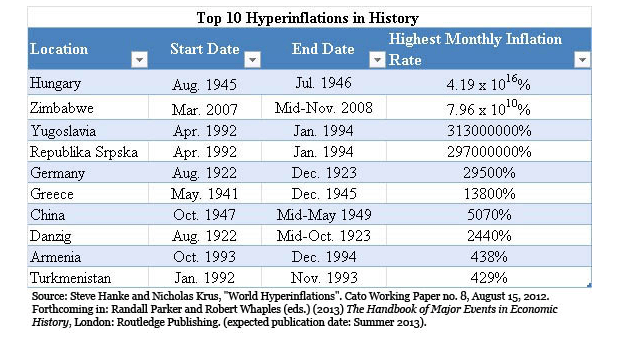
It should be an alarming fact for the proponents of fiat-based economies that we are increasingly seeing a high number of hyperinflation cases in the last 30 years alone as depicted in the chart below which still does not include a couple of more recent entries like Venezuela & Iran. The majority of the times this hyperinflation was caused by external factors like poor financial management or economic hardships like War & sanctions etc.
But we are not here to discuss causes of hyperinflation, rather see if this could be avoided with the new-found hope in Cryptocurrencies — a decentralized digital form of payments which can perhaps, ironically, bring some stability to the fiat-based system.
A little backdrop for people who don’t know about hyperinflation — it is a term associated with runaway inflation. Basically when a currency starts to lose value so fast that the prices in an economy begin to increase on a daily or even an hourly basis your currency is stuck in a spiral of hyperinflation from which it is almost impossible to recover. I just like to elaborate a little further with a couple of quick examples.
First, and perhaps the most popular instance of hyperinflation in history was in Germany after the First World War. A beaten-down Germany who had financed the entire War effort through borrowed funds had its currency “Papiermark” severely depreciated with the economy in shambles.
The war bill & repatriation money to the winners put the currency under further pressure and when the time came for the payments, Germany had to buy foreign currencies at any price, which led hyperinflation to the point where its currency became worthless.
The second instance was in Zimbabwe in 2008, where Economic mismanagement finally led to the collapse of the local currency with a staggering 79 billion percent inflation. They ended up adopting South African Rand & U.S Dollar.
The invention of Cryptocurrencies has given a new dimension to the digitizing of the global economy & maybe an alternative to the fiat-based currency system. The digital coins constantly come under fire for being too volatile & unpredictable with no tangible value attached to them to be considered a store of value.
Come to think of it, even the paper-based fiat currencies have no tangible value — they are just a piece of paper issued by a central banking authority & guaranteed by the respective governments of different countries. However, one thing that does make these digital coins attractive to people is their decentralized nature, unlike the fiats. The global financial authorities feel the decentralized nature is a risky bet & have been trying to come up with a regulatory framework that has eluded them so far.
Runaway inflation in countries like Iran & Venezuela recently have shown how Cryptocurrencies have given people of these countries hope of at least having a choice rather than looking towards their governments helplessly to bail them out of the situation.
There is one slight problem though, while people of these countries are all too happy to use the mainstream Cryptos like Bitcoin instead of their paper currencies for investment and spending purposes, the governments are looking launch their own national digital currencies — not necessarily to stabilize their Economic system & control inflation, but mainly to dodge the International Economic sanctions.
The problem with a centralized digital currency is the same though — government having control over the value & the supply which goes against the whole decentralized Ecosystem of the mainstream Cryptos.
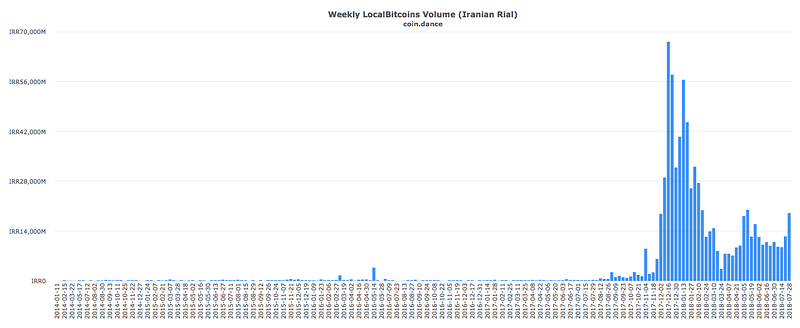
Talking about Iran, where the local currency Rial has plummeted to 100,000 to $1 US with the Economic sanctions crushing the country’s fragile economy and people have moved to buy Bitcoin for investment & store of value as evident from the spike in bitcoin trading volume in the chart above.
People have been accumulating other cryptos like Ethereum as well. So much for faith in fiat currencies. The government has announced that it is working on developing its own digital currency to avoid the sanctions & move to a stable digital alternative.
Venezuela is a glaring example of hyperinflation, where it has reached 1 million percent with the purchasing power of people severely depleted. The country is also fighting International Economic sanctions which have thrown its currency & economy into a tailspin.
Like Iran, people in Venezuela have moved to Cryptos as well. NANO community came forward to help feed the hungry with online donations through a Reddit campaign. EatBCH is another such initiative that is helping feed the hungry in South Sudan & Venezuela. Considering the philanthropic endeavors being initiated by mainstream Crypto communities the launch of a national cryptocurrency Petro (backed by Oil) wasn’t received with much enthusiasm in Venezuela.
After all the control of this digital currency still remains with the ruling dictatorship which cares more about dodging economic sanctions than worrying about the plight of its people. The Petro initiative has failed to gain much traction as the price of the digital coin has dropped to less than half its value since its launch in February.
I am not sure if National Cryptocurrency controlled by a central government is the answer to hyperinflation but the mainstream Cryptos have certainly gained traction as a better source of value & investment in struggling economies battling hyperinflation. Also with the philanthropic initiatives taken up by the digital communities is not only helping people in most need but clearing the stigma of illegal activities that is associated with Cryptocurrencies so often.
Related Articles: The rise of P2P Finance model, Bitcoin is still the Crypto kingpin, Blockchain, Cryptocurrencies & the shifting Paradigm, The ABCDs of Fintech
Stay in touch: Twitter | StockTwits | LinkedIn | Telegram| Tradealike
Originally published at www.datadriveninvestor.com on August 3, 2018.


