
Ireland Has A New Government — How Does That Happen?
A Guide To The Irish Political System, and to the new Government
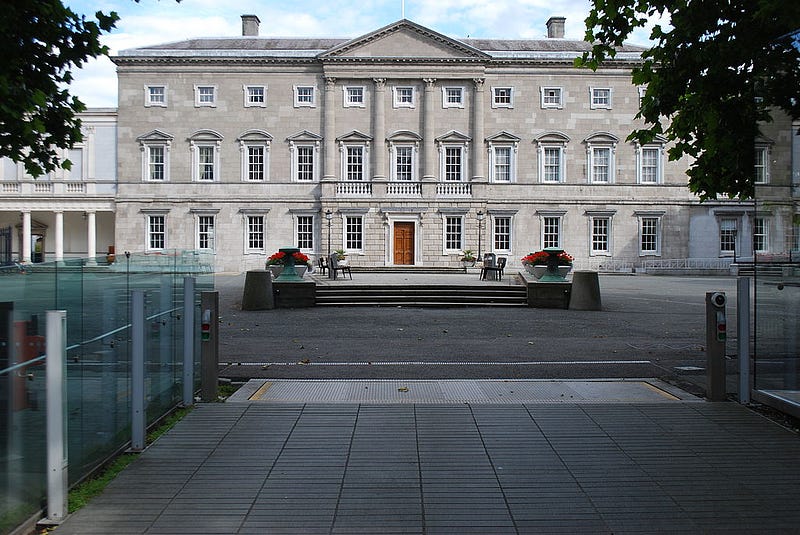
As regularly happens, Ireland has a new government. As is the case in Britain and the US, we the people complain regularly about them, regardless of who they are. Unlike the case with our noisy neighbors, we tend to have a broader representation in our parliament and our governments, and for all the flaws of the system, it is worth looking at how it operates, and how Ireland’s latest government has been formed.
We have a President Firstly, the important thing to know is that Ireland’s current president is formerly a poet, an unskilled laborer, a university professor, a writer for a rock music magazine, a member of both the Upper and the Lower houses of Irish Parliament, and a human rights campaigner. He is multilingual, has studied in three different countries, is married to a theatre actress, was Minister for the Arts, and was the president of a professional soccer club. He was re-elected with support from across most parties and is the most popularly elected person in state history, preceded by two popular female presidents. To be fair, I am mostly saying this to taunt American readers: the Irish presidency is really more of a ratifying body, rather than an executive officer. The President lives at Áras an Uachtaráin, where they will meet the Crown Prince of Ruritania, or attend an important lunch function with the trade delegation from Naboo, or greet Kylie Minogue on a State visit before approving the week’s going’s on in the Oireachtas. The real executive power lies with the government, which is formed out of our legislature
Legislature As with many parliamentary democracies, Ireland is bicameral with an upper house, and a lower house, together known as the Oireachtas. The upper house is called Seanad Éireann (the Irish for Senate), and it is somewhat analogous to the US Senate and the British House of Lords, even if it functions quite differently. The Seanad is chiefly a place where the various bills of the Lower house go for approval or otherwise. It also tends to discuss and debate the national issues, and matters of lesser importance — in the Seanad you may hear discussion of the plight of refugees from Syria across the world, judicial appointments, and everything in between. Senators sit on various Oireachtas committees, and up to two Senators are permitted to be cabinet ministers, though they are seldom invited to the top table. There are 60 Senators, 49 elected by vocational and educational panels, and 11 appointed by the Taoiseach (prime minister, coming from the Irish for Chieftan) of the day. The poet WB Yeats was a Senator, as was Katherine Zappone, an American born dual citizen who with her wife was key in bringing about Ireland’s same sex marriage referendum.
Our lower house parliament is called Dáil Éireann, or generally just the Dáil (sounding very much like the dole, which is what we call unemployment assistance). As before this compares with the US House of Representatives, and the British House of Commons. Presiding over the Dáil is the Ceann Comhairle (Head Council — similar to the Speaker of the House in the British parliament). This is an elected member chosen by the governing party/parties to act as the independent chair of the Parliament — the Ceann Comhairle at the dissolution of Parliament is automatically returned to the next Dáil without having to stand for election. Depending on the numbers game, governments have chosen members of opposition parties to ensure that they aren’t left short handed. Several Irish governments, particularly coalitions, have collapsed after failure in passing budgets, often triggering general elections — there were 5 in the 1980s.
In what the main parties consider ideal circumstances, during the general elections, any party that has elected 50% +1 of the available TDs (Teachta Dála — members of parliament) has a clear path to government. These days, there are 160 TDs, so as the Ceann Comhairle is a non voting TD, 80 votes are necessary to form a government. These 160 TDs are elected from 39 multi seat constituencies, each with 3, 4, or 5 TDs representing them. As the elections take place simultaneously, it is hard for these elections to be gamed to return a single party from one constituency. Further to prevent this, it isn’t the first-past-the-post, most-votes-wins system. To ensure better representation of the people of the nation, Ireland uses what Americans call a ranked voting system.
Now, I am well aware that many of you like the idea of ranked voting. And that is to your credit, it’s a good system that requires a parliament to contain more than two perspectives on how to govern. It is what we in the rest of the world call representation (it’s a new idea dating back to the ancient Greeks). However, saying you want a ranked voting system is kind of like saying you want to buy a ball from Dicks — firstly ick; secondly “Sir, we have at least 7 kinds of ball, including that egg thing that’s popular here”. There are 6 different kinds listed on the Wikipedia page on ranked voting, not including odd varieties, and combinational versions.
Voting System In Ireland, what we use is Proportional Representation — Single Transferable Vote. Sometimes you will see it listed as Instant Run-off — Single Transferable Vote, but mostly it will be written as PR-STV. There are a number of versions of Proportional Representation, but we have been using STV since our government’s foundation in the 1920s. To simplify it, on your ballot, you either make an x in a single box, and that is your vote for good or bad, or you list your votes, 1, 2, 3, however far down the list you chose. When all the votes are tallied and the spoiled votes removed, we have our total valid poll: to get the quote needed to be elected, we divide that by the sum of the number of seats available +1 — in a 5 seat constituency, you need to get more than a sixth of the valid vote, in a 4 seater, it’s a fifth, etc. Sometimes you can get two people elected on the first count, sometimes just the one, often none.
Once someone is elected, the second preferences of that candidates votes are tallied and distributed accordingly; if no-one is, those candidates whose combined votes would tally to the number required to elect the top candidate are eliminated, and their second preferences distributed. So on it continues until the required number of TDs are elected. If your candidate is eliminated, and your second or third choice has been too, it follows down the list until your vote gets to count for someone. It is not uncommon to see the last one or two elected without reaching the quota, but crossing the threshold by virtue of the elimination of the bottom candidate. Careful vote management becomes key — a party can elect multiple TDs in a constituency from little more than a quota and half, and some fail to get a second candidate elected where they have an abundance of votes for three.
With this system in place, the parties preselect candidates rather than having primaries. This dispenses with the messiness of additional elections which can come about with little notice. Some may argue that this is less democratic, but if does tend to reward the people who have put in time developing a profile as a local councilor, and as grassroots politicians, rather than parachuted candidates. Money becomes less of an issue in getting onto the ballot sheet, which can only be a good thing.
Typical Government Formation This system has made Ireland a nation with numerous small parties getting into the Dáil, as well as several independents — recently, it is typical for about 12%+ of TDs to be independents, with another 12% or so being members of parties outside of the main 4–5 parties. As a result, where getting to 50%+1 is the aim, these independents can play a massive part. Every vote counts, and a TD elected on a single issue of getting better funding for the local hospital can suddenly be a kingmaker in the creation of a government.
When one or more parties have enough TDs to support their party in government, there is a vote for various candidates to be Taoiseach. When one wins, they go to Áras an Uachtaráin to meet the President, who charges them on behalf of the Irish people with the task of building a government — obviously, that is done before the trip is made as a part of agreeing a programme for government to ensure support. Elections are scheduled to take place within 5 years of the previous election at minimum. Frequently, as is likely in a system of coalition government, it can be a lot less than 5 years. Notably, after the general election of June 1981, the government collapsed the following January. After another election, a government was formed in March, but it too was dissolved that November, giving Ireland its third general election in 18 months. As most Irish polling stations were sited in primary (elementary) schools, it was a great time to be a kid!
Got all that? So, we had an election on February 8th this year — the first general election to be held on a Saturday since independence. Our senior government party since 2011, Fine Gael, had dipped sharply in popularity, and the Dáil was due an election. Traditionally, Irish elections tended to either have one party get across the threshold, or two parties get close enough for either of them to be able to make a coalition with a smaller party or a number of independents. This time, it essentially ended in a three way tie, all three with just under a quarter of the TDs needed to make a government, meaning that for any kind of government to be formed, two would have to work together.
A Look at the Main Parties. The previous government was led by Fine Gael (Tribe of the Irish). They’re slightly right of centre-right (liberal conservative), but pushed for, and won, the same sex marriage referendum, the abortion referendum, and are led by a gay son of an Indian immigrant, Leo Varadkar. They also have presided over a massive spike in homelessness, and are often seen as being the party of big business and landlords. On this useful international political comparison tool, showing the main US presidential candidates in relation of the rest of the world, they would be slightly to the left of Cory Booker, and only to the right of Elizabeth Warren and Bernie Sanders.
Fianna Fáil (Soldiers of Destiny) are traditionally the big party, normally no more than another election away from power, prior to the massive economic collapse they presided over — and did little to halt — at the end of the 2000s. They are marginally more left than Fine Gael, but very traditionalist, and very “careful-now” nationalist — firm belief among their supporters in reincorporating the North of Ireland in a 32 county republic, but let’s not rock the boat. They have been led by Michéal Martin since they were kicked out of power in 2011. On the spectrum above, they are further left than Fine Gael, but still to the right of Warren. Ultimately, both parties are pretty similar, having both split off the original Sinn Féin party in the 1920s.
Finally at the big table, we have Sinn Féin (We Ourselves). Like Fianna Fáil, and Fine Gael, and most Irish political parties, they are a direct descendent of the original Sinn Féin that became central to the political side of Irish independence. As a consequence of the Civil War that happened shortly after the War of Independence, they left parliamentary politics. After the Civil War, any party not taking their seat in the Dáil immediately lost that seat, and that was the end their significance until the Civil Rights movement in the North in the early 70s. They reappeared in the British occupied North of Ireland as a more militant political force on behalf of nationalists / Catholics looking for the political reunification of the island of Ireland at the first opportunity— this perspective is known in Ireland as Republican. They have traditionally had close links to the Provisional Irish Republican Army (IRA, or sometimes the “Provos”). As the activities of the IRA wound down, the general election in 1997 saw them win a seat in the Dáil for the first time since the 1920s. They are now the coordinated most cross-border party in Ireland. Their leader is Mary Lou Macdonald , a prominent figure in Sinn Féin in the South since 2004. They are centre left to left wing (they have slightly different policies on different sides of the border), and a good step left of Sanders.
The 2020 Election Expectations initially were that Fine Gael would lose heavily to Fianna Fáil, and to a degree this is reflected in the worst turnout since 2002, with only 62.71% of those registered casting a vote. Sinn Féin expected a major breakthrough, but not that they would top the polls. As a result, they only ran 42 candidates in the 39 constituencies, so while they won the greatest number of first preference votes (24.5%), they failed to capitalise on it, electing 37 TDs. In contrast, with better vote management, Fianna Fáil won 37 seats on 22.2% of first preferences — 38 if you count Ceann Comhairle Seán Ó Fearghaíl. Fine Gael did better than projected with 20.9%, and overperformed with 35 TDs. This meant none of the three could form a government without at least two more parties, one of which would have to be one of the other two. Fianna Fáil and Fine Gael represent the opposing sides of the civil war politically, and that mistrust still exists. Sinn Féin would automatically be too nationalist for Fine Gael, too left for Fianna Fáil, and too close to their connections with the IRA for either of them.
Of the other parties, the Green Party (around the same standing as Sanders) pulled 12 seats, both the Labor Party (centre-ish, to the right of Warren) and the Social Democrats (“proper” left wing, beyond your wildest dreams here) picked up 6 seats, and PBP-Solidarity (marginally more left than the Social Democrats) got 5. There were also 2 elected for micro-parties, and 19 independents from all over — and off — the political spectrum.
With this the state of play, the big question was who would work with whom. In the immediate aftermath, all three main parties declared that they had won on their own metrics, and all noted how they were the only natural choice to form a government. Sinn Féin announced they were ready for government, and started looking for partners along the left side of Irish politics. A number of nationalist minded Fianna Fáil TDs and party members started murmurs that a Fianna Fáil / Sinn Féin alliance made most sense. In the meantime, in the absence of a new government, the previous Fine Gael cabinet retained the responsibility for running the country. This was to their advantage, as thanks their relatively good management of Covid-19 — far from problem free, but so much better than the English speaking countries who bore most influence on Ireland — their stock rose again, and they became a more attractive option in government than after the election.
It is fair to say that most people expected something to happen between Fine Gael and Fianna Fáil, seeing how similar the two parties tended to be. Ultimately, this has proven to be the case, with the Green Party agreeing to be the third member of the new coalition. A Programme for Government was agreed and ratified by the parties, and from June 27th, the new coalition had started to govern, with Mary Lou McDonald becoming Ireland’s first female leader of the Opposition. And it only took 140 days to sort out, which is still better than Northern Ireland where it took them 1090 days before forming one there in January.
This is not a typical coalition, though. Because of how finely balanced the numbers are, the plan is for the government to be more evenly shared than usual, with the two major parties having six cabinet posts each, and the remaining three for the Greens. Particularly unique to see is the sharing of the top position. Micheál Martin — the name most consistently misspelt in international coverage — to take on the role most consistently mispronounced in international coverage — Taoiseach at first. If things go to plan, he will be Taoiseach until December 15th, 2022, whereupon the leader of Fine Gael at the time will replace him. Leo Varadkar is relegated to the role of Tánaiste (deputy to the Taoiseach, from the old word meaning “Heir to the Chief”). It is planned that the Tániste will swap with the Taoiseach for the second half of this Dáil term, with the other cabinet posts staying put.
However, this may be an optimistic view. Already, many who could be described as “the plain people of Ireland” are unhappy with the new government: there is a feeling of dissatisfaction that Sinn Féin could win the popular vote but are not in power. Fianna Fáil’s mismanagement of the greatest wealth Ireland has known between 1997 and 2011 is not forgotten. Fine Gael’s austerity policies from 2011, and their pandering to big business and presiding over record homelessness is also fresh in the mind. As a result, frustration can seen on Irish twitter with the Greens for joining the two worst parties ever. Both Fianna Fáil and Fine Gael also have a tradition of internal power struggles. Further pressure on this coalition will come from the Covid-19 Crisis — Ireland and the Irish have behaved sensibly and cautiously, but it is a strain mentally and economically on everybody. The aftershocks of Brexit continue to reverberate, and at some point the question of reunification of the island will once more be raised, however realistic it may be. It seems today that two and a half years is a very a long way away.