

IQ Testing: 5 Reasons To Be Concerned
short takeaway: it’s really not all it’s cracked up to be

1 — IQ or Intelligent Quotient has no useful definition
The usual definition, one used by textbooks, is that an IQ is what the IQ test measures. Not the greatest definition but I have never seen a better one.
Here, for example, is a 2020 definition from Wikipedia:
An intelligence quotient (IQ) is a total score derived from a set of standardized tests or subtests designed to assess human intelligence.
There are many kinds of intelligence and many kinds of cognitive tests. Each test measures only some of these intelligences — and only at one given point in time. People grow, people develop, people change….so do test scores.
Yes, I do know there is some correlation between some tests over some periods of time, but I also know there are many other factors to weigh in.
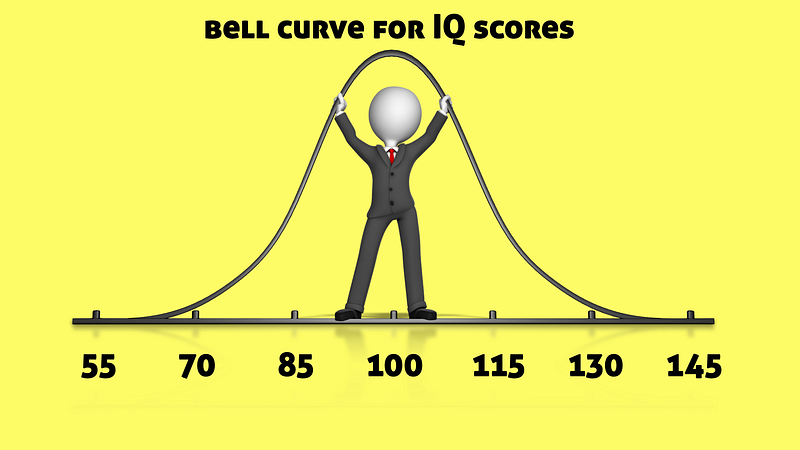
2 — When reporting IQ scores, the standard deviation is universally ignored
Standard deviation is the variance around a mean or average. Every measurement has a standard deviation, not just IQ measurements.
Most human measurements fall into what is called a bell curve or a normal curve — like the one in the image above.
In that curve, 100 is always the average IQ score. Each black mark on the line is one standard deviation. I added the scores that would go with each standard deviation.
For every IQ score, the set standard deviation is 15 — so your IQ is your test score +/- 15 — but we almost never read that.
For example, if your score on an IQ test came out to be 120 — your actual IQ could range from 105 to 135.
Yes — it could be anywhere within that 30 points! With the labels we use for the test numbers, you could actually be anywhere between average to gifted!

3 — IQ scores can, and do, vary yet they are treated as if etched in stone
A young child in school might be given some sort of IQ test and that specific number may follow him or her through the rest of the school years — if not through life.
Decisions are made based on that score as if it were a permanent feature of that child — and it is not.
Scores can vary by the test given, illnesses, who is doing the testing, under what conditions, and more….
Many of our tests are standardized on middle-class white populations!
Tests can be group tests or individual tests— and the tests are very different for a group than for an individual. And those individual tests are done by professionals — and can be expensive.

4 — IQ scores are used to categorize; often in some permanent way
As in #3, an IQ number can follow a person and be used for placement in specific groups, classes, or programs — or even placement into an institution.
Some schools require an independently administered IQ test for placement in what they call their talented and gifted program. Wealthier parents usually opt for this.
This categorizing happens in spite of most IQ tests having built-in biases and a score that can change over time or from test to test and from evaluator to evaluator.
And labeling children can be counterproductive — and have a host of worsened outcomes.
Labeling tends to “stick” — think back to your early school years and the nicknames given to your schoolmates based on things like reading or math ability…..

5 — IQ scores can be influenced by the person giving the test
In almost any testing situation, the person giving the test can affect the score by subtle means. This can be quite unintentional, but it could also be very intentional…and can be done while staying within the parameters of the rules for that particular test.
For example — some tests allow the evaluator to ask specific follow-up questions. One’s tone of voice and/or inflection. Facial expressions can convey many messages — and these messages can substantially impact the score.
So do I do IQ testing? Not anymore — but over my professional psychology career, I have given more IQ tests than I can count.
Most of the major individual IQ tests give a wealth of cognitive information; the actual IQ score is, for me, the most minor aspect of the test.
Unless I had to be specific, I gave a range for the score. I used the test to find a person’s cognitive strengths — not their weaknesses.
And I refused to test children whose parents were shopping around for “good” scores. Yes, there were parents who took a child to several psychologists to be tested because they hoped the repetition would increase the child’s score, and the “best” score would be the one submitted to the school.
IQ testing can be so beneficial if done with the knowledge of one’s own biases, not thinking of the score as anything more than a clue to the person's cognition, and thinking of it as a fluid result, not a permanent label….

And how all this relates to our educational system is, as I am prone to say — a whole ‘nother soapbox oration…..
And how it might relate to politics? Well — I already wrote about that!


