
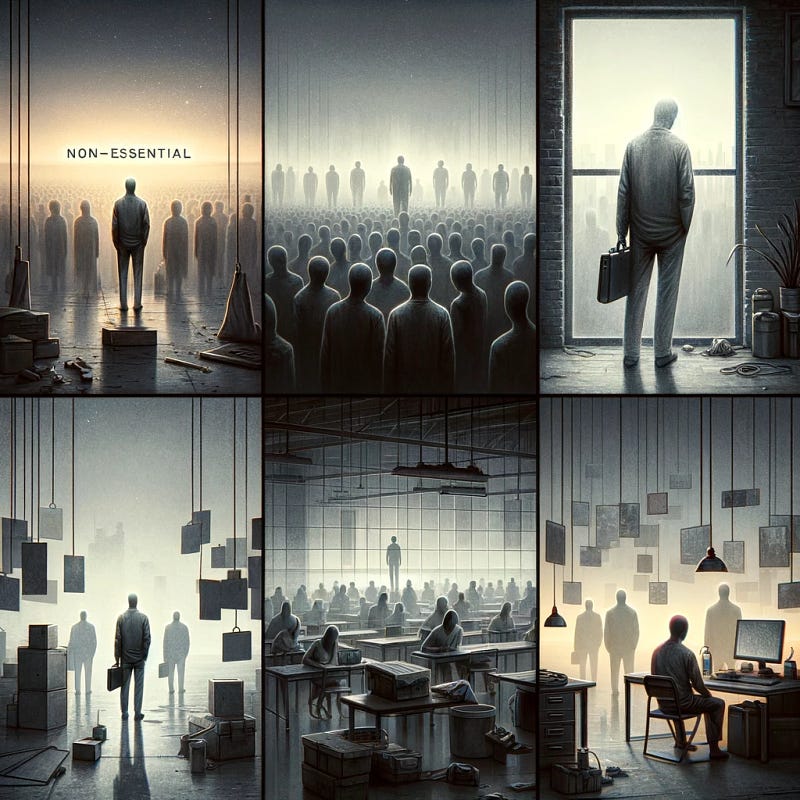
Invisible scars: The hidden trauma of being labeled ‘non-essential’
“Only when the tide goes out do you learn who has been swimming naked.“— Warren Buffet.
Okay, let’s face it, we’ve all been harbouring a deep and dramatic secret. I know I certainly am— a revelation that hit me like a thunderbolt during the COVID-19 pandemic. It was a stark, uncomfortable realization that the work I do, much like that of countless others, was abruptly labeled ‘non-essential.’
This term, ‘non-essential,’ echoed in my mind, a jarring reminder of our society’s sudden re-evaluation of value and importance. It’s a secret that, I suspect, resonates with many of us, a shared experience in a world turned upside down by a global crisis.
You’re not an essential worker!”
Excuse me, what?
Alright, my reading friends, grab a tissue, a hot toddy, and perhaps phone a friend, because it’s high time we unpack this slightly absurd yet poignant aftermath of our recent collective human experience.
Ah, the Covid 19 Pandemic — remember when job titles got as politically charged as a U.S. election night? Suddenly, you were either in the 'essential' camp (cheers to the nurses and doctors) or, like many of us, lumped into the 'non-essential' brigade. It felt like being sorted into Hogwarts houses, except nobody wanted to be in 'non-essential'. It's like the whole world was playing a giant game of dodgeball, and guess who got picked last? So, buckle up, folks. Let's navigate this whimsically tragic chapter of the 'non-essential' odyssey, armed with a dash of humor and a pinch of wit. Shall we?
I come from rural landowning Caribbean farming stock and much of my foundation, and the way I see the world even today, is informed and shaped by a heavy dose of country common sense. And even having emigrated with my family to Canada, much of this foundation remains.
I think you will agree that for many immigrant families of a certain generation this is true. It is the group of immigrants who remind their children that their menu of job options were, but five.
Say it with me: Doctor, Lawyer, Engineer, Nurse, Teacher.
While this may have changed over the years to include technology, banking, and other newer job titles, particularly for certain cultural groups, it suggests that our parents may have had a better understanding of what constitutes essential and non-essential labour. This “something” is highly represented int he Warren Buffet quote: “Only when the tide goes out do you learn who has been swimming naked.” And the tide has gone out as many of us grapple with the understanding of the shift in our worth as workers in our respective economies.
COVID 19 Pandemic — After the tide goes out
In the wake of the COVID-19 pandemic, a seismic shift occurred in our collective understanding of work and worth. As the world grappled with an unprecedented health crisis, a new term entered our lexicon: “essential workers.” This label, as critical as it was for our society’s functioning, inadvertently cast a shadow on many other professions. It brought an unspoken, yet deeply felt, trauma: the realization that some of our labour, our daily contributions, were deemed “non-essential.”
As we navigated through the depths of this crisis, we discovered a more profound truth about our interconnectedness and the value of every role in our society.
This was not just about work; it was about the human spirit and resilience.
I recall a story of one of our local bookstore owner, previously overlooked in the grand economic narrative, became a beacon of hope and connection. Her small shop turned into a gathering place for the community.
She organized virtual reading sessions and discussions, providing a much-needed sense of normalcy and comfort. Her role, once considered peripheral, emerged as a vital thread in the social fabric. This story exemplifies how the pandemic redefined our perception of value and significance. It taught us that every job, every task, carries an intrinsic worth, not because of its economic output, but because of its contribution to the human experience.
In this new light, the term “non-essential” lost its sting, replaced by a newfound appreciation for the diverse tapestry of roles that sustain our communities.
The invisible line: essential vs. non-essential
The pandemic drew a stark line, dividing jobs into categories of essential and non-essential.
This division was more than logistical; it was emotional and psychological.
For those whose careers fell into the latter category, there was an underlying message that their work, and by extension, their contributions, were less valued.
This division, however, also sparked a collective re-evaluation of what truly matters in society. It highlighted the importance of roles often taken for granted, like healthcare workers, but also revealed the unseen value in every profession.
I recall a musician in a local Toronto neighborhood, whose career was deemed non-essential, yet during the lockdown, his balcony performances brought immeasurable joy and a sense of unity to this isolated community. His music transcended the physical barriers, weaving a tale of hope and solidarity. This personal story underscores that the worth of a job should not be measured merely by its label of ‘essential’ or ‘non-essential,’ but by its impact on the human spirit.
The pandemic, in challenging our perceptions, taught us that every role, no matter how seemingly small, contributes to the intricate and beautiful mosaic of our society.
The grief of self loss
Unacknowledged Grief and Identity Crisis For many, work is a significant part of identity. The sudden label of ‘non-essential’ not only impacted livelihoods but also led to a crisis of identity and self-worth. This unacknowledged grief, a by- product of the pandemic, has yet to be fully addressed or understood.
This unspoken grief also opened the door to a transformative journey of self-discovery and redefinition.
As individuals grappled with the loss of their professional identity, many found new paths and passions that had lain dormant. A poignant example is that of a friend, whose wife is a seasoned event planner, whose career was halted overnight. Faced with this abrupt change, she turned to her long-forgotten love for painting.
Through her art, she not only rediscovered a part of herself but also brought beauty and inspiration to others during those bleak times. Her story is a testament to the resilience of the human spirit and the potential for growth in the face of adversity. It illustrates that while the pandemic stripped away certain aspects of our identity, it also provided an opportunity to explore and embrace other facets of ourselves, leading to a richer, more diverse sense of self.
The mental health implications of this categorization are profound. The pandemic’s strain was not limited to the risk of illness. It included the psychological burden of feeling ‘non-essential,’ which exacerbated feelings of isolation, anxiety, and worthlessness.
Towards a more inclusive understanding of essential work
As we move forward, there’s a need to redefine what essential work means. It’s crucial to recognize and validate the diverse roles and contributions of each individual, regardless of their job title. This redefinition is not just for economic recovery but for healing the silent, unarticulated trauma many have experienced.
This redefinition paves the way for a more inclusive and empathetic society, where every contribution is acknowledged and valued. It’s about shifting our perspective from a hierarchy of jobs to a network of interdependent roles, each playing a vital part in the tapestry of our communities. A compelling example of this shift is seen in the rise of remote and flexible working arrangements, which have allowed people in various professions to continue contributing in meaningful ways, often blending their professional skills with personal passions and family life.
This shift not only aids in economic recovery but also in mending the psychological and emotional fractures caused by the pandemic.
By embracing a broader and more inclusive definition of essential work, we not only heal but also build a more resilient and compassionate society, ready to face future challenges with a collective strength and understanding.
A collective healing starts with acknowledgement
The COVID-19 pandemic has been a mirror, reflecting deep-seated issues in how we value labor and individuals. Recognizing this unarticulated trauma is the first step toward a more inclusive and empathetic society, where every form of labor is acknowledged as a vital thread in the fabric of our community.
This acknowledgment serves as the cornerstone for a more profound and universal healing.
It invites us to look beyond conventional metrics of success and productivity, to see the human stories and efforts behind every job. By valuing all forms of labor, we not only heal the wounds of those who felt marginalized but also enrich our collective consciousness.
A heartening example of this can be found in community initiatives that sprang up during the pandemic, where volunteers, many from so-called ‘non-essential’ sectors, became lifelines for those in need. Their acts of kindness and solidarity went beyond monetary value, weaving a stronger, more compassionate social fabric. Such examples underscore the power of collective acknowledgement and respect for all forms of work. In doing so, we not only rebuild a more equitable society but also nurture a culture of mutual respect and understanding, crucial for our collective well-being and progress.

About me: Hello, my name is Kem-Laurin, and I am one half of the co-founding team of Human Tech Futures. I am currently pursuing a doctoral degree (University of Waterloo). My research inquires into identity construction through contemporary case studies (judicial) that demonstrate how citizens’ data is collected and utilized. Whether data is illicitly harvested or willingly shared, the resultant algorithmic constructions wield immense power over users whose identities are quantified through information. My research objectives are to (1) develop a critical understanding that will then allow me to (2) produce concrete heuristic principles for use in AI powered design systems (as informed by my professional experience in systems design).
Professionally I practice as a Principal HCD Strategist and Design Thinking Coach. Prior, I led large Design and Research teams in HCD at Blackberry Autodesk and also worked at Siemens in German, USA. In my spare time, I build layered gardens with a tropical vibe while my 135 pound GSD looks on. Today I feel blessed to have traveled to over 25 countries before the world transformed to what it is today; I was able to experience a good breadth of human experiences. Periodically, I give back as an active mentor to my students, and many burgeoning critically thinking HCD Researchers who seek to make the world a better place.