
Investing for Beginners
What you need to know to start investing in the stock market — Personal experience!
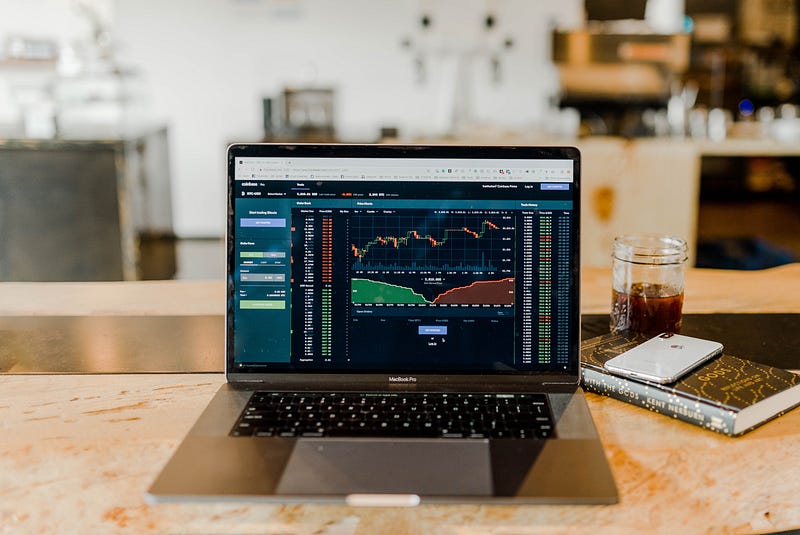
Ok, I’ll be straight with you! When I started investing I had no clue what I was doing. I knew that the money I had in my savings account was costing me money due to inflation rather than getting me any decent interest.
The first step was going to my bank and talking to a professional. He answered the questions I had and helped me open my first investment account. In the beginning, I was checking my investment account every around the clock. I was very anxious about it and wanted to see if I made the right decision.
I put a large sum in my investment account at once and when the value of my investment went down I was terrified, but I remembered that investing is for the long run and not for short gains. A couple of months later, I received my first dividend payment, which immediately was used to buy more stocks. Here, I discovered the beauty of dividend stocks and compound interest and it became the strategy I’ve used ever since.
My investment journey is now 4 years old. I’m still not an expert on it. But I guess it is time to share what I’ve learned with others and highlight the strategy I’ve been using.
Through this, I’ll be addressing three main points:
- How to start investing
- Portfolio diversification
- Cryptocurrency
- My personal investing strategy
Define your investment strategy
If you decide to invest in the stock market, you can either manage the investment on your own, use an investment advisor, or use a service with robo-advisor. Define your investing strategy and your risk level, as different strategies come with different risk levels.
Do you have your goal in sight? This is important because your goal can determine the type of investor you will become.
If you decide to invest independently, shop around to find the best-suited service for you. Different brokerage accounts come with varying management fees and with different types of investments.
After you have answered these questions and have done your homework, it is time to open your investment account.
Let’s start investing
Once the account is open, you can transfer your initial deposit to it. Then you should set up an automated transfer to it monthly. The amount you should transfer to your investment account depends on your budget. A good practice is to allocate a minimum of 20% of your income to your savings. Take a look at your budget and find a suitable amount for you.
You should also not forget to build a rainy day fund. A good recommendation is to have three months’ salary in your rainy day fund. This can be used if sudden costs occur which were not foreseen previously. This money can be left in your savings account or can be allocated into low-risk portfolios.
Now your investing goal is established, your investing account is open, and the automated money transfers are set up, it is time to start investing. One word you will constantly hear while investing: “diversification”.
Diversify your portfolio
It is necessary to diversify your portfolio to reduce the risk in case a certain market sector crashes.
Do not put all your eggs in one basket
Therefore, it is recommended to invest in a mix of assets. A classic mix is to invest in large-cap U.S. stocks, small-cap U.S. stocks, real-estate investment trusts (REITs), bonds, and foreign stocks. There are multiple model portfolios, that you can find online. One of the common (low risk) ones, is the All-Weather Portfolio by Ray Dalio. Ray Dalio suggested investing 40% in long-term bonds, 30% in stocks, 15% in intermediate bonds, 8% in commodities, and 7% in gold.
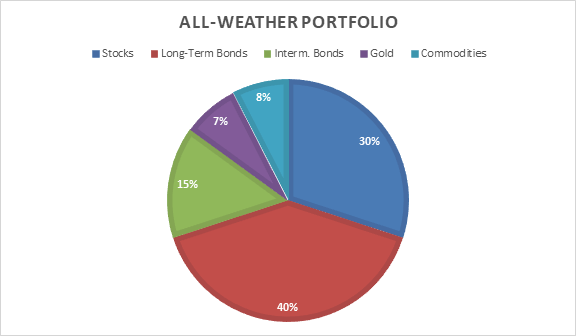
The All-Weather Portfolio by Ray Dalio is a risk-low investment strategy. It is usually outperformed by the S&P500 index, but when the market is crashing down, the All-Weather Portfolio holds strong.
If you are not sure which type of stocks to buy, and you want to diversify your portfolio more, consider investing in ETFs. ETF stands for exchange-traded funds. They are a type of security that involves a collection of securities (e.g. stocks), which often track a certain index. ETFs can be traded exactly like stocks. Some ETFs track a certain index like S&P500 while others track a certain industry (e.g. videogames or pharmaceutical companies). ETFs can include stocks, bonds, REITs, commodities, etc. Think of a certain industry and add ETF to the end, and you will find it. ETFs typically have low management fees.
Investing in cryptocurrency
At the end of 2017 cryptocurrencies skyrocketed. Everybody heard of this and wanted to be part of it. Afterward, the crypto market took a deep dive and hasn’t reached the levels of 2017 ever since. Therefore, it is a vital question to ask:
Shall I invest in cryptocurrency?
And the answer is yes and no:
- Yes, Cryptocurrency is a valid investment option, it is very volatile and you can score some serious gains from investing in this sector.
- NO, It is extremely volatile and you can lose a lot of money if you invest in this sector.
No one can say if the cryptocurrency market will grow further or crash in the coming time. Everybody is analyzing the situation from their own perspective. However, everybody agrees that if you have a small part of your savings in cryptocurrency, the gains that you might get, are worth the risk. What does this mean?
This means, that if you have a certain amount of cash overflow that you do not need at all in your life and that you are willing to consider already lost, then it might be good to put this cash in cryptocurrency. If you lose it all, you never needed that money in the first place, and losing it won’t hurt you. But if it skyrocketed, then the gains you will receive, outweigh the risks.
How I optimized my Savings?
I started investing in large companies, such as Apple, Amazon, Microsoft, Boing, and Unilever to name a few. Afterward, I focused my investments on value stocks with good dividend yield.
The dividends I receive are used to buy ETFs. I buy a mix of different ETFs to diversify my investments even further.
I always keep three month’s salary in my savings account. This money is my emergency fund.
In the last year, I started to also invest in commodities, utilities, and gold. These investments have lower growth than stocks and ETFs but come with lower risks.
Since early 2018 I have allocated a certain amount monthly (ca. 10% of my monthly savings) to buy Bitcoin, Etherium, and Ripples (cryptocurrencies).
Since the beginning of 2020, I started to invest my cash-back from my credit cards with a robo-advisor. The robo-advisor allocates 90% in stocks ETFs and 10% in bonds.
It is never too late to start saving and investing. Putting your money in a savings account is costing you money if you factor in the inflation rate. Investing your money helps in overcoming the inflation with a chance of generating more in the process. Inform yourself about the different possibilities in the market and chose the most suitable option for you and your saving goals. We are in the age of information. You can find helpful information everywhere. If you are a beginner, start by asking a professional. Learn through the process and in the end you will be able to manage your investments on your own.
This article is for informational purposes only. It should not be considered Financial or Legal Advice. Not all information will be accurate. Consult a financial professional before making any significant financial decisions.


