
Investing 101: it is really not hard once you understand this one principle!
Stop using a FINITE strategy in an INFINITE game

The world’s first stock markets are generally linked back to Belgium. Bruges, Flanders, Ghent, and Rotterdam in the Netherlands all hosted their own “stock” market systems in the 1400s and 1500s.
Yes, I did totally just copy/paste that from the internet. Let’s just call it ‘research’. However, as I live in Belgium, in a weird way I am kind of proud now.
The official NYSE stock exchange we know now, was founded much later in 1817.
Why am I even writing this? I am so happy you ask. I have just proven that some form of stock market dynamic has existed for over 500 years. And I think that most of you reading this, will agree that the major stock markets of the world, will not likely disappear in the coming years. Hey, and if you think that it will all disappear (looking at you Mr Claus Schwab), then we will have much bigger existential problems anyway.
The global Stock Market is INFINITE
What I was trying to say in the previous paragraph, is that ‘the’ stock market as a whole has become an infinite or perpetual living and breeding organ. It was started hundreds of years ago and most probably, it will exist for hundred of years more (evil galactic civilizations: stay away!).
Total Market Value of the U.S. Stock Market The total market capitalization of the U.S. stock market is currently $50,781,697.5 million (or $50.8 trillion), (Jan 1st, 2024).
The world’s stock market exchanges have a combined market cap of $89.5 trillion.
Yes, I have just done it again: I totally copy/pasted that from the internet. I am getting good at this research thing.
89 trillion dollars, to me that is mind boggling and it totally enforces my earlier point. This number has been growing year over year and will continue to do so for many years more. SO many people are getting filthy rich from it, you cannot change human nature.
Companies are a finite investment
I can already visualise the ‘buy and hold’ investors running to their garage’s to take out the pitch forks and the torches ! Sacrilege, how dare he even say that !
Let’s take our time machine and go back in time for a moment. Everybody knows the company Nokia, right? I fondly remember their 3310 mobile phone. I think I probably have the world record in playing snake. But jokes aside: Nokia started at the NYSE in 1994 at 1.74$. In 2000, due to the immense popularity of mobile phones (and snake), the stock rose to over 53$. That is an insane profit. Fast forward to today: the stock stands at 3.6$. If you bought Nokia in 1994 and used a ‘buy&hold’ strategy, I guess you would be about as happy as going to work after your daughter threw a bottle of itching powder in your pants (I do not recommend).
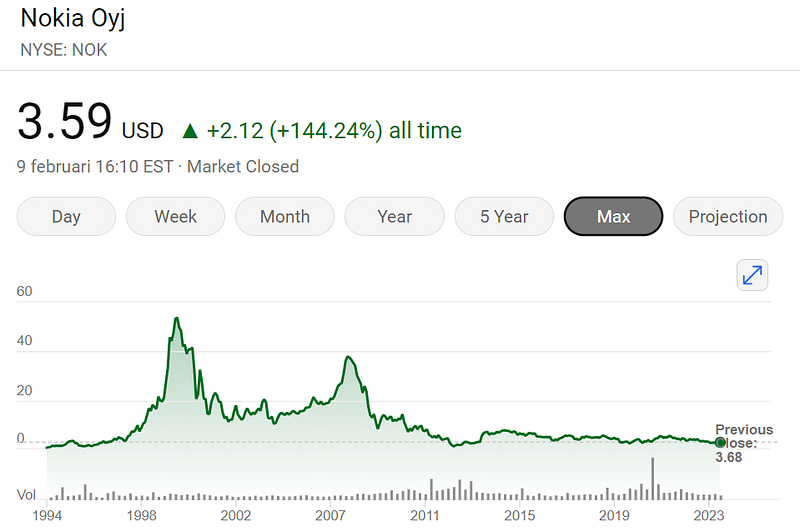
What happened? Simple, Apple was not around yet, Android did not exist. Something better came along. The same principle can easily be applied to the top companies of today:
- Tesla: Chinese companies are popping up with equal range for a fraction of the price. In Europe, brands like Mercedes and BMW who are dominating the company car scene, are bringing out their EV models, instantly selling them in their company leasing models, leaving Tesla out.
- Google: ChatGPT might easily replace google searches the future.
- Microsoft: Maybe apple vison pro and Meta quest will come up with totally new ways of doing business: into the virtual world, in a virtual office using co pilot to record the meetings and AI serving the coffee (joke).
My point is that the biggest companies now, will not stay the biggest forever. Buy&hold investors are playing ‘TO WIN’: to make an investment and to make more money after a while. However, in the stock market there is no ‘end game’, no evil boss to defeat, no ‘you now have all the money, so you win the game’. Playing to win in the stock market, results unfortunately in more losing, than winning.
To make money, adapt to this INFINITE strategy
Use infinite low-cost index funds to match the infinite stock market
Index funds can be either passive or active, but this is not the point of this article. The point is that these funds either automatically or actively track an index: an average of a pre-defined basket of stocks.
The fact that they ‘change’ over time, is the key to successful investing, especially if you add 10+ years in the mix.
To (finally) start making some decent gains, do this:
- Find a low cost broker (in Europe, avoid banks)
2. Open a free account
3. Start immediately with a low-cost index fund. In Europe, a worldwide accumulating one (high taxes in EU) and in the US, you can go for an SP500 one.
4. Learn more about the stock market on your own pace from here and add strategies as you learn (add some small short term satellite positions, some options, some gold or crypto if you are into that).
5. Be patient for minimum 5 years, 10 or more even better.
6. Ignore all the fire and brimstone messages on social media: panic SELLS, bad news SELLS. Ignore the BS.
Think about this, next time you are considering buying the next hype stock. Happy investing all !


