
Inventing Monsters: How Childhood Trauma Derails My Day
Lessons from my abusive home are hard to unlearn. Some monsters don’t like to be leashed.
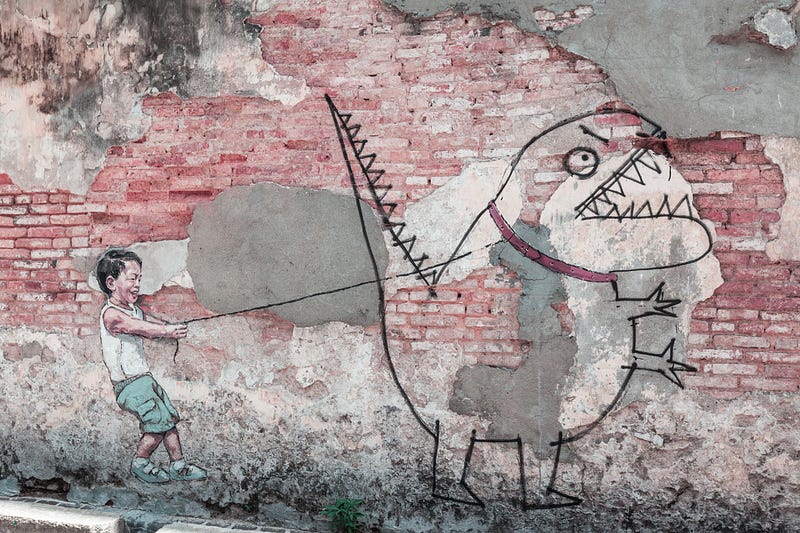
Logic isn’t the solution when my nervous system begins to dysregulate. My mind begins to race while fixating on all kinds of things that are neither true nor helpful.
Stay calm. Stay present.
These are not as easy to do. But I am learning how to navigate these monster-filled passageways with intentional practice and a whole lot of grace for this journey.
How Did I Get Here? Lessons from Our Past
What we expect to experience in life and how we interpret the behavior we see (or in some cases, don't see) from others is built into our thinking and understanding by the lessons we learn as we grow up. Our parents and caregivers help us make sense of our world. Without intentional effort, we will always see what we were taught to see.
My life experience has taught me that I should not trust other people. My mother’s mental illness had deep elements of paranoia. She taught us both by example and intentional lessons that no one is worthy of trust. And as a mother, she proved that point with her Jekyll and Hyde life of warm connections followed by unpredictable bouts of horrific abuse.
The lesson that runs the deepest corridors of my heart is that there is no one that I can count on and that I must do everything myself. I have learned when I find myself thinking these thoughts that I am in real danger of falling completely apart. Those thoughts are my brightest red flag that my ability to stay safe is about to expire.
The lesson holding my deepest heartache is that I am not worthy of consideration or love. No matter how much I try to be a better person, I will be abandoned and alone because I am unlovable and not worthy of anyone’s effort. The damage from abandonment and the isolation I experienced in childhood remain the crux of the work I do daily to remain healthy.
I have also learned that if I pay close enough attention, I can keep the people around me safe. The flip of that coin is that if someone is hurting then I must have somehow failed. This is not a god complex or any such delusion. It is a by-product of being the oldest child in a torturously abusive home growing up.
Securing physical safety for my younger siblings was a top priority because when I failed, they suffered. If I missed the cue that mom was having a bad day, they suffered for it. If I didn’t keep them as quiet as mom wanted them to be, they were made to suffer as I was told their pain was because of my negligence.
These lessons are not just things I know in my head. They are built into my body’s survival system and a part of my deepest wiring. When something triggers one of these buttons, autopilot takes over, and calm leaves the scene.
Where These Lessons Lead
Interestingly enough, for a lot of people when they talk about becoming dysregulated, it is all about the fight. People often recognize a meltdown when there is yelling, physical aggression, and explosive behavior.
Since we only engage in behaviors that serve a purpose, fighting quickly left my repertory of worthwhile things to do. I would argue that the fight response was literally beaten out of me. The price was simply too high and it never actually helped me be safer.
My defaults are to try to flee to outrun the danger at hand or to be immobilized and freeze up so I become invisible.
The way this has impacted my past relationships is that at the first sign of danger, I engage in some pretty awful defensive behavior to blow everything up by proving I am not actually lovable, and then I run away as far and as fast as I can.
Over the years, a few friends and lovers have dared to pursue me but those have been few and far between. I rarely do shoddy work, so when I implode a relationship, the destruction level is usually well beyond repair.
Learning and Growing
Several years ago, I became aware of this pattern and decided to actively engage in addressing this with the hope of finding healthier paths in my relating. It has been a fairly successful journey as I pursued relationships built on honesty and trust with people who I know genuinely want to be a part of my life.
It has been a process and often a battle, but the growth has been worth it. It has been a long time since I actually pulled the lever to flee, though my hand has been on it many times while I worked through the process of returning to safety.
The growth gives me much to be thankful for, but recently I have discovered a much bigger nemesis that needs to be addressed.
When my stress response is activated, my ability to freeze up is legendary. That is not something I even understood about myself until the latter part of 2019. While some of these areas of growth and self-understanding have been a part of my healing journey for decades, this most powerful piece only came to the surface recently. It feels much like discovering a mighty villain hidden in plain sight.
There are really two specific things I am beginning to recognize when I freeze. Sometimes they are both present, but others it is just one.
There is an actually immobilizing physical freeze that happens. It is like I can’t will my body to action. It looks like sitting in my recliner when I should be packing to travel. This isn’t a relaxing experience. It is completely different than the avoidance and procrastination we all encounter from time to time.
When this freeze is happening, I want to be moving, packing, and getting things done. But I just can’t. My body literally is unwilling to do what I am asking it to do. It is an awful feeling and though I am doing nothing physically, it is an exhausting experience.
The other and actually far more common experience for me is the psychological/emotional freeze. It is like my mind fixates on a problem or challenge and can’t move past it until it is solved. In this space, there is a rumination on whatever is happening. It is like my mind is trying to find all the possibilities and available solutions so that I can choose the best course of action.
The problem however is that when I am in a stress response, my brain does not actually use logic and is not actually seeking a solution. The solution my body finds safety in is rumination. And that response is neither helpful nor healthy.
Still So Far To Go
What to do about it becomes the big question.
With the flight response, recognizing the red flags that started to wave when the edge of that response was peeking over the horizon was key learning. That solution has been rather successful. When I can predict where I falling apart, I can figure out how to get to safety before that happens.
I need to do the same with my freeze response.
My first step is to stop picking up the idea or emotion that starts the spin in the first place once I have reached my conclusion about the matter while I am in safety. This is way harder than it sounds for me to actually do.
My brain is just trying to keep me safe and doesn’t like the idea that logic can be in charge. After all, what if something is missed? What if I can find the one little piece that will change what I think I have learned through logic? What if one more twisty journey through all the pieces puts the puzzle together in a completely new way?
For the longest time, I believed that just one more spin through all the details would reassure my mind that all is well. What I am finding is that this is not the case. All that is happening is that I am creating monsters in the closet and under the bed who are not actually there.
So for today, when my mind whispers to me, I am not going to even start that cycle. The world has enough real monsters, I don’t need to invent more.
Read more about Maggie and her journey.
Want more from Maggie Q. Collins? Subscribe to her email list.
Today is your day to become a subscriber to Medium! Your membership directly supports Maggie Q. Collins and other writers so you keep getting great content.


