Physics
Intuition behind Maxwell’s Equations

In the last couple of centuries, there has been a tremendous development in the field of Physics. From Electrodynamics and Relativity to Quantum Mechanics and String theory, humanity has made some substantial steps in understanding the world and reality in general. Among the numerous theories and models that have been developed over the years, there are certain few equations that stand out for their importance and elegance. Maxwell’s equations fall into this category. But what do Maxwell’s equations actually describe and how can we intuitively understand what they entail?
Maxwell’s Equations are four equations that constitute the foundation of classical Electromagnetism. They describe how electrical and magnetic fields are created as well as their behavior. But let’s take things from the beginning with some definitions.
We define the electric force as the attractive or repulsive interaction between any two charged particles or objects.
Similarly, we define the magnetic force as the attraction or repulsion that arises between electrically charged particles because of their motion.
In physics, a field is a region of space where each point is affected by a force. The nature of the force describes the field. For example, if the force is the gravitational force then we are talking about a gravitational field. In our case, the forces will be electric and magnetic in nature so it makes sense to talk about electric and magnetic fields denoted as E and B respectively.
A simple way to understand how the electric and magnetic fields look like is to visualize them as a region in space with directed lines, known as field lines, pointing in different directions. This is why they are often called vector field in mathematical terms.
In the case of the electric field, the direction of the lines shows the direction of the force that a positively charged particle will experience if it is located at that particular point in space. The density of the lines tells us how strong that force will be. The situation about the direction of the force is a bit more complicated in the case of the magnetic field but the core idea still stands. It is a region of space with directed lines.
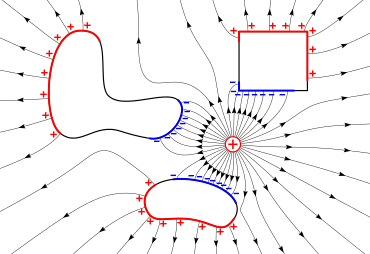
With that in mind, one can easily understand why the electric and magnetic fields are so important. If we know the E and B fields in a region of space we can predict the forces and thus the motion of any charged object that enters the aforementioned region. The following four equations, known as Maxwell’s equations provide a mathematical tool in understanding the behavior of such fields:
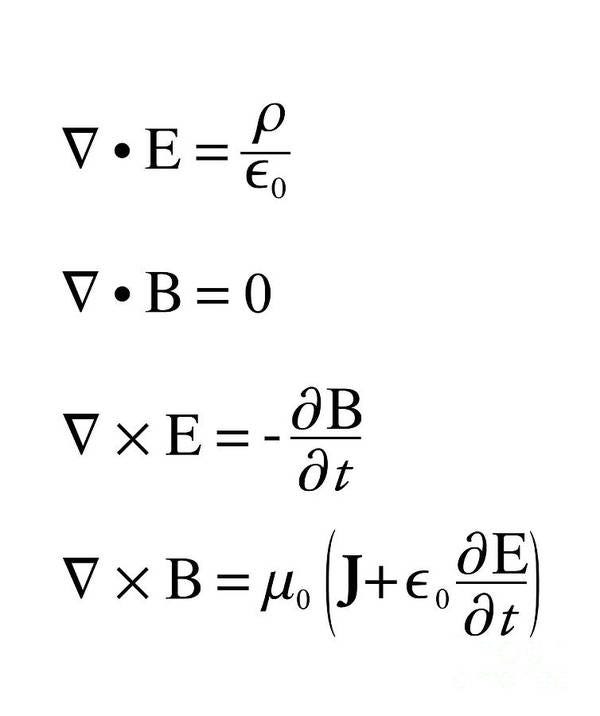
where:
- ρ is the charge density, the amount of charge per unit volume.
- J is the current density, the current per unit surface area.
- E is the electric field.
- B is the magnetic field.
- εₒ and μₒ are constants that are not important for the purposes of this article.
The reader should be familiar with the mathematical concepts entailed in the equations (partial derivative, divergence and curl of a vector field) as we will not be reviewing them here.
One useful tip to keep in mind is that it is more intuitive to read these equations from right to left. In particular, in each one of them you can think that the right side is “the cause”, the thing that already exists somewhere in space and the left side is “the effect”, the thing that happens due to the cause. Okay, cause and effect from right to left.
Let us start with the first one.
1) Gauss’s Law for the electric field
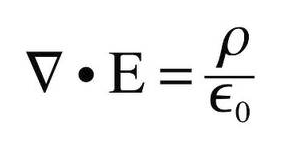
Bearing in mind the tip that we discussed above, the first of the four equations tells us that a charge density in a region of space results in a divergence of the electric field at that region. A positive charge creates a positive divergence and a negative charge created a negative divergence.
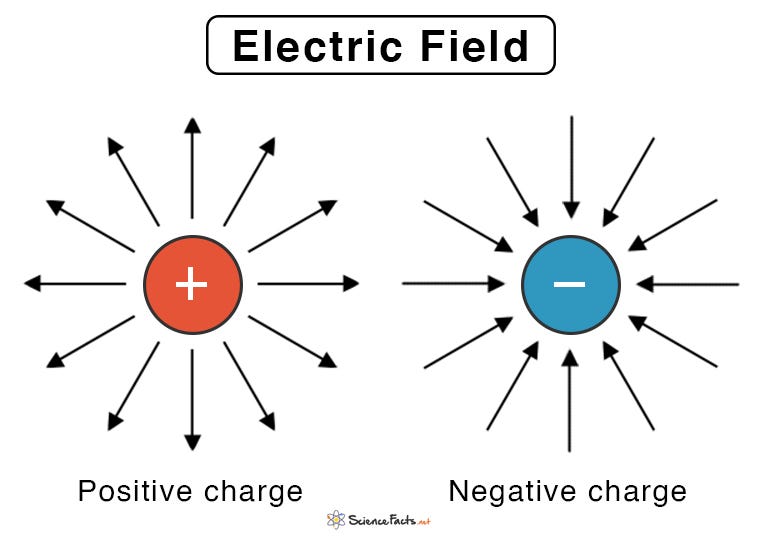
What that means intuitively is that if we have a positive charge somewhere in space then the lines of the electric field that we mentioned before will be directed outwards, away from the positive charge (positive divergence). If the charge is negative then the lines will be pointing towards the charge (negative divergence). That is all.
2) Gauss’s Law for the magnetic field
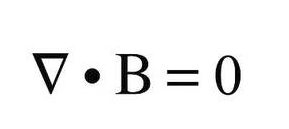
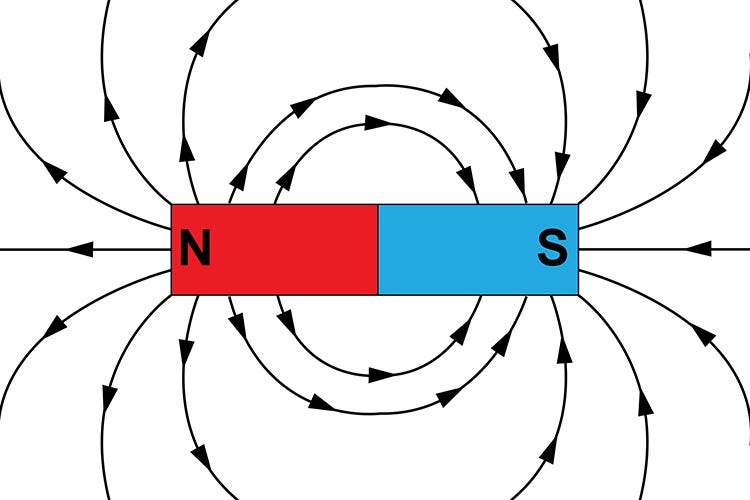
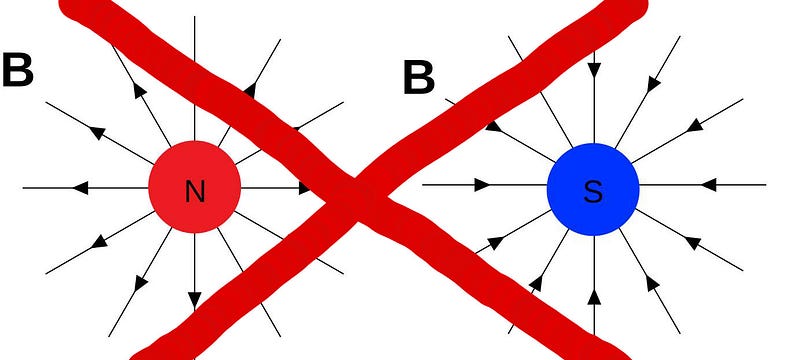
Things are similar but simpler in the case of the second of the four equations. This equation tells us that the divergence of the magnetic field is always zero. What this means is that there cannot exist lines in the magnetic field that exclusively leave or enter a magnetic object. That is not true, as we saw earlier, in the case of the electric field. Intuitively, we can interpret the above equation as follows: There cannot exist magnetic monopoles. Every magnetic object has two poles, a north pole, and a south pole. The magnetic field lines leave the north pole of the object and they always return to the south pole of the same object.
3) Faraday’s Law
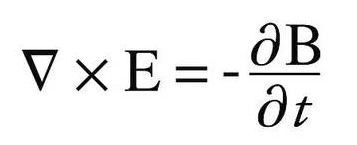
Following the same tactic in reading the Maxwell’s equations (cause and effect from right to left), this equation, known as the Faraday’s Law, tells us that a changing in time magnetic field creates an electric field in the form of a curl. In other words, a changing in time magnetic field creates an electric field whose directed lines’ shape is a curl, a loop.
This is actually the basic idea behind how turbines work or, more specifically, the idea behind how the generator of the turbine works. To put it in simple words, imagine the inside of the turbine is connected to a loop of wire. Moreover, suppose that this loop of wire is inside a magnetic field like in the picture below.
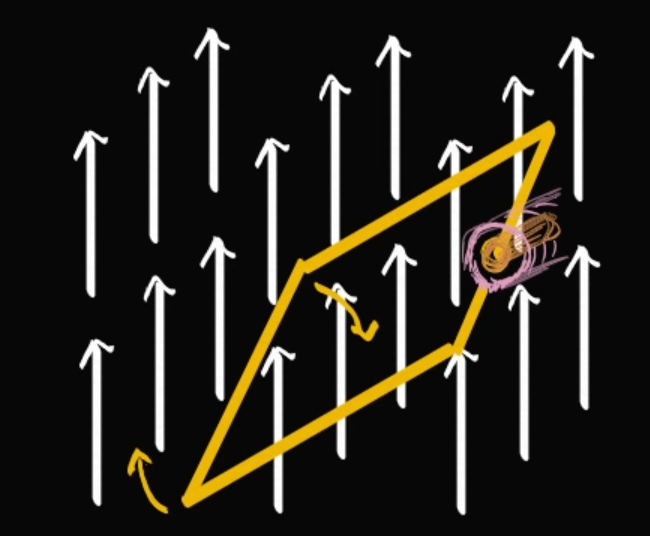
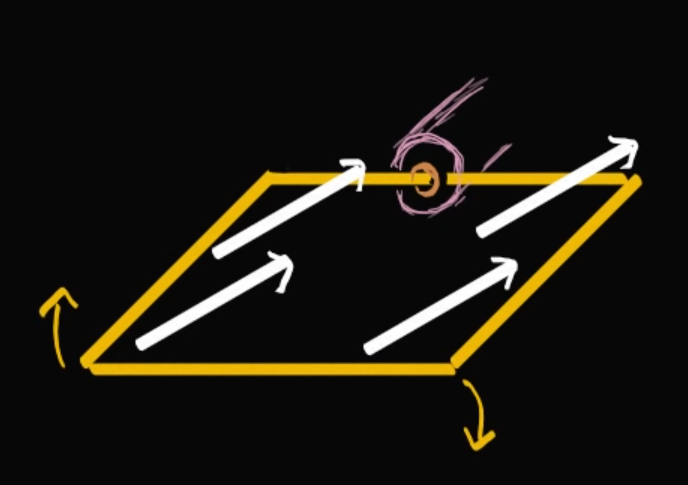
Now, as the wind rotates the propeller, the wire also rotates inside the magnetic field. This is equivalent to a changing magnetic field with time (we change its angle relative to the wire) and, thus, we get a current flowing through the loop of wire. Mechanical rotation turns into electricity using Faraday’s Law!
1) Ampere’s Law
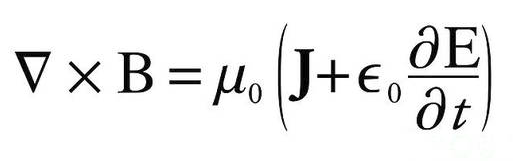
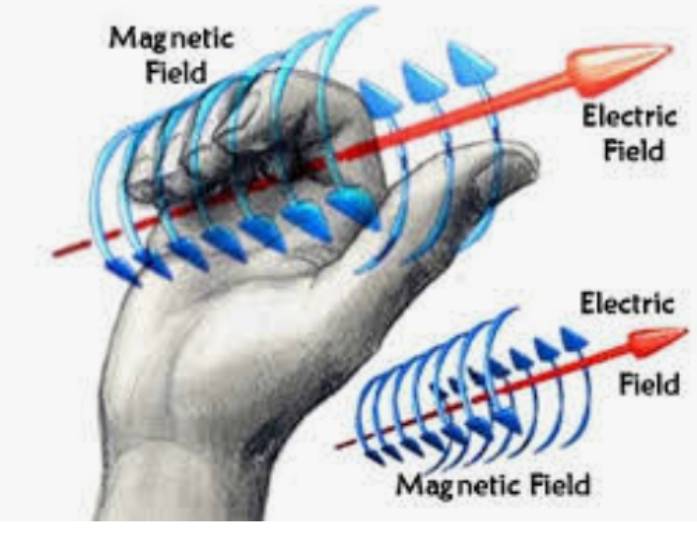
This is pretty similar to Faraday’s Law except for one key difference. In this case, we see that there are not one but two things that can induce a magnetic field in the form of a curl. In complete analogy with the previous equation, a changing in time electric field creates a curl in the magnetic field. However, there is another thing that has the same effect, a current! Yes, any current flowing through a wire creates a curl in the magnetic field around the wire. There is a magnetic field around every wire in our house. To find the direction of the magnetic field we curl our right hand around the wire and we point our thumb in the direction of the current. The direction to which our other fingers loop is the direction of the curl of the magnetic field.
Conclusion
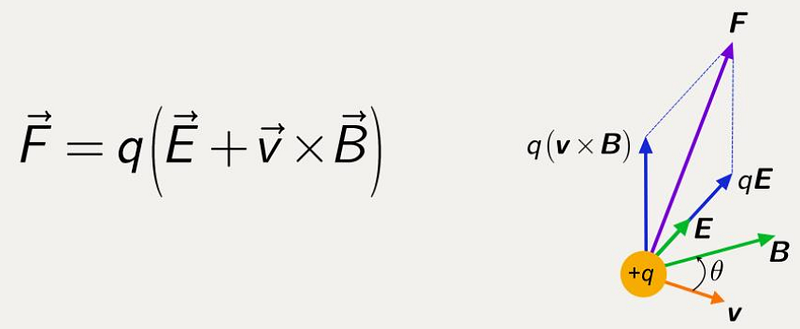
Maxwell’s Equations are four differential or integral equations — they can be found in both forms— that describe how electric and magnetic fields are created and behave. These equations together with the Lorentz Force, the total electric and magnetic force that a charged particle is subject to, gave birth to classical Electromagnetism.