
Math
Intuition behind Complex Numbers
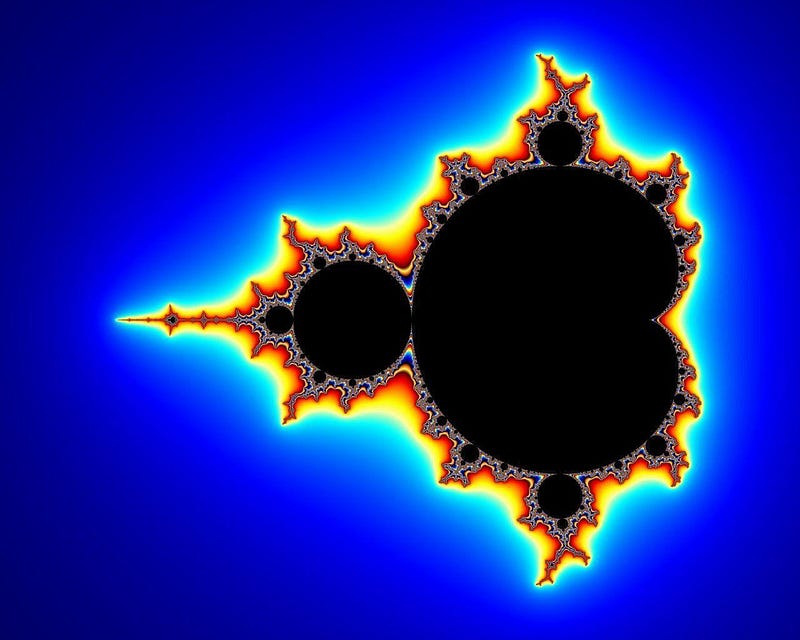
Complex numbers are everywhere. From signal processing and circuit analysis all the way to quantum mechanics and fluid dynamics, the imaginary unit, i, seems to be dominating most of the equations in engineering and physics. But how can that be? How can a number so seemingly arbitrary such as i with no obvious real-world interpretation be as useful as it is?
The imaginary unit whose symbol is i, or j for electrical engineers, is defined as the square root of negative one.
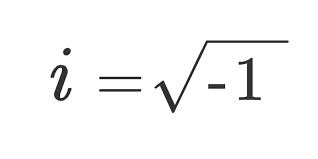
But didn’t we all learn in high school that one simply cannot define the square root of a negative number? It is true that when someone first comes across the concept of the imaginary unit is filled with doubt and suspicion. In order to understand its significance, however, I will ask you — in the context of this article — to pretend to forget everything you know about mathematics. I will offer you an additional way to look at the science of mathematics, one that makes complex numbers not only desirable but necessary. Let’s begin!
Mathematical Formalism
Mathematical Formalism is one of the main theories in the philosophy of mathematics.
According to formalism, all mathematics can be reduced to rules for manipulating formulas without any reference to the meanings of the formulas. Formalists contend that it is the mathematical symbols themselves, and not any meaning that might be ascribed to them, that are the basic objects of mathematical thought.
—Definition by britanicca.com
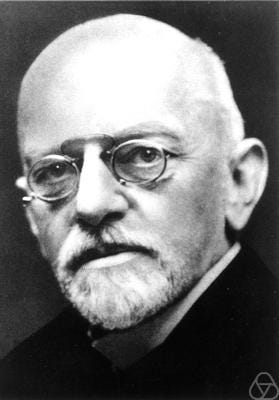
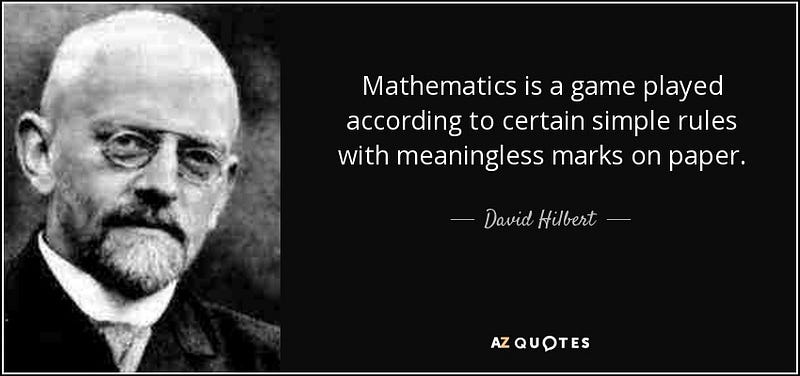
This is a very interesting outlook in regards to the nature of mathematics first introduced by none other than David Hilbert himself. According to formalism, mathematics can be thought of as a game. We have some symbols and some rules to manipulate them. Using these manipulation rules, we arrive at certain syntactic structures and truths — known as theorems — that hold for the aforementioned symbols due to the very rules that we ourselves established. There is no deeper meaning than that.
The beauty of it all is that we can actually use this game we humans invented, mathematics, to model various phenomena that we encounter in the real world. Choosing which syntactic structures and symbols of our game to use each time in order to describe a situation in the real world is often the most difficult part. With the brilliance, however, of certain people in the past and today, we have managed to cover a wide range of scenarios.
Since our little game seems to be doing a great job in describing the world so far, we should strive to evolve it as much as we can. If we somehow manage to find all the syntactic truths that our symbols and rules entail then all we have to do is find an interpretation for each one of them, right? This is exactly how formalists view mathematics and as we will see, this point of view will clarify many of the “controversies” found in it.
Negative Numbers
Before we dive into imaginary and complex numbers let’s ponder, for a minute, over negative numbers first.
One key aspect of mathematics is solving equations. As we established before, there is nothing special in solving equations in itself, it is just a game. However, since in many real life scenarios we are interested in finding a certain unknown quantity — e.g. the velocity of an object, the energy transferred, the probability to find a particle at a specific location etc — it seems reasonable to evolve this aspect of our game.
When it comes to numbers, the first kind of number that was introduced in mathematics was the one of the real positive numbers. We added symbols such as “1” or “2” or “14.5122” to our little game because we saw that they had an immediate and intuitive interpretation. They could be used to describe all sorts of quantities of physical objects. The number of apples in a bag, the age of an old man and the height of a woman are examples that fall into this category. These symbols are the solutions to many equations such as the following:
- x — 20 = 5
- 6x — 3.1 = 4
- x³+ 4 = 5
However, the positive real numbers are not enough to describe the solutions of all equations. Consider the following arrangement of symbols in our game:
- x+ 6 = 4
Using the same logical rules that were used before, there is no way to arrive at a real positive solution. This does not deter us at all. Since we do not have a mathematical entity in our game to describe these solutions, we will introduce one. Let’s call them negative numbers and as a symbol, we will use whatever symbols we used for the positive numbers but we will put a negative sign in the front. In fact, it is sufficient to only define one negative number and the rest will easily follow. Let’s define “the negative unit” as -1 and then every negative number is equal to its positive counterpart multiplied by the negative unit.
If the real positive numbers can be geometrically visualized as a half-line from 0 to positive infinity, then the negative numbers are merely an extension of that half-line to the left, from 0 to negative infinity.
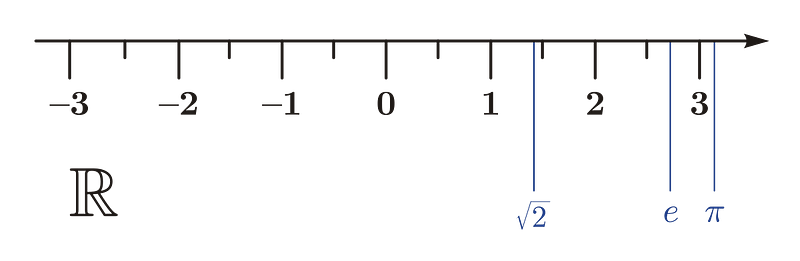
We can manipulate the negative numbers in the same ways that we manipulate positive numbers. Moreover, we can use their definition to get rid of an entire operation in our game, subtraction. Now, whenever we see a subtraction of two numbers we can replace it with an addition of the first number and the negative of the second.
As an example, 5 — 3 is the same as 5 + ( — 3).
We are exposed to the concept of a “negative number” at a very young age and thus we take it for granted but if you think about it they are not intuitive at all. There are no negative numbers found in nature. You can’t say “there are minus 5 apples in that tree”. Negative numbers are entities we added in our game in order to evolve it. Then, we found several interpretations for them so as to use them in our real world.
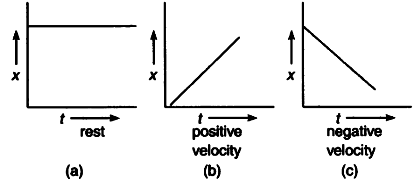
What are these interpretations? Well that depends. When we are talking about the speed of an object, for example, if the answer comes up as a negative number then we know that the direction of its motion is opposite to the one that we had initially assumed. In this case, negative numbers are used to indicate direction. Another example is found in finance. If we are calculating the total revenue of a business over a period of time and we find a negative number at the end of our calculations then this means that the business is actually losing money. In this case, negative numbers indicate a deficit. There are more interpretations of negative numbers but these two are the most prominent.
Imaginary and Complex numbers
If you have understood everything that we have said so far then you can already foresee how we will approach the concept of imaginary numbers. Consider the following equation:
- x² + 1 = 0
This time neither positive nor negative numbers can do the trick. Well, that didn’t stop us before so it won’t stop us now. Let’s add some more entities to play within our game. Let’s define a new symbol, i, to be the square root of negative one. Why did we define a symbol like this? Because this solves the equation above according to our established rules of our game. No deeper meaning, simple as that.
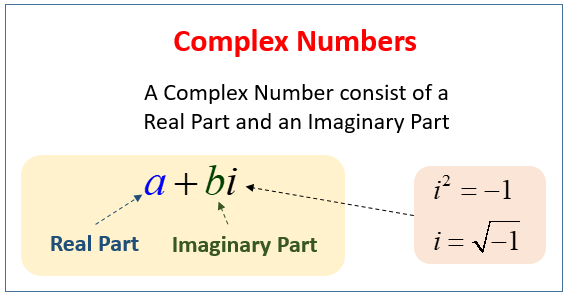
Again, imaginary numbers can be added and multiplied using the same rules of algebra as real numbers. i + 3i = 4i and i*i = -1. We can even add an imaginary number with a real number to get a so-called complex number. The real number that was used in the addition constitutes the “real part” of the complex number while the imaginary number constitutes the “imaginary part”.
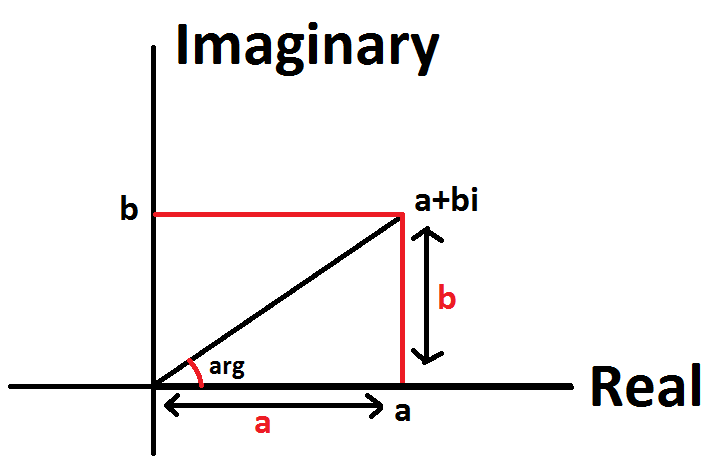
Geometrically speaking, just like the real numbers, we can use a straight line to visualize imaginary numbers. Moreover, we can place the imaginary line perpendicular to the real line to form the complex plane where every complex number corresponds to a point with a real and an imaginary coordinate.
Okay, we have successfully included the concept of the imaginary unit in our game. Time to find some applications and interpretations.
For starters, complex numbers are used all the time in electrical engineering. They are the backbone of the Fourier transform which helps us analyze the frequency content of a given signal. Moreover, in mathematics, the Laplace transform, which includes complex numbers, helps us transform differential equations to algebraic ones making their solution much simpler. Finally, Euler’s formula directly reveals that complex numbers have a link to cosines and sines and thus, they are easy to use when we want to describe an oscillation of any kind.
One additional remark about imaginary numbers is that we can think of the multiplication of a real number by the imaginary unit, i, as an anticlockwise rotation of 90 degrees in the complex plane.
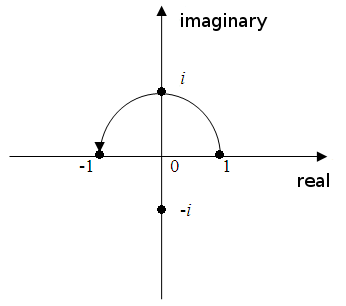
Consider the number 1 for example. This number lies on the real line in the right side along with the positive real numbers. Multiply 1 by i and you get the number i, a rotation of 90 degrees from the initial point of 1. Multiply it again by i and we get the number -1 which lies again on the real line. Multiply it two more times and we are back to where we began.
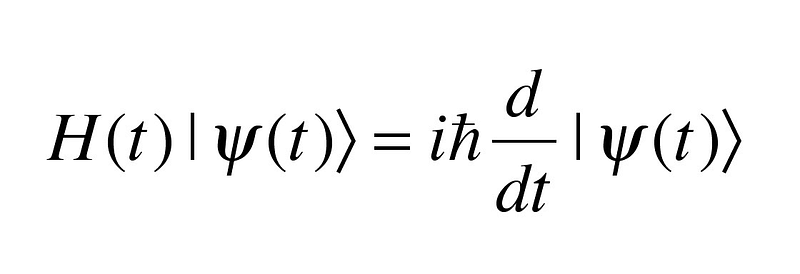
One real-world application of complex number becomes apparent in quantum mechanics. Although we will not dive into the Schrodinger equation in this article, it turns out that it is only through complex numbers, a concept that we seemingly arbitrarily introduced, that we can accurately model the probability to find a particle at a specific location.
Although the direct real-world interpretations of complex numbers are limited, their applications in mathematics are invaluable. Complex numbers make mathematics a lot easier on numerous occasions. They help us describe phenomena, such as oscillations in a very compact way. Moreover, not only do they enable us to solve many problems faster — such as differential equations — , they enable us to solve problems which we couldn’t possibly approach using only their real counterparts. The name “imaginary” is unfortunate at best because as we see, they are just as real and useful as the “real” numbers.
I would like to end this article by answering a question that many of you are probably thinking about right now. Why stop here? Since complex numbers are useful why not invent a new kind of number? First of all, there are “more kinds of numbers” called quaternions and octonions but they are not nearly as useful or widely used as complex numbers. The reason that the last “important” numbers are complex numbers is that they are algebraically closed. This means that all complex polynomial equations have solutions in C, the set of complex numbers. There is no polynomial equation whose solution is not a complex number. This is called “The Fundamental Theorem of Algebra” and it was proved by Carl Friedrich Gauss.

If you have any requests for a future “Intuition behind…” article make sure to leave a comment or send me a message.


