
Introverts, You Need 3 Traits to Become a Great Software Architect

When I entered the software industry, I was aghast by my company’s extreme bias towards extrovert programmers.
Guys who spoke more than everyone always got their desired outcome: Pay hike, promotion, or permanent immigration sponsorship to developed countries.
World is inherently biased towards extroverts
I wasn’t exactly an introvert, but I lacked serious representational skills when it came to talking technology. I firmly believed that lack of programming expertise should never be compensated by empty words. But somehow, in my team setup at that time, that trait used bring great success.
Little did I know, that what I was experiencing was a global problem. Within a decade, Susan Cain, the author of the bestselling book “Quiet: The Power of Introverts in a World That Can’t Stop Talking” proclaimed that the world was inherently biased towards extroverts.
My dismal state remained with me until I met some truly great software professionals who were introvert, and made it big comfortably.
I not only admired them, but also got to figure out the exact traits that made them admirable. While gaining someone’s admiration is a lofty ideal in an stress-laden industry like software, many a times, one can obtain it by fulfilling a simple requirement: Being fit for the company, not just for the sake of interviews, but for the whole time of job execution.
This article is to describe the three traits that make introvert programmers a great fit for software companies. But before we delve into them, I would like to go through the background of what makes them fit for every software company.
The Myers Briggs Types:
Corporates across the world have long adopted psychometric techniques to evaluate how much a candidate fits the company culture, and more specifically, the role he/she is applying for.
The most prominent among those are known as MBTI (Myers Briggs Type Indicator) psychometric tests. Myers Briggs Type Indicator is a unique personality type, derived from a combination of 4 basic personality traits.
According to MBTI, any person can be defined by a four-letter personality type. Each of those letters can be:
- Expression: Extrovert vs Introvert (E vs I) — you can be E or I, but not both.
- Grasp: Sensing vs Intuition (S vs N) — you can be S or N, but not both.
- Decision Making: Thinking vs Feeling (T vs F) — you can be T or F, but not both.
- Planning: Judging vs Perceiving (J vs P) — you can be J or P, but not both.
MBTI based psychometric tests asks a number of questions to the candidate, each representing a couplet (Extrovert vs Introvert is a couplet), and assigns a point to traits based on answers.
In a 32-point MBTI-based test, each trait score could be:
Expression: E: 5, I:3 => E wins
Grasp: S:2, N:6 => N wins
Decision: T: 3, F: 5 => F wins
Planning: J: 1, P: 7 => P wins
Based on the results, you are an ENFP persona.
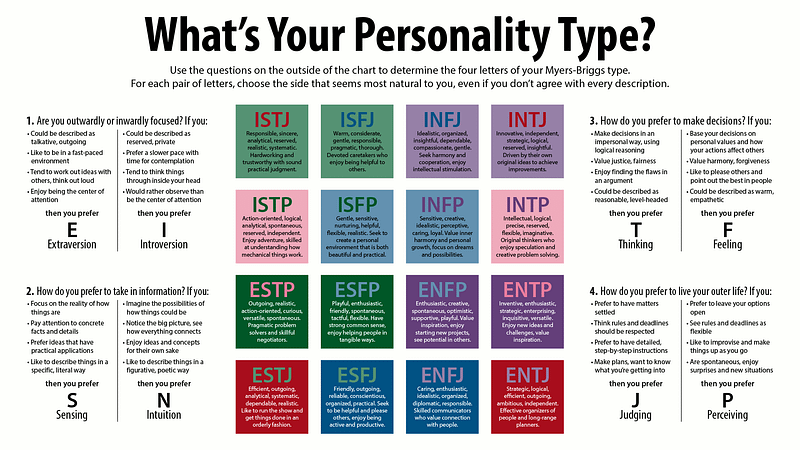
If we read the traits of an ENFP from the above image:
- Enthusiastic, Creative, Spontaneous, Optimistic, Supportive, Playful.
- Values Inspiration.
- Enjoy starting new projects.
- See the potential in others.
According to MBTI, however, you can’t be an ESNT person or an ISTF person, because you can’t be sensing and intuitive at the same time, nor you can be thinking and feeling at the same time.
This atomic nature of traits has lately drawn some criticism for MBTI, because it brings imperfect evaluation. Presence of conflicting traits is a completely human thing, but the nature of MBTI tests forces a candidate to take one of those dual traits — thus masking his true identity.
In my latest eBook about Senior Developer Interviews, I have dedicated a chapter to how MBTI affects software psychometric tests. While MBTI perfectly evaluates the role fit, it is less than perfect when it comes to evaluating culture fit.
Yet, I am sure MBTI based tests are widespread in software research institutes and R & D departments where the importance of role fit supersedes that of the culture fit. Some mainstream software companies that refuse to evolve may be conducting MBTI interviews, too. Amazon’s well-known STAR interview format also has its roots in MBTI based personality categorization.
The most fitting software role for introverts:
According to the 16-personality website, each MBTI personality type fits specific role within an organization.
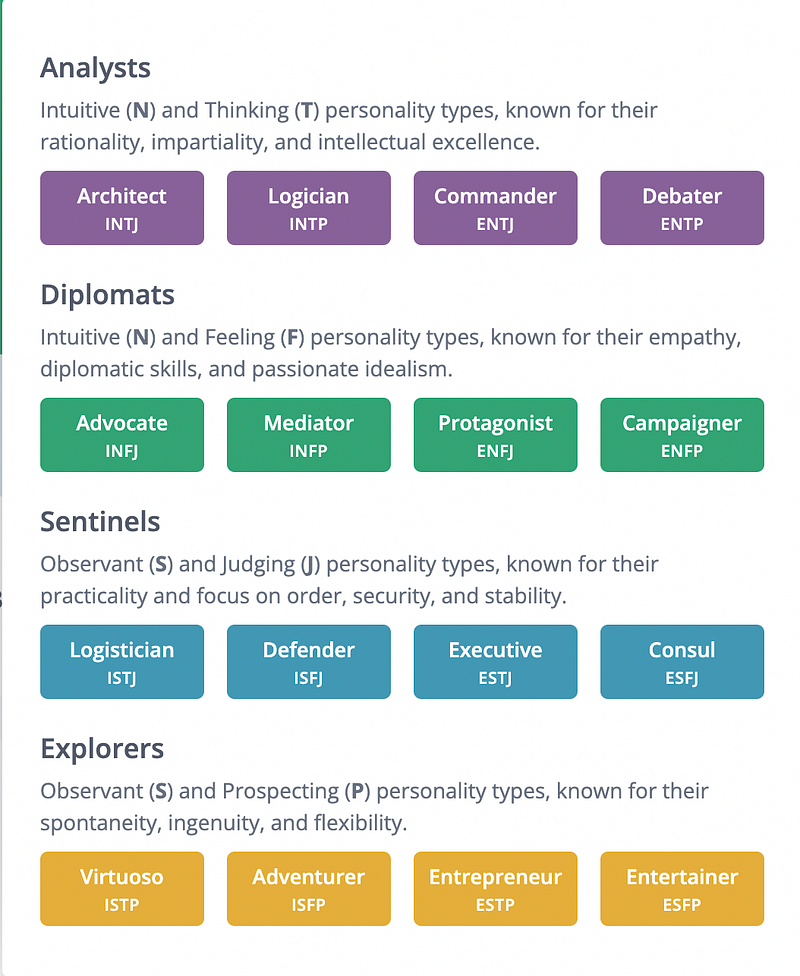
As you can observe in the image, introverts (with an I) can fit into these 8 roles: Architects, Logicians, Advocate, Mediator, Logistician, Defender, Virtuoso and Adventurer.
Out of those 8, architect is the only fitting personality type when it comes to software. One can surely add value to an organization being one of the other 7 types, but these types are difficult to demonstrate during the constrained format programming interview.
Architects aren’t born. A developer has to turn into an architect through a structured metamorphosis.
Also, architect is one of the most sought-after role in the industry, because architects aren’t born. A developer has to turn into an architect through structured metamorphosis.
Being an introvert, you are already armed with the most important trait of a senior developer: Keeping your thoughts to yourself until they ripen, and
- Either the time is right, and your team is in crucial need of a new thought/perspective, and
- Everyone else has already spoken.
What remains to become an architect? From INTJ, one needs to gain N (intuitive), T (thinking) and J (judging) skills.
Let us fill in the gaps with MBTI traits.
N-Intuitive:
Data is helpful. But intuition allows you to save a lot on unnecessary data experiments that are costly and time-consuming.
In my latest team meeting, the product manager proposed to generate an analytics event every time user visited a product screen.
Everyone agreed, except for the most senior guy who was responsible for implementing the feature. He was silent — a perfect example of an introvert developer.
As usual, his silence made the product manager specifically ask for his opinion.
He said, “I have a hunch this will be an overkill. Let us log an event whenever user clicks on the “More info” button — which is much more meaningful interaction just before the “Buy” button. If we log the product screen visit, we will be burdening the analytics servers with lot of visitors that aren’t potential buyers.”
The product manager said, “But we can’t depend on hunches.”
To that, the developer spoke, “In the absence of prior data, hunches are what we have.”
He took a brief pause, then continued.
“Ask yourself: If you have decided to buy a certain product from our website, just before you press the “Buy” button, which event has the more likelihood?”
- You visiting the product screen? OR
- You pressing ‘more info’
The product manager was speechless. Everyone in the room knew the answer. It was the latter.
Data is helpful. Sensing challenges and improvements is even more helpful. But intuition allows you to save a lot on unnecessary data experiments and combating costly + time-consuming challenges.
A rookie developer rely on skills and data, and deliver whatever is asked. An experienced architect rely on his hunch, and delivers value even when he avoids doing something.
T-Thinking:
A good architect always acts in the best business interest of the company, and he is smart enough to intertwine his personal career growth with that of the company.
A good architect is always rational. He is married to the best principles of great software. At the same time, he isn’t steadfast to rigidly follow the book. He knows when rules must be obeyed, where they can be broken to protect the greater good, and when it is inevitable to break them.
While having everyone’s best at his heart, he is far from biased. He isn’t someone who can be easily provoked. He never acts under any emotional pressure or fear. He always acts in the best business interest of the company, and he is smart enough to intertwine his personal career growth with that of the company.
A good architect listens not with his ears, but with his brain. He gives ample room to his teammates and management to vent their feelings, but when it comes to judgement, he resorts to nothing but his own intellect.
Last but not the least, a good architect’s thoughts are best expressed through the code he writes/designs, or the documents he drafts. He is not someone who spends an inordinate amount energy explaining his thinking to others.
J-Judging:
When it comes to MBTI definition, Judging means making of rules that can be easily implemented by anyone in the team, regardless of the timeline or seniority.
Whether it’s a building or software, a good architect lays out his plans up to the millimetre’s precision. Additionally, he also templatizes his work to enable future teammates to follow the same format. He spends inordinate amount of time laying out firm rules, to leverage scalability and leave out very little room for confusion.
An average architect quickly builds features. But a good architect builds feature-building capabilities. These capabilities enable even a junior dev add any feature in the minimum possible time.
Communication is a big enabler to any team’s well-functioning. But after the big rules are laid out, when it comes to standard details, communication is the biggest roadblock to productivity. A good architect documents precisely to minimize the need for communication and maximize the team productivity.
Conclusion:
Despite its perfect traits definitions, MBTI evaluations aren’t the truest mark of a programming candidate. HR and recruiters don’t always do a great job converting MBTI traits to relevant questions.
I have seen many capable architects getting rejected by great companies. Despite grasping them well, I have been rejected many a times for architect roles.
However, being an introvert already, if you always keep the NTJ traits in mind, your metamorphosis towards an architect role becomes smoother and quicker. It’s only a matter of time until you meet your MBTI soulmate interviewer, who will recognize the potential architect in you.
When it happens, the time has come to build great things, and reap the unfair advantages of your introversion.
Level Up Coding
Thanks for being a part of our community! More content in the Level Up Coding publication. Follow: Twitter, LinkedIn, Newsletter Level Up is transforming tech recruiting ➡️ Join our talent collective