
Introduction to the Absurd
In a universe that seemingly lacks reason and order, our unmet innate desire for meaning might create a sense of alienation and dissatisfaction with life or even lead us to question the nature and purpose of our existence. The absurd can be described as a conflict or dissension between the human tendency to seek inherent value and meaning in life and the inability to find any in a purposeless, meaningless, chaotic, and irrational universe. Neither the universe nor human existence is absurd on its own, it is only the dichotomy of the two that creates the absurd.
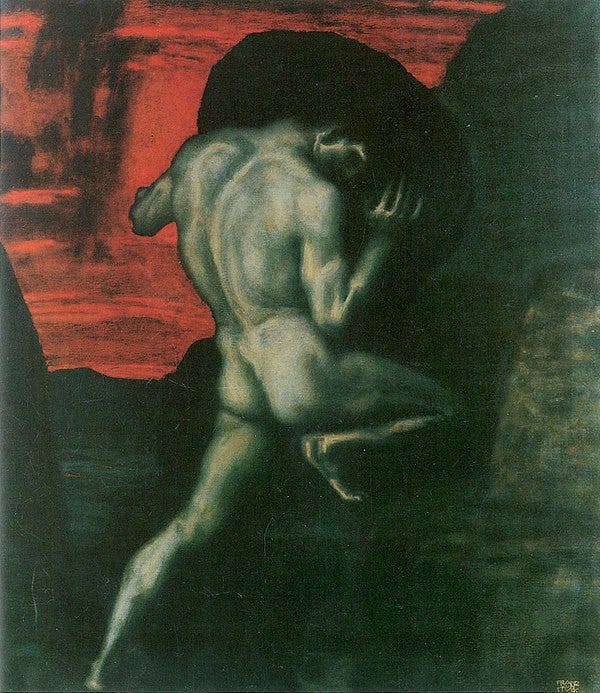
In his journals, the 19th-century Danish philosopher, Soren Kierkegaard, wrote about the absurd in an attempt to confront this crisis before the French-Algerian, Albert Camus, published his essay ‘The Myth of Sisyphus’ in 1942, in which he presented Absurdism as a belief system.
For Kierkegaard, God solves the problem of the absurd as God wills our existence and makes possible a better future with the promise of an afterlife. He writes: “When the believer has faith, the absurd is not the absurd, faith transforms it…the passion of faith is the only thing that masters the absurd.”
In Greek mythology, Sisyphus was the first king of Ephyra. He escaped death twice by tricking the gods and his punishment was to endlessly roll a massive rock up a hill just to watch it fall back again. In his essay, Camus used this myth as an allegory to the human condition and our daily struggles that sometimes feel like futile repetitive tasks.
For Camus, ‘the absurd is essentially a divorce’ between human life and the universe. Neither of them is necessarily absurd on its own but rather their relationship is. He argues that the solution is to find worthy and valuable experience within the absurdity of life. He says “The realization that life is absurd cannot be an end, but only a beginning” and thus we can still choose to give life meaning. “One must imagine Sisyphus happy”, he asserts.


