
An Introduction to Machine Learning

As you know, the applications of Machine learning appear everywhere in our life. For example, when you search for something in Google, based on Machine learning algorithms, it recommends to you the most performance results related to your keywords. Facebook, Youtube, and Amazon also use recommendation systems for suggesting the users their products. Apple develops Machine learning algorithms for face and fingerprint recognition to activate your devices without using your password, … Thanks to Machine learning, our lives have become much more convenient.
In this article, we will study various types of Machine learning algorithms and their use cases. The blog outline consists of four parts:
- What is Machine learning?
- Why use Machine learning?
3. Types of Machine learning algorithms.
4. Use cases of Machine learning.
Let’s start!
I. What is Machine Learning?
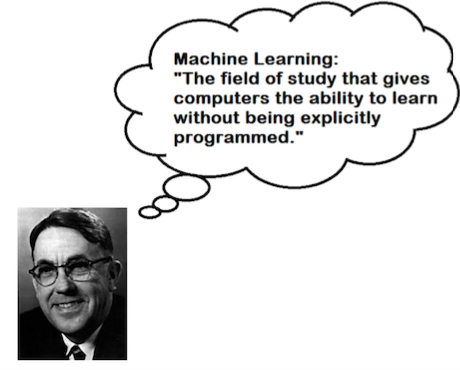
In 1959, Arthur Samuel defined: “Machine Learning is the field of study that gives the computer the ability to learn without explicitly programmed”.
In 1997, Tome Michel gave another definition of Machine learning which is more technical: “A computer program is said to learn from experience E with respect to some class of tasks T and performance measure P if its performance at tasks in T, as measured by P, improves with experience E”.
II. Why use Machine learning?
To see the importance of Machine learning, let's consider an example of spam email recognition. For this problem, you first have to examine what a spam email looks like. You remark that it may contain many errors and links, or some words like “bank card”, “free”, and “congratulation”, … After analyzing all possible characteristics, you have to write a program to detect them repeatedly for all emails. Therefore, your code will be very long and complicated to maintain. By contrast, the Machine learning technique studies automatically what characteristics are contained in a spam email, and the code becomes much shorter and simpler to maintain. Furthermore, machine learning algorithms give us better results compared to the traditional ones.
In summary, there are some reasons why we should use Machine learning algorithms instead of traditional methods:
- Machine learning algorithms are faster, require less computational power, and give better results compared to traditional algorithms.
- Machine learning techniques can find solutions to some complicated problems while traditional methods can not.
- Fluctuating environments: Machine learning systems can adapt to new data.
- Machine learning algorithms are good for the exploration of complicated problems with a large dataset.
Please notice that, for building a Machine Learning model, the number of data in the training set must be large enough so that the model can learn correctly. Sometimes, we have to feed the model with thousands of data to get high accuracy. The more varied the data, the higher accuracy of the model. That is why the data is so important for Machine Learning and the Data Science domain.
Andrew Ng: “It’s not who has the best algorithms that win. It’s who has the best data”.
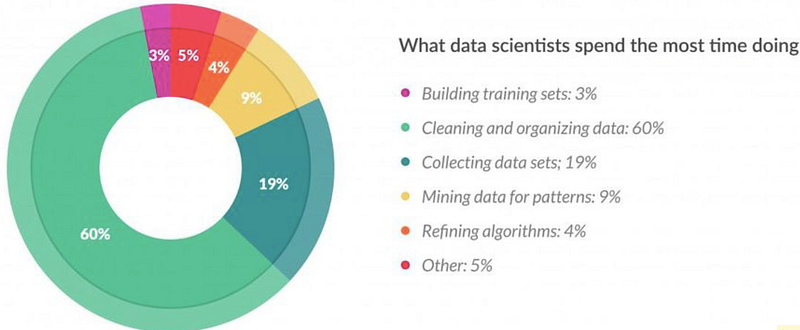
According to Forbes, data scientists spend around 80% of their time preparing and managing the data for analysis.
III. Types of Machine Learning Algorithms:
Machine Learning algorithms are classified into 3 principal types:
1. Supervised learning
Supervised learning is the most popular algorithm for performing Machine Learning operations. The data, in this case, is labeled. A supervised learning algorithm identifies the features explicitly and carries out prediction or classification accordingly.
a. Classification
Supervised learning algorithms are applied for the problem of classification when the variables are discrete.
Let’s consider some simple examples of this problem:
Example 1: Spam email detection
We aim to build a Machine Learning model for classifying emails as spam or not spam, based on the number of errors and the number of links in emails. This method is figured out by the following figure. If the number of links and errors in an email is large, then this email will be classified as spam. Otherwise, this email is classified into the non-spam group. We can simply assume that the machine learning model for separating these groups is a straight line.
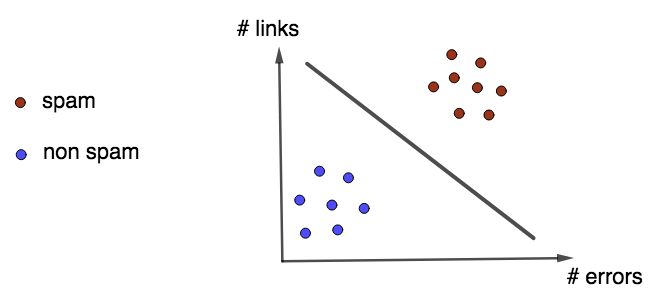
Once the model is determined, it can be applied for predicting any new email. If the number of errors and links of an email belongs to the lower region of the straight line, then it will be classified as a non-spam email, and vice versa.
Let's consider another example of building a Machine learning model for detecting some image objects like fruits.
Example 2: Fruit detection
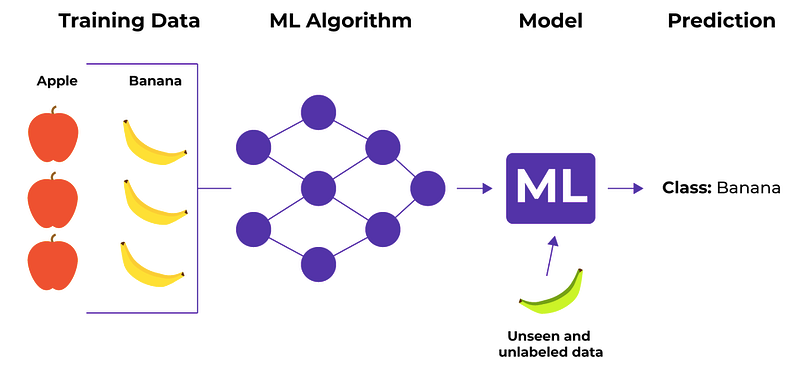
Given two types of fruits: apples and bananas with their annotations. To build a machine learning model to classify these fruits, the machine will first extract some features like color, length, and width corresponding to each object. Then, the model is trained on the training set. It learns what features are associated with each label.
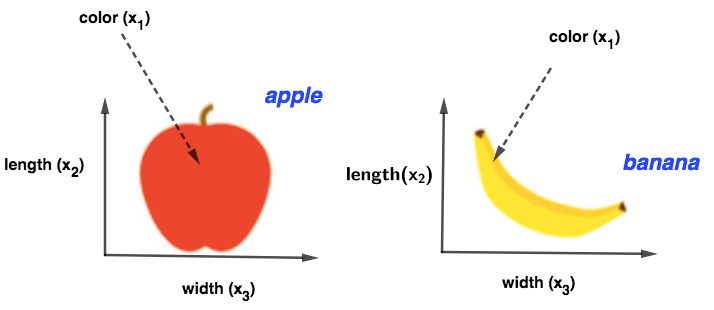
After training for the model, we can apply this model for predicting a new sample on the test set which does not have a label.
b. Regression
In the case when the variables are continuous and the target values are not finite, the Machine Learning algorithms can be applied to the regression problem.
Example: House price prediction
Given a dataset of prices of some houses in Toulouse, which is figured out in the following figure.
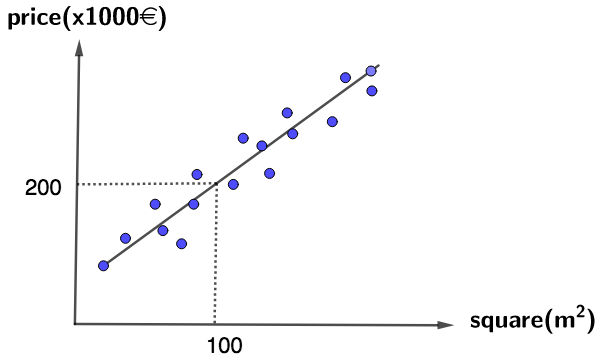
We are supposing that the relationship between the house prices and the squares is linear. We aim to build a linear model f(x) = ax+ b that best fits the data. The parameters a and b are estimated so that the following cost function is minimized:
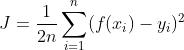
where n denotes the observation number, y_i and f(x_i) denote the true and the predicted value corresponding to the feature x_i, respectively. Once the model is built, it can be applied to predict the price of a new house that did not appear in the given training data.
Some supervised learning algorithms are used popularly as Linear regression, Logistic regression, Support vector machine, Random forest, Gradient Boosting, and Artificial neural networks. These algorithms are applied for solving various problems such as image classification, fraud detection, score prediction, …
2. Unsupervised learning
Unsupervised learning algorithms are applied in cases where the data is not labeled. This type of algorithm aims to identify the data based on their structures, densities, similar segments, and features, ….
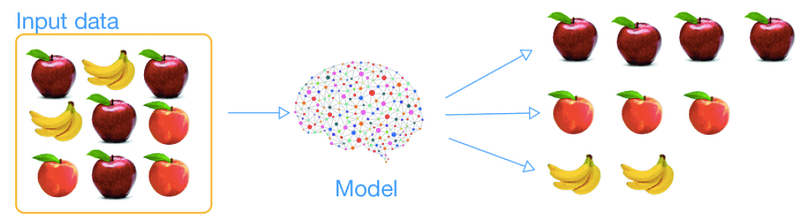
Example: Given some groups of fruits without annotations. We aim to build a machine learning model that can classify these fruits based on their colors and their shapes. All fruits which have similar color and shapes will be classified into the same group. This type of algorithm is called clustering (or cluster analysis), and it is also a popular technique in Unsupervised learning.
There are also some other unsupervised learning algorithms such as Principle component analysis, Anomaly detection, and Autoencoders, …
Unsupervised learning algorithms are used widely for solving some problems as:
- Customer segmentation for understanding the customers from different groups, to build strategies for marketing.
- Recommender systems, aim to group all the users with similar patterns to recommend similar content.
- Anomaly detection, which is applied for fraud detection.
- …
3. Reinforcement learning
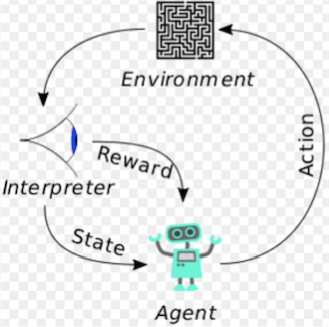
Reinforcement learning is a machine learning algorithm that allows the machine to learn through interactions with the environment and using feedback from its own actions and experiences.
Some elements of Reinforcement learning:
- The environment is the physical world that the agent operates in.
- The state describes the current situation of the agent.
- The reward is the feedback from the environment.
- The policy is the method to map the agent’s state to actions.
The following figure describes briefly how the Reinforcement learning algorithm works. An agent takes actions in an environment, which is interpreted into a reward and the state, then fed back into the agent. This procedure is repeated until the cumulative reward of the agent is maximized.
Reinforcement learning is different from Supervised learning. While supervised learning is learning from the training set and its decision is made from the initial input data, the decisions of Reinforcement learning are made sequentially, depending on the input of the current state.
Reinforcement learning is also different from Unsupervised learning. Unsupervised learning aims to find the similarities or differences between input data, the goal of Reinforcement learning is finding a suitable action model at which the cumulative reward of the agent is maximized.
Reinforcement learning is applied widely in many domains such as robotic manipulation, natural language processing, self-driving cars, industrial automation, gaming, and news recommendation, …
4. Machine learning use cases
Healthcare
- Machine learning can be applied to predict different types of diseases, such as lung cancer based on lung scan images, brain cancer, Alzheimer’s disease based on PET scan brain images, and more. These technologies analyze medical images to identify patterns and abnormalities that may indicate specific conditions.
- Since 2019, various machine learning-based research has been introduced to detect COVID-19 infections based on lung images or cough sounds. These approaches have been used to develop models that can aid in the early detection and diagnosis of COVID-19. Besides, some deep learning-based models have been developed to detect if the individuals are wearing masks or not, you can refer to this Kaggle competition (https://www.kaggle.com/datasets/andrewmvd/face-mask-detection).
- ML plays a crucial role in drug discovery by analyzing vast amounts of genetic and molecular data. These techniques help researchers identify potential drug candidates and predict their effectiveness. By leveraging machine learning algorithms, scientists can expedite the process of identifying and developing new drugs.
- Remote patient monitoring is another area where ML is being applied. This approach enables healthcare professionals to monitor patients remotely, collect relevant health data, and receive alerts in case of any abnormalities. Machine learning algorithms can analyze this data and provide insights to healthcare providers, helping them make informed decisions about patient care.
Education
- Chatbots are a popular application of Natural Language Processing (NLP), a subfield of machine learning. They are designed to simulate conversations with users, providing interactive practice and feedback. Chatbots have been widely used in the development of self-learning language applications such as Duolingo, Mondly, Andy, etc. These applications leverage chatbots to enhance language learning experiences. In recent times, the introduction of Chat GPT from OpenAI has marked a significant development of AI in general, and of NLP in particular.
- Personalized learning: Machine learning can also be employed to develop adaptive learning systems based on the student's individual needs, strengths, and weaknesses.
- Automated grading: Machine learning can be trained to automate the grading process by analyzing patterns in student responses.
Environment
- Climate prediction: Machine learning algorithms can analyze various environmental factors such as temperature, rainfall, humidity, and more from historical data to make predictions about the climate in the near future. This application helps in forecasting weather patterns and understanding climate dynamics.
- Energy optimization: Machine learning can be utilized to analyze historical energy consumption patterns along with relevant factors like weather conditions, equipment usage, building size, occupancy rates, and more. By leveraging this data, machine learning models can predict future energy consumption, enabling better energy management, optimizing energy usage, and facilitating efficient energy distribution. This approach promotes the balance between energy supply and demand while reducing wastage.
- Environmental monitoring: Machine learning techniques can be employed to analyze satellite imagery and detect changes in ecosystems, wildlife habitats, pollution levels, and other environmental parameters. By automating the analysis of large-scale data, machine learning assists in monitoring environmental changes, assessing the impact of human activities, and aiding in conservation efforts.
Transport
- Autonomous vehicles: Autonomous vehicles are a prominent application of machine learning. They are developed by leveraging various machine learning methods, including object detection, perception, scene understanding, path planning, decision-making, etc. These technologies enable vehicles to navigate and operate in a self-driving manner, using machine learning algorithms to analyze sensor data and make real-time decisions.
- Traffic management: Machine learning is employed to analyze data from diverse sources such as traffic cameras, GPS, and sensors to predict traffic patterns and optimize signal timing. By understanding traffic flow, machine learning models can suggest alternate routes to minimize travel time and improve overall traffic efficiency. Additionally, machine learning can be used to detect vehicles that are speeding or running red lights, enhancing safety and enforcing traffic regulations.
Besides, the applications of machine learning in many other domains such as banking, production and business activities, politics, etc
In conclusion, this blog provides a brief introduction to machine learning algorithms and highlights their diverse range of applications in different domains. In the upcoming blogs, we will delve into different machine learning and deep learning models.
Thanks for your reading!


