
Introduction to Genetic Algorithms — Including Example Code
A genetic algorithm is a search heuristic that is inspired by Charles Darwin’s theory of natural evolution. This algorithm reflects the process of natural selection where the fittest individuals are selected for reproduction in order to produce offspring of the next generation.
Notion of Natural Selection
The process of natural selection starts with the selection of fittest individuals from a population. They produce offspring which inherit the characteristics of the parents and will be added to the next generation. If parents have better fitness, their offspring will be better than parents and have a better chance at surviving. This process keeps on iterating and at the end, a generation with the fittest individuals will be found.
This notion can be applied for a search problem. We consider a set of solutions for a problem and select the set of best ones out of them.
Five phases are considered in a genetic algorithm.
- Initial population
- Fitness function
- Selection
- Crossover
- Mutation
Initial Population
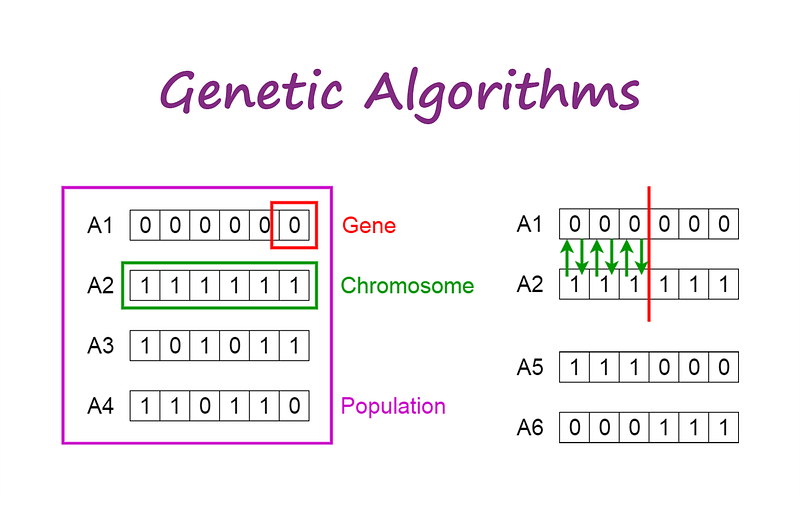
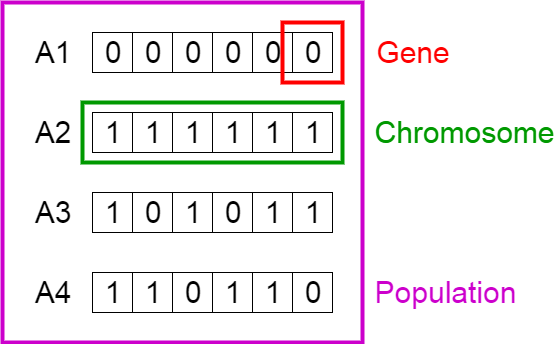
The process begins with a set of individuals which is called a Population. Each individual is a solution to the problem you want to solve.
An individual is characterized by a set of parameters (variables) known as Genes. Genes are joined into a string to form a Chromosome (solution).
In a genetic algorithm, the set of genes of an individual is represented using a string, in terms of an alphabet. Usually, binary values are used (string of 1s and 0s). We say that we encode the genes in a chromosome.
Fitness Function
The fitness function determines how fit an individual is (the ability of an individual to compete with other individuals). It gives a fitness score to each individual. The probability that an individual will be selected for reproduction is based on its fitness score.
Selection
The idea of selection phase is to select the fittest individuals and let them pass their genes to the next generation.
Two pairs of individuals (parents) are selected based on their fitness scores. Individuals with high fitness have more chance to be selected for reproduction.
Crossover
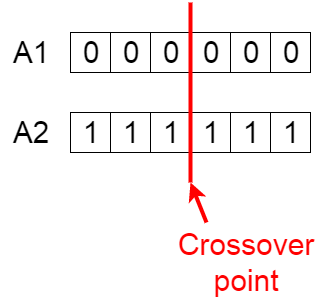
Crossover is the most significant phase in a genetic algorithm. For each pair of parents to be mated, a crossover point is chosen at random from within the genes.
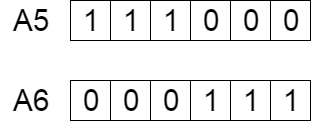
For example, consider the crossover point to be 3 as shown below.
Offspring are created by exchanging the genes of parents among themselves until the crossover point is reached.
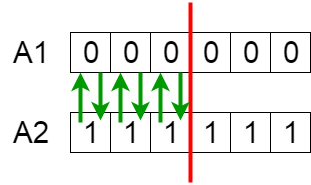
The new offspring are added to the population.
Mutation
In certain new offspring formed, some of their genes can be subjected to a mutation with a low random probability. This implies that some of the bits in the bit string can be flipped.
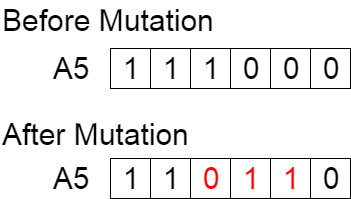
Mutation occurs to maintain diversity within the population and prevent premature convergence.
Termination
The algorithm terminates if the population has converged (does not produce offspring which are significantly different from the previous generation). Then it is said that the genetic algorithm has provided a set of solutions to our problem.
Comments
The population has a fixed size. As new generations are formed, individuals with least fitness die, providing space for new offspring.
The sequence of phases is repeated to produce individuals in each new generation which are better than the previous generation.
Pseudocode
START
Generate the initial population
Compute fitness
REPEAT
    Selection
    Crossover
    Mutation
    Compute fitness
UNTIL population has converged
STOP
Example Implementation in Java
Given below is an example implementation of a genetic algorithm in Java. Feel free to play around with the code.
Given a set of 5 genes, each gene can hold one of the binary values 0 and 1.
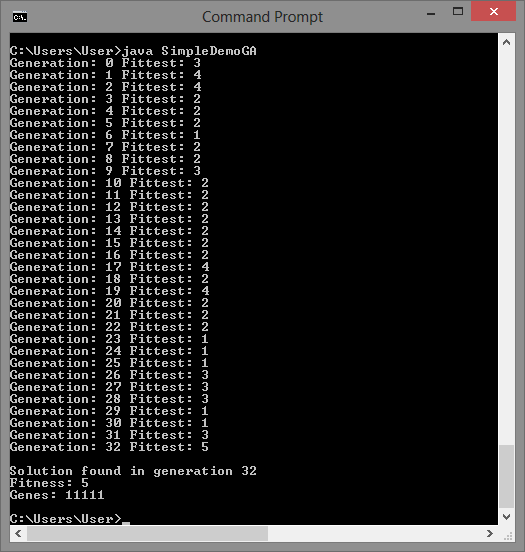
The fitness value is calculated as the number of 1s present in the genome. If there are five 1s, then it is having maximum fitness. If there are no 1s, then it has the minimum fitness.
This genetic algorithm tries to maximize the fitness function to provide a population consisting of the fittest individual, i.e. individuals with five 1s.
Note: In this example, after crossover and mutation, the least fit individual is replaced from the new fittest offspring.
Edit
Check out this awesome implementation of genetic algorithms with visualizations of the gene pool in each generation at https://github.com/memento/GeneticAlgorithm by mem ento.
Thank you very much mem ento for sharing this repo with me and letting me add the link to the article.


