
Good Will Toward Men: Introduction
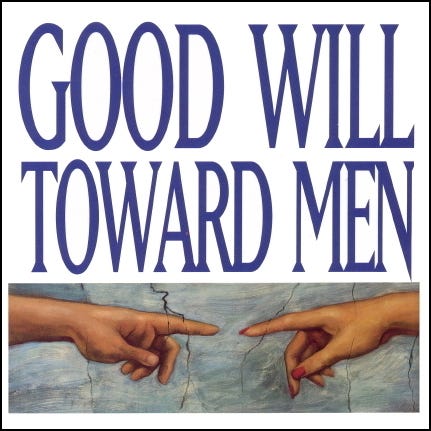
Sometimes I think things have changed a lot between women and men since 1994 and I feel hope. Sometimes I think they haven’t changed much at all or have actually gotten worse and I am left with the sad feeling that the most intractable sexism of all is the idea that sexism harms only one sex.
Introduction
The purpose of Good Will Toward Men is to help defuse tensions be-tween women and men. I will be happy if readers derive insights that assist them in finding and fostering healthy romance, but I will be infinitely more fulfilled if it can help correct some of our nation’s mon-strous social maladies — the fragility of its families, the twisted views of manhood and womanhood our children are learning, the seething psychosexual anger and cynicism that is sapping our American optimism, joy, confidence and vigor.
America’s most intractable social problems, commonly ascribed to racism and economic disadvantage, may in fact also be based on other forms of prejudice and impoverishment. It seems quite clear that many of the men who are packing our prisons, who arrived there after wreaking violence, mayhem, pain and social discord, did not end up in jail because they, as men, “have all the power.” It seems instead that in a society that tells them they are nothing unless they have power — power very narrowly defined in economic and political terms — they either (1) attempted to steal, counterfeit or otherwise fake some or, (2) exploded with the frustration of having none even while being told they “have it all.” Clearly, something in addition to racism and economic hardship is at work in the problems of men in the underclass. Their problems affect us all.
I believe we can trace the woeful decline in American society back to the 1960s, and in large part to the ascendancy of the notion that men, especially in family life, are disposable at best, and the embodiment of all that is harmful at worst.
For thirty years we’ve heard an articulation of male-female issues primarily from a female point of view. Feminism is dominating the gender issues agenda by demanding and achieving wide consideration of such questions as “who has better jobs?” “who earns more money?” “how can we make men pay more child support?” and “who is in Congress?” The recent book Women Respond to the Men’s Movement clearly demonstrates modern feminism’s reluctance to expand the inquiry to include other questions, such as “who lives happier, richer, warmer, more connected, more fulfilling lives?” “what is power, anyway?” “don’t children need anything from their fathers other than money?” and “why is no one in Congress willing and able to see and address the problems facing men?” When I read Women Respond to the Men’s Movement, the title of another neo-feminist volume — Backlash — came ironically to mind.
To achieve better understanding and cooperation, to promote love and respect between women and men, we must disabuse ourselves of the notion that women are the only gender with valid items for the agenda, and that men constitute the only sex that has advantages to share. An image that often pops into my head is of women and men sitting across from each other at a negotiating table. The females are pointing at the males and saying “You do this wrong, you do this wrong, and you do this wrong. And to correct it you need to give us this, give us this and give us this.” Men are crossing their arms and turning away. “Okay, what’s in it for us?” is the natural and healthy question that seems never to have been answered, primarily because men have never thought or felt free to ask it.
Besides, men are largely unable even to articulate what it is that they would like to have coming their way across the negotiating table. Women’s domination of the public discussion of gender issues has made it nearly impossible for men — individually or collectively — to consider their needs. Men do not address the fact that they commit suicide four times more often than women, that men die seven years younger than women, that men are more likely to be alcoholic and abusive of drugs, that men often don’t know their kids, that men’s lives often are empty, mechanical and cold.
But men know deep in their hearts that one of the greatest shams ever concocted is the notion that by virtue of their gender they enjoy lives of power and privilege while women live lives of unmitigated degradation and oppression.
Notice that a few paragraphs ago I said, “For thirty years we’ve heard an articulation of male-female issues primarily from a female point of view.” I did not say “feminist point of view.” The feminist perspective is not the only female outlook that holds great sway in America. Feminists and conservative women like Phyllis Schlafly may think of each other as enemies, but they both focus on women’s wants and needs. The conservative women’s agenda, because it is supported by the status quo, is stated not as questions, challenges or demands, but as calm assertions of immutable fact. We often hear conservative women state with equanimity that “women’s essential nature is to nurture” and “women instinctively know what is best for children and families” and “men were put on this earth to be good providers.” Curiously, feminism, pursuing its unacknowledged backlash against men’s incipient inquiry into their situation, seems to be re-embracing the prerogatives of motherhood and the exclusively economic focus on fatherhood, especially where divorce forces the questions of fairness, equality and the proper roles of men and women. This alignment of conservatism and feminism has left little room for people of progressive mind on issues of gender. We must carve out new territory in which men’s concerns — such as the ones discussed in this book — can be given due consideration.
Why, you might ask, must women be involved in initiating this pro-cess? If men really need a change, why don’t they just make it happen? The answer lies in a paradox. It could plausibly be argued — and it is, in fact, often said — that the reason only a few men are speaking up on the issues of their gender is that most men feel there is nothing to say, there are no problems. The premise of this book, however, is that the reason most men are not speaking up is precisely because there is so much to talk about. One of the things that most needs to be talked about is what keeps men from talking.
We would recognize the folly of mistaking a maximum security prison for a country club: “Nobody is leaving. It must be awfully nice in there.” Men, I would submit, are in the most maximum security prison of all, the prison that convinces its inmates that they are right where they want to be, that they are perfectly and enviably positioned to achieve all the success they want, that as economic providers they are admired, loved and appreciated, and that if they ever begin to think otherwise, they must have a “personal” problem to be denied and buried in shame.
The oft-stated notion that women’s work is undervalued has a corollary: men’s work is overvalued. Society’s ancient, single-minded focus on survival and efficiency viewed men’s difficult and lonely struggles on the front lines of production, protection and competition as absolutely essential. Perhaps because men’s traditional work is often inherently stressful and unrewarding in any spiritual or emotional sense, society must rely on customs and mores to rigorously enforce and persuasively induce men’s attendance to their narrow range of du-ties. Words like “failure” and “loser” suggest the power of enforcement. “Money” concisely names the inducement.
On the other hand, perhaps women’s traditional work of tending the home fire with the children is seen as inherently attractive and re-warding. Perhaps society is less in need of endowing it with artificial “value” to induce women to perform it, and is less insistent that women “prove” their womanhood by submitting to it. Perhaps society is less apprehensive about women experimenting with alternatives to “women’s work” than it is about men exploring different ways of being “manly.” Perhaps that is why women have been freer than men to talk about “choices” and have been able to achieve the widespread expan-sion of their gender roles we have seen in the past thirty years.
The question now is: what will women do with their ever-growing freedom? I am optimistic that women of good will, once they see the “male bastion” for what it is, will toss men the key: “Hey, snap out of it! That’s no country club you’re in. We’ll still love you if you leave it. We’ll adjust. We want our men to be alive and free.” But to the extent that women harbor doubts that they really want men to unlock their lives, to the extent that men perceive that women love them for stay-ing where they are and doing what they do, men are unlikely to be convinced that freedom and options will bring them happiness. We need assurance that we can venture forth without losing women’s love and acceptance.
Another reason women must be involved in the discussion of men’s gender-based social concerns is that in discussions of sexism, men are the suspect class; we have been effectively defined as the enemies of gender justice. The women in Good Will Toward Men are helping to pro-vide credibility for a new male-friendly agenda, and are suggesting actions and attitudinal changes that will make a real difference in relationships between women and men.
While reading this book, you might feel like a fly on the wall, eaves-dropping on conversations about some of the most complex, con-founding, fascinating, emotional and crucial issues facing women and men, indeed, all of American society today. If so, you might feel like a fly with opinions, experiences, attitudes and insights of your own. You might find yourself saying, “Wait, but what about…” and “Don’t say that! Say this.”
I find myself thinking the same things every time I look through the book. The interplay of gender issues between women and men generates an almost infinite network of thoughts, associations and lines of reasoning. None of these conversations would happen the same way twice.
If you adhere to feminism as “the pursuit of more rights for women,” rather than “the pursuit of equal rights between the sexes,” you will find this an exceedingly difficult book to stay with. I ask you please to resist saying, “Yes, but what about [a problem women face]…” and to devote your attention at least momentarily to the problems men endure. This book’s purpose is not to be in and of itself a balanced discussion of sexism; its purpose is to redress a much larger — societal — imbalance on that terribly complex subject. Few of this book’s 78,000 words are devoted to restating the very real problems of sexism against women, about which millions upon millions of words have been written. No one connected to this book denies or has for-gotten the existence of sexism against women. We are attempting only to understand and demonstrate that sexism is a reciprocating engine.
The women who participated in the creation of Good Will Toward Men are heroes to me. I am grateful for their courage and magnanimity.
I owe it to them to make it perfectly clear that they have participated independently. Only one of the women knew the content of the conversations I had with any of the others, and she knew of only three. Any reader who is of a mind to criticize certain portions of this book should let his or her criticism be focused. The only idea we know with certainty that these women hold in common is a desire to find new approaches to old problems between women and men.
Each woman in the book had the right to approve the final version of her chapter. But rather than edit these dialogues extensively — a process that could go on forever — we cleared up the syntax a little, rearranged a few sections, and let them go, even if some of the things we said or the ways we said them surprised even us. The dialogues are intended as food for thought, as starting points rather than as academically rigorous expositions or the final word on any topic.
About me, you should understand that I have long had an abiding interest in what are described in shorthand as “men’s issues.” My first conscious effort in the field was In a Man’s Shoes, a radio talk show I started on the station at Towson State University near Baltimore, in 1983. In retrospect, I know that I’ve been concerned about sexism against males for a long, long time. I always knew, for instance, that there was something not quite flattering in the “compliment” I often heard in my youth: “You’re really good with babies — for a boy.”
Since developing a conscious awareness of the effects of sexism on men, I had a sixteen-month stint as the executive director of the National Congress for Men (now the National Congress for Men and Children), an organization dedicated to “preserving the promise of fatherhood” after divorce. Though never married and not a father, I understood intuitively that parenting was a central issue for men, in much the same way that earning money was crucial to women. As executive director of the National Congress for Men, I could feel the pain of childless fathers — and dealt firsthand with the anger their pain can generate.
I also developed a part-time career as a free-lance writer “specializing in gender-based social problems.” And, in 1991, a few friends and I established the Greater Baltimore Commission for Men, a nongovernmental body whose purpose was “to bring awareness of male gender issues to social policy-making, and to raise public awareness of the existence and consequences of anti-male bias and stereotyping of men and boys.” The support we had hoped to elicit for GBCM never materialized, and we disbanded fifteen months later.
With this background, I interviewed the women in this book not as a disinterested observer, but as a person whose feeling for the social significance of men’s issues is deep.
I hope this book will help convince men that it is okay to talk to women across the sometimes fiery gulf between the sexes, that women of good will can listen open-mindedly, and that we can reverse the vicious cycle of injury, accusation and noncommunication women and men are in today.
I hope this book will encourage women of good will to become more vocal in their conversations with other women who are trapped in the old mentality of concentrating only on their half of the gender dynamic.
I hope this book will provide impetus to American men to expand the process of talking among themselves about the predicament of their gender. Strengthening the culture, pride, and ethos of healthy masculinity is crucial to the healing of our nation.
Prologue
One day a few years ago, I was talking about gender issues with a friend of mine. “Did you ever notice,” he asked, “that we have the word misogyny to denote anger at women, but we don’t have a word — except misandry, which no one knows or uses — for anger at men?”
“Yes, I have,” I answered. “Isn’t that something?”
“It sure is,” he responded. “It just proves that in this man’s world, being angry at men is simply not allowed.”
Surprised, I said, “Gosh, I came to an entirely different conclusion.”
“How could you possibly come to a different conclusion?” he asked. “It’s obvious.”
“Well,” I began, “what’s the word for crossing the street against a light or in the middle of a block?”
“That’s jaywalking,” he answered.
“And what’s the word for crossing the street at an intersection with a green light?”
“There isn’t any word for that. It’s just called crossing the street.”
“And so maybe,” I suggested, “the reason we have a word to spotlight anger at women is because we want to punish and discourage it, and the reason we don’t have a word for anger at men is because, like crossing the street with a green light, it has complete social sanction.”
My friend had no response — other than to insist that surely I must be wrong.

I publish frequently. To never miss a story, ask Medium to notify you by email when there’s something new.

I am serializing my 1994 book Good Will Toward Men for free. It’s a collection of interviews with twenty-two women about making gender equality a two-way street. Check out the chapter list.


