
Introducing myself to 80’s Asian Cinema
This quarantine bring me another place to look up: the cinema, especially the Asian
This last month I start a cycle of learning about cinema, emphasized in the Asian industry, especially the culture of Taiwan, China, Japan, and Vietnam.
I understood now all that I invested in Hollywood consumption, it is so dirt to our standpoint as the audience.
My classes have been taught by Krinegrafo, under Yoshua Oviedo leading. It is very enthusiastic to me, forming part of these cycles. I just consider myself as a “cult movie fan”, but does not know about planes, times, photography appreciation and others. And of course, less of Asian cinema.
Living in Latin America, made us stay far away from these movies. I’m not sure, but it is probably after the Oscar-Winning by Parasite (2019) created by the South Korean director Boon Joon Ho, the looking of Asian Cinema is going to level up in our continent America (hope so!).
I’m not an expert, but I’m in love with
As long I learn about cinema, I know how big are the appreciations that we can found around the technical criteria of the movies. The variable of time and culture is very important to consider the specific compose of every movie, dialogues, and cameras.
I’m not an expert, but I know the basics, and this is not an introduction to a technical basis; it is more how much good are the Asian cinema for dummies. And like when you’re learning something new, and suddenly, you want to share it with a friend or followers, this is what I mean with this blog posts. In this same way, I found a match with this kind of movie; I’m pretty in love with the topics, the prosaic view, and the understanding of how the movies are composed.
It is easy to get engaged with this kind of cinema, but you have to give time to your perspective and try not to expect that Asian cinema is so accelerated, as Hollywood cinema does.
Explanations of the Asian movies (80's)
Following the ‘speed of the movie’, the Asian movies have a very interesting and slow system of motion. The camera moves according to the characters’ view and you can find diversity between each other directors. Some have a very special focus on architecture, others into the distance between characters to study emotional expression, etc.
I wondering that the most interesting thing is the change in the perspective of this understanding from Western cinemas: not fast, slowly. And this is not just, a technical resource. It is also a political position against the commercial and fast point of consumption for the audience.
This keeps slow in Asian cinema, allow us to understand very well the understanding of each character. Not just the dialogue, even we can understand the contradictions between them, the confusion. Expressions that we can just see, taking a moment to see the relation with existential-emotion, and existential-space.
Another of the aspects that I found very interesting, is the camera games that we can found as an explained realism. We can found a market full of people, where many of them are just walking around, or selling their stuff; meanwhile, the characters are inhabited with the normal symbiotic of the space. This aspect, opens a gate to understand better the idea of human drama.
Finally, I found very especial how historical are the movies, and how important it takes the political history in the narrative of worrying in each character. If you don’t know very well about the eastern history, you’re going to learn very well, about the meaning of every event in the history of them.
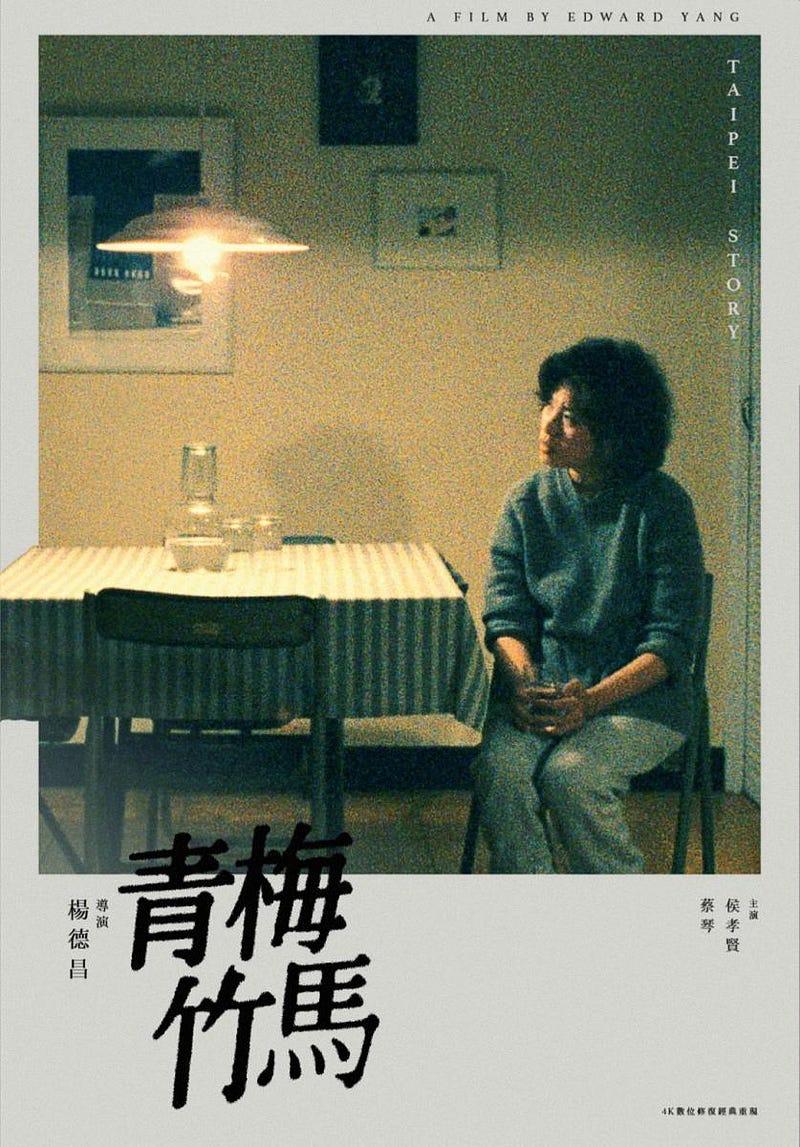
Where to start: Taipei Story (1982)
Taipei Story (1982) is a movie directed by Edward Yang, and you can find in this plot, a very close story of couple themes. It tells the story of Lung (Hou Hsiao Hsien acting, another very famous director), an former baseball player of Taiwan, who returns to his country from America, and has to help his father with his cloth store. It is interesting because the main character is no Lung, is Chin. Women who work at the office and found love in Lung. They try to hang on their relationship, but the first love -very present in Yang movies-, keeps on and start opening a distance between them.
The city, the love, and the genre mandate of their time creates a very interesting film. The camera is marvelous, if you love pictures, you’re gonna find it very pleasant to see each camera plane, very interesting.
If you want to see it, found the recovered movie, with colors, it is better to enjoy it for sure.
Another movie that I recommend is a City of Saddness (1989), released four years after Yang’s movie. It is considered his masterpiece, and you cand find a complete movie with history, politics, the complexity of social military in Taiwan, and very emotional movie. A picture of their epoch.