
Introducing Metra — Not Just a Railroad — Actually Epic Results
Metra, Chicago Transit Authority (CTA), and Pace — Chicago Empowers People — Fantastic Focus — Article One of a Five-Article Series
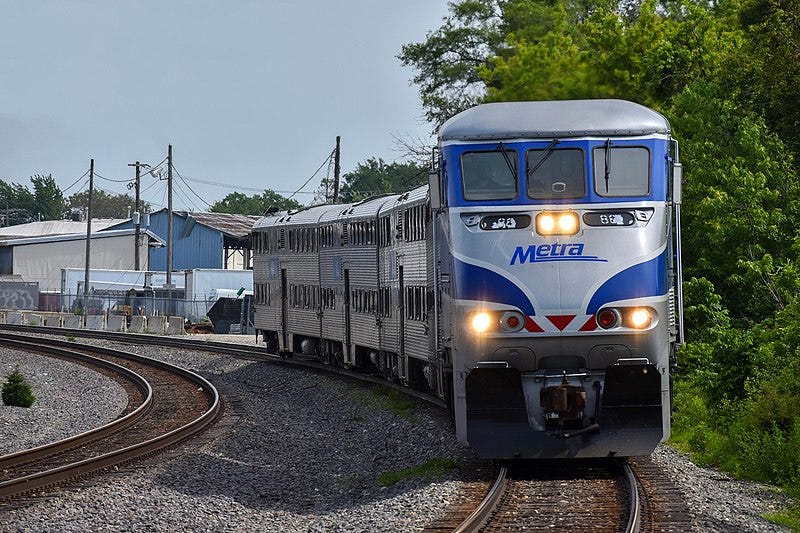

Introduction to Metra
I want to tell you about a commuter rail system in the Chicago Metropolitan area. I will include five articles on Metra in this series. In article one, we will examine an introduction to Metra, Metra, Chicago commuter rail, the formation of the Rural Transit Assistance (RTA), Metra branding, growth and expansion, corruption, under-funding, and stations.
Metra System
This system serves the city of Chicago and its suburbs on the Union Pacific, BNSF, and other railroads. The system comprises 242 stations and 11 rail lines.
It is the most extensive system outside the New York metropolitan area and the fourth busiest in the nation. The Chief Executive is James M. Derwinski. The headquarters is at 547 W. Jackson Blvd. Chicago, Ill 60661. The company website is metra.com.
Ridership on this system is high; in 2022, it had almost 24 million riders, making the day-to-day count about 141 thousand. The system’s busiest day was November 4, 2016, when the city held a victory event for the Chicago Cubs in honor of the team winning the World Series.
The original Metra was the descendent of numerous commuter rail services dating back to the 1850s. The current system goes back to 1974 when the Illinois General Assembly set up the Regional Transportation Authority (RTA). The RTA consolidated public transit operations, including commute rail in the Chicago area.
The reason for creating the RTA was the anticipated failure of commuter service operated by various private railroad companies in the 1970s. In 1983, RTA established a Commuter Rail Division and placed commuter rail under it. The Division began working in 1984 and branded itself Metra in 1985. The track is a standard gauge rail (4 feet + 81/2 inches), and the length of the system is 487.5 miles.
Metra still has freight rail operating on its routes. Metra owns all rolling stock and is responsible for all stations along with the respective cities. Since it started, Metra has directed more than $5 billion into the commuter rail system of the Chicago metropolitan area with the Chicago Transit Authority (CTA). Metra has rolled out a new real-time train tracking system website that allows passengers more visibility in their commute.
History
Chicago commuter rail
Chicago has been a central Midwestern hub in the North American rail network since the city’s founding in the 19th century. It has more rail running in more directions than any other city in North America. Chicago became a center for building freight cars, passenger cars, and diesel locomotives. The first commuter services included the Chicago, Burlington, Quincy, Chicago and North Western, and Milwaukee Road.
Chicago had the world’s most extensive public transportation system by the 1930s. Commuter rail services started to decline. By the mid-1970s, the commuter lines faced an uncertain future.
Some railroads had been losing money for several years and used trainsets with passenger cars dating back to the 1920s. Burlington Northern, Milwaukee Road, Chicago, North Western, and Illinois Central were all in this tenuous position.
Formation of the RTA
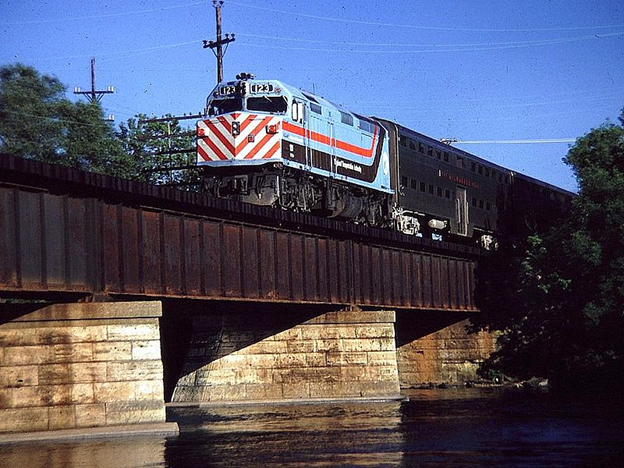
RTA began by using second-hand equipment. Then, it delivered its first new EMD F40PH locomotives in 1976. This fleet is still in service today. The companies that had provided commuter rail in the Chicago area continued to operate under contract to the RTA.
.jpg)
RTA experienced financial problems within a decade of being formed. Two rail providers, the Rock Island Line and the Milwaukee Road Line, went bankrupt. RTA operated the Northeast Illinois Regional Commuter Railroad Corporation.
In 1982, this corporation worked those lines directly. In 1983, the Illinois Legislature reorganized the RTA. When this occurred, the RTA ran the day-to-day operations of all bus, heavy rail, and commuter rail services throughout the Chicago metropolitan area.
RTA is responsible for directing fare and service levels, setting up budgets, and finding sources for capital investment and planning. RTA created a new Commuter Rail Division and Chicago Transit Authority (CTA) and Pace to handle commuter rail operations. CTA is the operator of mass transit in Chicago and some of its suburbs, and it is an independent governmental agency supported by RTA.
CTA service connects with Metra, the suburban bus, and the paratransit service, Pace. Pace is the suburban and regional paratransit division of RTA. It was created in 1983 by the RTA Act. RTA merged bus services in the Chicago suburbs under the Suburban Bus Division, later rebranded as Pace. The RTA is the financial oversight body for the three agencies, CTA, Metra, and Pace.
Metra branding
To simplify the commuter rail system operation in the Chicago area, the RTA Commuter Rail Division adopted a unified brand for the entire system–Metra or Metropolitan Rail. The Metra service helped bring a single identity to the many infrastructure components the Regional Transportation Authority’s commuter rail system serviced. However, the system is still known as the Commuter Rail Division of the RTA.
The Northeast Illinois Regional Commuter Railroad Corporation (the operating arm of Metra) operates seven Metra-owned routes. Union Pacific and BNSF operate four other routes under contract to Metra. The Metra name designates all services provided.
Metra owns all rolling stock, controls fares and staffing levels, and is responsible for most stations. Freight carriers that operate routes under contract use their employees and maintain the right-of-way for those routes.
Union Pacific will transfer operations of its three lines to Metra by the first quarter of 2024. The Union Pacific will continue to own and maintain the right-of-way.
Growth and expansion
Metra had record ridership and expanded its services in the late 20th century and the start of the 21st century. A new line from Union Station to Antioch, titled the North Central Service, was begun by Metra in 1996. Metra added new intermediate stops on this line by 2006.
Union Pacific extended the Union Pacific West Line from Geneva to Elburn. Metra stretched the South West Service from Orland Park to Manhattan. Metra boasted a 95.8% average on-time performance in 2012.
Metra measured on-time performance for a train’s arrival at its last station no more than six minutes late. Metra posted its fourth-highest volume despite decreased employment opportunities in downtown Chicago.
Metra has invested over $5 billion in infrastructure over the past three decades. That investment included purchasing new rolling stock, building new stations, renovating tracks, modernizing signal systems, and upgrading support facilities. Metra improved the Union Pacific Northwest and Union Pacific West Lines.
Metra also planned two new Metra routes, the SouthEast Service and the Suburban Transit Access Route (“STAR” Line). In 2023, Metra announced plans to extend the Milwaukee District West Line to Rockford, Illinois, with intermediate stops at Huntley and Belvidere by 2027.
Corruption
Allegations and investigations of corruption have marred Metra’s reputation. In April 2002, board member Don Udstuen resigned from Metra and his executive job with the Illinois State Medical Society. He admitted taking bribes to steer Metra contracts to firms associated with Roger Stanley, a former legislator who pled guilty to his part in Illinois’s Operation Safe Road scandal.
Metra’s executive director, Phil Pagano, faced investigation for taking an unauthorized $56,000 bonus and was later found receiving improper payment of $475,000 in vacation pay. The agency’s board scheduled to discuss his fate. The same day, Pagano stepped in front of a moving Metra train in an apparent suicide.
Around the time of Pagano’s death, allegations also surfaced that a Metra employee demanded a $2,000 payoff from the studio that used Metra in the 2011 film Source Code. That employee was later relieved of his duties and retired.
In June 2013, Metra CEO Alex Clifford resigned with no public comment. The Metra board demanded his exit and worked a severance package of $871,000. A non-disclosure statement was part of the package.
He rejected requests for patronage hiring and promotion, including a request to promote a longtime supporter of State Representative Michael Madigano. The company was rumored to have arranged Clifford’s ouster. At about this same time, five board members resigned.
In August 2013, the remaining board members elected Don Orseno as interim CEO. (The board had reduced membership to six members because of board members resigning. Because the membership was so few, the board needed more authority to elect a permanent CEO.
Two men, Orseno and Alex Wiggins, shared duties as co-executive directors.) Orseno’s long railroad career began with work setting up trains and checking doors for the Chicago, Rock Island, and Pacific Railroad. His experience was favorable in the board’s decision.
By October 2013, local officials had restored Metra’s board to 11 members. After reviewing four candidates, the re-constituted board appointed Orseno CEO of Metra in January 2014. The Metra board found a lengthy history of political patronage at Metra in 2014.
Underfunding
For some time, Metra was underfunded and needed help to keep most equipment and rolling stock up to date. Metra claims to require $2 billion per year to keep rolling stock rebuilds current. Metra received about $700 million per year in its budget.
Because of this extreme funding shortfall, Metra had to cut back on new rolling stock. They revitalized their Rebuild Programs. They rebuilt railcars and locomotives with more unique state-of-the-art utilities.
Rebuilds cost a fraction of buying new rolling stock, such as with their Amerail-built cars. Rebuild programs can rebuild aging cars for about $650,000, whereas buying that same railcar new would be about $3 million.”
Operations
Stations
Apart from a route or branch terminus, each station provides travel toward (inbound) and away from (outbound) downtown Chicago. Using Metra service, a passenger can connect between the city and a suburb or between two points in the suburbs. Metra’s commuter rail system connects points all over the Chicago metropolitan area, providing some intracity connections within Chicago.
Conclusion
This article is at its end. This article examined an introduction to Metra, Chicago commuter rail, the formation of the RTA, Metra branding, growth and expansion, corruption, underfunding, and stations.