
Introducing Forest 1.0
Today, I’m extremely excited to announce the public beta availability of Forest 1.0, the world’s first full-stack programming and execution environment for quantum/classical computing. You can use Forest to develop algorithms for quantum/classical hybrid computing, and you can use it to learn how quantum computers and algorithms really work. You can simulate those algorithms on up to 30 qubits using our Quantum Virtual Machine, or QVM™, running in the cloud. And you can interact with real quantum chips using simple function calls that execute on an active system.
Rigetti Computing is a full-stack quantum computing company, and Forest is a full-stack product. So I’d like to highlight some of the key technical milestones that underpin Forest at both the hardware and software level.
Fab-1
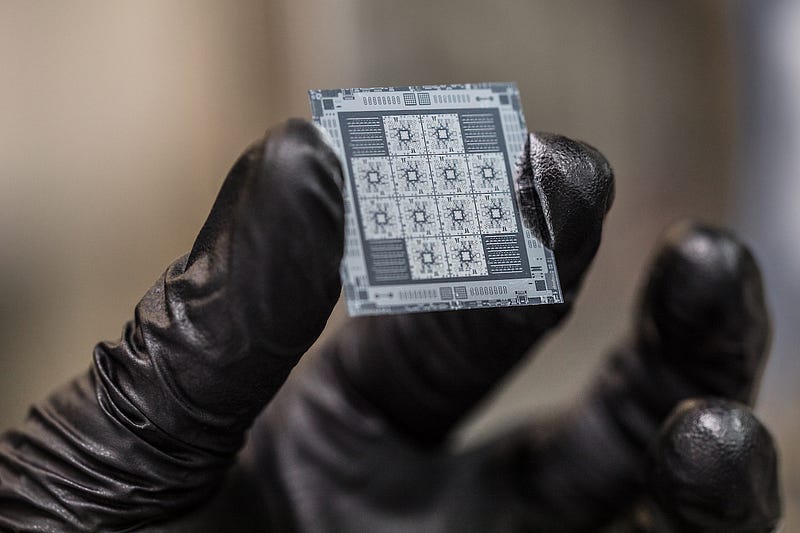
We’ve developed a highly coherent and scalable quantum integrated circuit architecture. Two key ingredients are a new fab process for superconducting through-silicon vias, and a low-temperature bonding process for 3D integration.
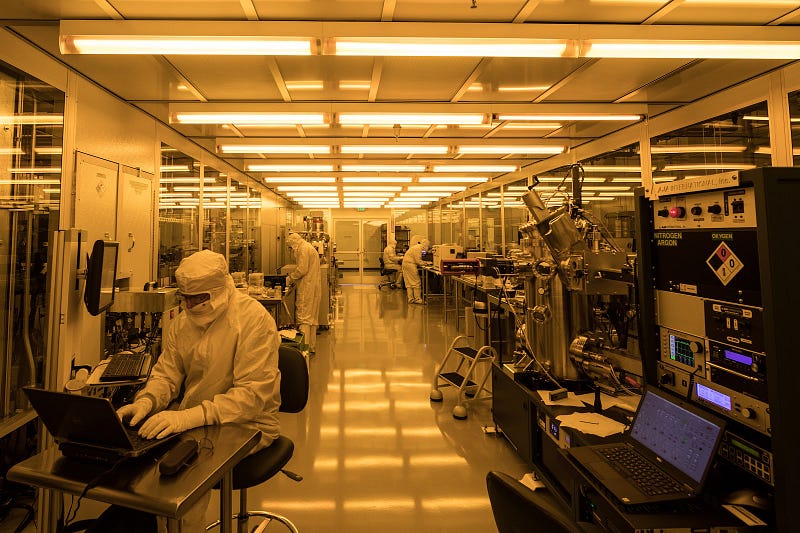
To further accelerate our progress in design and manufacturing capabilities, about a year ago we decided to make a strategic investment to build the world’s first commercial quantum integrated circuit fab, called Fab-1. Today, we are officially marking the opening of this new facility (see photo below).
Fab-1 is based on the latest semiconductor processing tools and technology, but, unlike traditional fabs, operates in rapid-iteration mode. Today, we can produce an entirely new design for a 3D integrated quantum circuit in about 2 weeks. Because of the exponential value of iteration cycles in the development of any complex technology, I expect Fab-1 to be a key driver and strategic advantage in our march towards ever greater processing power (more qubits, faster gate times) and performance (longer coherence times, lower error rates, greater connectivity) from quantum chips over the coming years.
Nagesh Vodrahalli has joined the company in the role of VP of Process Technology, leading Fab-1 and our overall fab strategy. Nagesh brings decades of executive and technology leadership in advanced semiconductor manufacturing and 3D integration, including time at Intel, HP, and Altera.
New Two-Qubit Gates
We’ve developed and demonstrated a new two-qubit gate scheme based on direct parametric modulation of qubit frequencies. This gate scheme can be faster and more selective than previous methods, making it better suited for scaled-up chips with many qubits. Details are available in 3 papers describing the theory and experimental implementations on 2-qubit and 8-qubit processors. A software upgrade to Forest to unlock this functionality will be available later this year.
Characterizing the performance of quantum chips is a complex and subtle process. To ensure that we are using the most rigorous and efficient characterization routines — and that those routines are adapted or extended to practical, cutting edge hardware — we have entered into a collaboration with the Quantum Characterization, Verification, and Validation (QCVV) team at Sandia National Labs. The team, led by Robin Blume-Kohout, is one of the leading independent groups in the world in QCVV. The collaboration is underway, and we expect initial results this year.
We are excited to announce the addition of two leading quantum computing researchers. Marcus da Silva has joined the company, managing our device design and theory team, and Colm Ryan has joined our quantum engineering team.

Software and Applications
Forest is built on top of Quil™, the first instruction language for hybrid quantum/classical computing. Hybrid quantum/classical algorithms take advantage of the best aspects of a classical computer and a quantum computer simultaneously. Classical computers are best at rote sequences of arithmetic, while quantum computers are best at manipulating extremely large ensembles of information at once.
Quil is an open and portable instruction set, using a shared memory model that is optimized for near-term algorithms and hardware. Forest 1.0 includes pyQuil, a set of open-source python tools for building and running Quil programs. You can see more about how Quil and pyQuil work in this video.
To help illustrate how quantum computers might one day be used to solve problems that are currently impossible, we have built an interactive demo showing how an example algorithm, the Quantum Approximate Optimization Algorithm, uses quantum mechanics to find optimization-based solutions to NP-hard problem types, such as MAX-CUT.
Developing quantum computing software is one of the most fascinating and challenging emerging fields of engineering. Today, that field is at the foundational stage, where learning and discovery are at a premium. Our full-stack strategy allows us to run faster, more tightly coupled iteration cycles between hardware, software, and applications.
Jeff Cordova has joined the company as VP of Software Engineering to lead the development of our quantum operating system and quantum cloud services infrastructure.
What’s Next?
Products are built by systems of people functioning together as a team. Existing companies, when faced with profound technological change, must adapt an existing machine to produce a new kind of work output. Startups have the opportunity and imperative to build a fundamentally new kind of machine to produce that new work output.
Rigetti Computing is a new kind of machine, and Forest 1.0 is an example of its work output. We are centered around rapid iteration design-fab-test cycles, powered by incredible scientists and engineers that further build and refine the machine every day.
In the past 18 months, the output from those internal iteration cycles has accelerated. We’ve gone from single-qubit devices to fully-functional 8-qubit systems that are now in the final stages of validation. These systems will be made available on Forest later this year.


