
Introducing Adobe Firefly — The New AI Tool
Adobe’s new product can make data scientists’ life easier
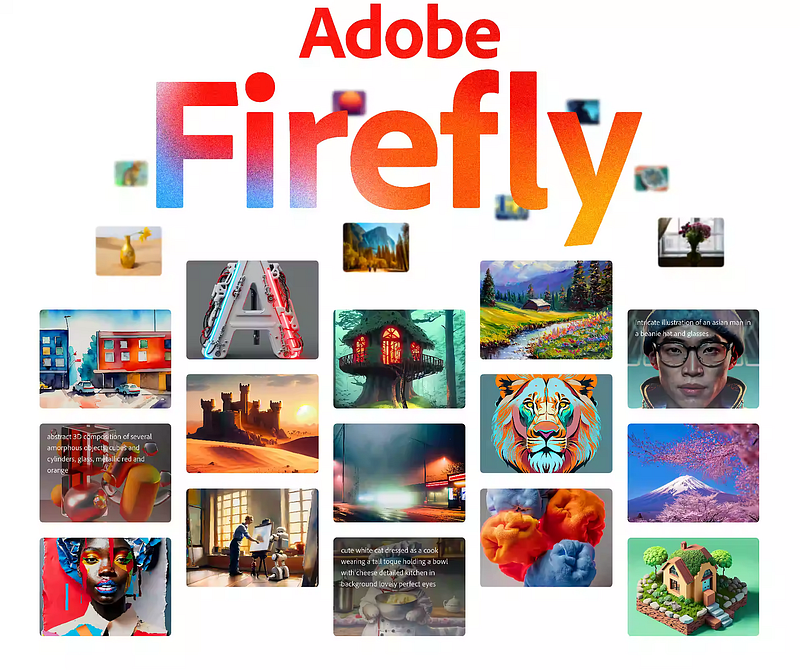
The AI industry is going wild and proof of that is that we’re constantly being bombarded with news about new algorithms and features data scientists are developing.
Adobe didn’t want to be left behind and decided to use AI to provide what they’ve called Adobe Firefly: a family of creative generative AI models coming to Adobe products. [1]
It was just yesterday that Adobe presented Firefly to the public and there’s a lot of hype around it. I can understand that and I’m sure you’ll do after this story because what they’ve created looks amazing.
In this post, I’ll focus on explaining what Adobe Firefly is, some of its cool features, and how we can profit from it as data scientists.
Let’s get started.
What Is Adobe Firefly?
Firefly is a set of generative AI models creators can use to create images, videos, illustrations, artworks, marketing templates, 3D modeling… Options are limitless.
Adobe Firefly is still in the beta phase and only those who are granted access can start using it.
We know nothing about the exact models they’re using but the way they describe it pretty much narrows the range of possibilities. We know they use generative models which, for those not familiar with the term, are models that have the ability to generate new data instances based on a given input like a text.
If you want to dig deeper into generative models, I strongly suggest you start with Generative Adversarial Networks (GANs). In the resources section, there’s a link to a great post from Abhishek Kumar in TDS[2].
Adobe Firefly’s Features
The main one is that it allows us to type commands to generate images. Similar to DALL-E 2[3], we can input a text describing what we want to be displayed and it tries to match our demands.
However, Firefly is more versatile. DALL-E 2 generates an image, while Firefly allows us to create parts of an image (expanding them), transform sketches into vectors, add styling to existing videos or pictures, and even select and replace certain parts of an image with generated variations.
It has the benefits of generative AI incorporated into the amazingly well-built existing Adobe products. Well, I haven’t got access to the tool yet but I’m sure it’s going to be well-integrated, and working with it is going to be smooth.
But let’s remember it’s in the beta phase still.
Another nice feature is, again with a text prompt, applying styling and textures to texts. For example, we can make letters look like candy, ice, or whatever more complex idea you might have.
The last one they highlight is the ability to recolor vectors, which is still not available but that’s going to be huge as well. Again, from a text description, you’ll be able to change the color of your vectorized artwork.
This is cool because you reap the benefits of working with Adobe (vectorized designs) while also using AI to improve your products.
I can’t say it with 100% confidence, but I’m pretty sure it’s going to be the first tool out there able to do that with vectorized illustrations because all I’ve seen until now use rasterized images.
Basically, Adobe Firefly provides new editing capabilities removing the need to manually add those edits. This can be revolutionary.
How Data Scientists Can Profit From Adobe Firefly
I think this tool’s main profiteers will be creators who are already using Adobe products like Illustrator or Photoshop on a regular basis. Firefly will ultimately make their lives easier and the biggest improvement will probably be the reduced dependency on the creator’s creativity.
But I believe we can leverage it as data scientists as well.
There could be different use cases but I see it as a great tool to generate image datasets to train our models.
Imagine the famous hand-written digit recognition problem we’ve all tried when learning how convolutional networks work, and imagine there wasn’t any dataset online you could use to create the model. You would have to manually generate thousands of images of hand-written digits. That’s feasible, but time-consuming and not efficient.
With Adobe Firefly, the time spent creating this dataset can be hugely reduced.
Let’s use another example, in which you want a model to detect watches in an image. Well, you can also generate your dataset with Adobe Firefly. You can generate all sorts of images, some containing watches and some without.
Instead of relying on a pre-created dataset found on the Internet, or having to create one manually on our own (taking lots of images), we can leverage Adobe Firefly to make this tedious task easier and more optimal for the problem we’re trying to solve.
Conclusion
Adobe released the news yesterday (March 21st) and generated a lot of hype around this product. I hope you are now hyped as well because I think this is a great step forward for Adobe to improve its products and ultimately get to more people.
I believe Adobe Firefly will revolutionize the industry. Just like a graphic designer can’t afford to not use Illustrator, Firefly will be a daily tool for a lot of people from very different industries in the future.
And we, as data scientists and data-related individuals, can also benefit from this AI tool just like we’ve been using other AI-based tools during the last months like ChatGPT.
The AI age has begun and things are about to get interesting.
                          Thanks for reading the post!
            I really hope you enjoyed it and found it insightful.

          Follow me for more content like this one, it helps a lot!
                                  @polmarin
Resources
[1] Adobe Firefly
[2] Generative Adversarial Network — Abhishek Tumar on Medium (TDS publication)


