
An Arabic Treatise on Djinns
Introducing a newly-discovered tale from the Caucasus
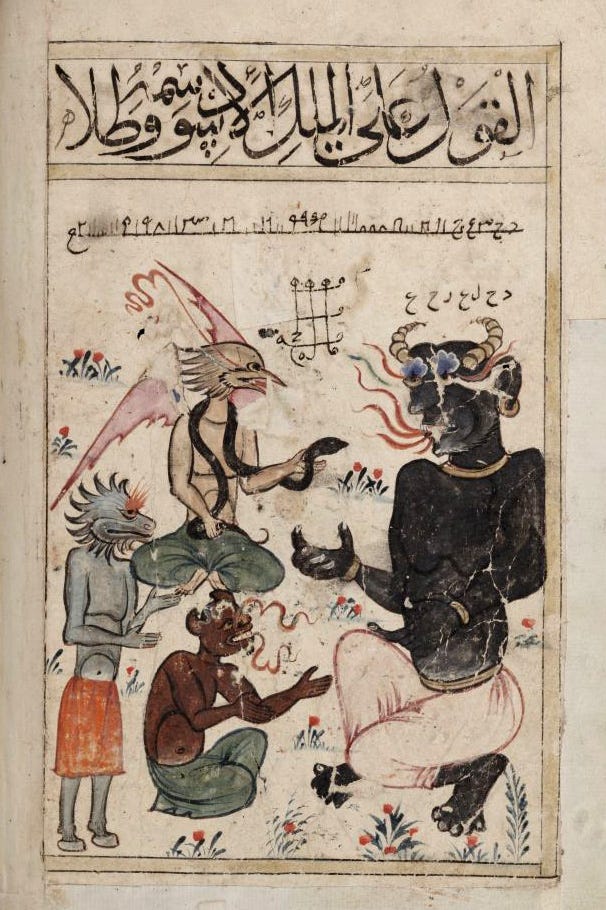
As a preview of a forthcoming study guide on the literatures of the North Caucasus from antiquity to the present, I share here a story about a newly-discovered treatise on djinns from early modern Daghestan
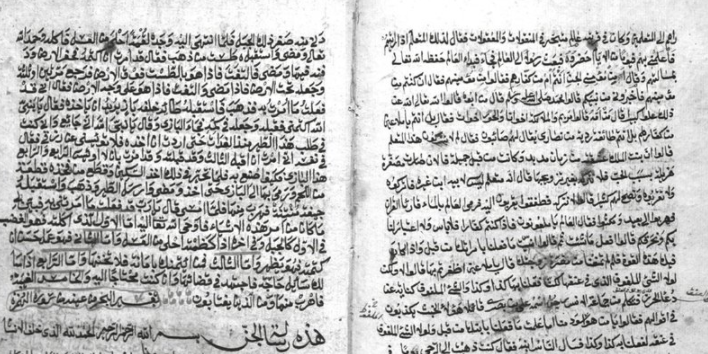
[from “Early Modern Documentary Prose of the northern Caucasus”]
In the domain of prose as much as of poetry, literary production across the northern Caucasus took place overwhelmingly in Arabic-script literatures. In the domain of prose, most short analytical writing fell under the heading of risala, an Arabic term that can be translated as “treatise,” “essay,” or “epistle” depending on the context and content. Most narrative literature pertained to historical writing (tarikh) in one way or another. The writing of risalas flourished throughout the post-classical and early modern period. One example from seventeenth-century Daghestan is the Treatise on Djinns (Risala al-Jinn) by Muhammad b. Umar al-Daghestani, from the village of Irib. This unpublished work, of which only four copies in the world have been identified, is held in the Saidov fund of the Institute of History, Archeology, and Ethnography of the Daghestan Research Center of the Russian Academy of Sciences. It was copied by the 20th century Daghestani scholar Ali al-Ghumuqi (Ali Kaiaev), whose works are discussed in the section on life-writing; this copy formed part of the library that al-Ghumuqi kept secret during the Soviet period and which was only revealed to the world after the end of the Soviet Union. In another surviving manuscript, the treatise bears a longer title: “This is a story about an amazing incident that once happened to the jinn in the Daghestan village of Irib in 1076 (1665 CE).” The work is remarkable in many respects, not least for its memorable combination of a theological debate, a tragic story of unreciprocated love, and a historical rendering of a specific incident in the Irib, which the author records in the spirit of documented fact.
Narrating the theological debate between the famed Daghestani scholar Talhat Qadi, a group of djinns whom he calls “Christian,” and their king, the Treatise on Djinns bears the traces of the highly syncretic milieu in which Daghestanis operated long after the conversion of most of the region to Islam. The first part of the text unfolds in the form of a dialogue between the scholar (identified as the historical Talhat midway through the exchange) and the djinns. In this part as well as towards end, when the action has concluded, the dialogue reads like a play, albeit one composed in a literary tradition that was unfamiliar with the conventions of modern drama. After the first part of the theological exchange is complete, the story turns to the resolution of the core problem that brought them into contact: the daughter of the king of the djinns is in love with a Daghestani Muslim youth and wants to marry him. The djinns torment the poor youth in the hopes of compelling him to agree to the marriage. But he is his parents’ only son, and will not abandon them.
The conflict is resolved when the king himself appears and engages in extended negotiations with Talhat near the village mosque. The narrative then returns to the dialogic mode of theological debate. Talhat asks the djinns probing questions, such as “Why do you harm us, when we have done nothing to harm you?” and “Who is your prophet?” He also asks the djinn about their daily rituals, such as “On what days do you fast?” The result is a lively text that also sheds light on the worldview of Daghestani Muslims from this period. In an intriguing metaphysical aside, we are told that Talhat “could neither hear nor see the djinns due to the wall that stands between djinns and humans.” Talhat’s conversation is mediated by a designated intermediary between the humans and the spirit world, who is also a scholar. The exchange between Talhat and the djinns suggests a worldview that, while it rejects certain theologies and favors other ones, also recognizes in the religious practices of the djinn — who are figured as both Christian and Sabean — a shared idiom for worshipping God. The world view implied by this exchange is quite unlike the stereotyped representation of Islam as a religion that condemns all that is foreign to it. Instead, we find here a syncretic view of religion, in which conflicting religious practices blend easily with everyday life, and underwrite robust and open intellectual inquiry.
A further interesting point in this text is the representation of the djinns’ religion. The djinns refer to their God as Allah and they fast and pray just as Muslims do, albeit on different days. That the conflict between the Daghestanis and the djinns is not really about religion is further underscores by the plot: the djinns are attacking the Daghestani youth because the daughter of their king wants marry him, not due to any doctrinal differences. At the same time, the details of the djinns’ religion are a central aspect of the narrative and ethnographic interest of the story. In the course of their dialogue, Talhat accuses the djinns not only of being “from the cursed society of the Christians,” but of belonging to the branch “referred to as the Sabeans.” Such syncretism is reflective of Daghestan’s links to the Christian cultures of Georgia as well as pre-Islamic Chechnya and Ingushetia. Talhat’s conflation of Christianity and Sabeanism may seem erroneous to some schools of thought. However, the Shafiʿi school of Islamic jurisprudence that Daghestanis followed held that Christianity and Sabeanism resembled each other. Further, Orientalists such as V. V. Bartold have contended that the Sabeans were not originally a unified group. These links make the association between Christianity and Sabeanism in this 16th century treatise more plausible.
Finally, it is worth nothing the ways in which Treatise on Djinns locates a narrative of events that typically are relegated to the sphere of the miraculous within a precisely delineated historical time. The text is clearly dated, both with regard the timeline for the events it narrates (4 February 1665–6, in the month of Ramadan) and the time of its composition (1667–8). The author further stipulates that everything which he has recorded was conveyed to him directly by the intermediary “including the words of the teacher of the djinns and their king.” The author’s insistence on the historical veracity of his narrative adds a further empirical dimension to the uncanny events narrated in his text. In sum, the as-yet-unpublished Treatise on Djinns is a masterpiece of early modern Daghestani literary and religious culture that suggests a strong degree of tolerance for — and curiosity about — the non-Muslim peoples who resided in Christian-dominant regions bordering Daghestan, such as Georgia and Tushetia (mentioned in the text as the place of exile for the daughter of the king of the djinns), home to the Batsbi people who speak a language closely related to Chechen and Ingush.
Sources
Шехмагомедов Магомед Гаджиевич & Хапизов Шахбан Магомедович “«Хазихи рисала ал-джинн» — Дагестанское сочинение жанра манакиб: предисловие, перевод и комментарии,” Вестник СПбГУ. Востоковедение и африканистика 9.3 (2017): 266–280. Article on Risala al-Jinn, with facsimile of Arabic text (pp. 269–272). Available online at: https://dspace.spbu.ru/bitstream/11701/8521/1/04-Shekhmagomedov.pdf.
Шехмагомедов Магомед Гаджиевич & Хапизов Шахбан Магомедович “«Хазихи рисала ал-джинн» Дагестанская рукопись 1666 г. о мирах джиннов и людей” https://mkala.mk.ru/articles/2018/01/06/khazikhi-risala-aldzhinn.html
V. V. Bartol’d, “K voprosu o sabiiakh,” Sochineniia, vol. VI Raboty po istorii islama i Arabskogo khalifata (Moscow: Nauka, 1966), 469–488.
Read more about the Caucasus
Rebecca Ruth Gould, Writers and Rebels: The Literature of Insurgency in the Caucasus (Yale University Press, 2016).
Charles King, The Ghost of Freedom: A History of the Caucasus (Oxford University Press, 2009).