
Interview with a Poet — Sally Mortemore
Thinking About Poetry
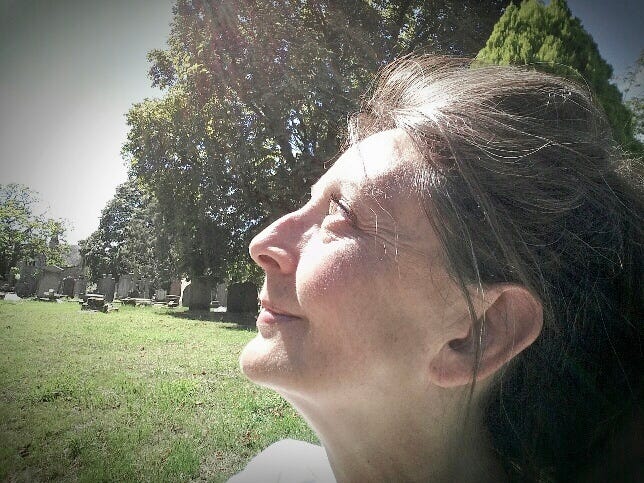
Editor’s Note — As we continue our series of interviews with poets, I am thrilled to introduce Sally Mortemore. She is an individual with a rather impressive resume that includes more than poetry. This has been an exciting endeavor to read her responses.
For you, poetry is… AND/OR… Poetry is not…
When I was a teenager, poetry was an escape; it was not so much about escaping my environment, or teenage emotional angst, but about firing my brain with poetry analysis. Looking at the subtext, the deeper meanings, the imagery and coming to my own conclusions as to what the poet was saying. So it was an escape from the normal-ness of everyday life, maybe.
I had already found a connection with Shakespeare having been introduced to him at the age of 11; the rhythm of speech was also something of a fascination; and I think it was Chekov who talked about the vowels being the river’s flow/the emotion of words, and the consonants are a word’s containment, or the river’s banks. So I see poetry as emotional expression, a story, a flow of words, a picture of words, a river overflowing with thoughts.
When you write poetry, what is the source of your motivation?
Sometimes it is pain. Pain of relationships. Pain of the world. Pain of other people. Sometimes its beauty of love, beauty of nature. A lot of the time it is inequality in society. Sometimes it is just the need to tell a story.
What habits or processes do you use when you write poetry?
Reading my words out loud. That has to come from being an actor, I’m sure. I need to feel the flow, the rhythm, the emotion and whether or not the choice of words have the right sound — sometimes the consonants are too hard, or too soft for the context, and the only way I can hear that is to read the words out loud. There are times I can feel and hear all those things without having the word, so I just have to go away and take the dog for a walk until a word with the right meaning which fits the beats comes into my head. The dog has a lot of walks!
What determines success for you? What makes you say, “Yes, I got this.”
When a piece flows easily within my heart and doesn’t trip over itself. Sometimes I come up with a line that I really love and I work so hard at trying to make it fit in, but reading it my heart knows its superfluous and eventually I have to get rid if it; and though it hurts at the time I can eventually let go and say, “I got this.”
What do you look for in a good poem, a good poet?
Simplicity. Honesty. Depth without being overly clever or using words the reader might not understand. A natural flow. I also love a twist.
What advice would you give the fledgling poet on Medium?
I’m not sure I’m in a position to advise young poets. I didn’t come to poetry through an academic root, I just knew I enjoyed analyzing text and finding meaning and flow. That led me to becoming an actor, but I also trained full time as a classical dancer, so movement informs flow of words too. I’ve worked with directors whose academic backgrounds hold them back from being creatively expressive, or looking outside of the box. So maybe looking outside of the box is a term of advice.
I was rehearsing for a show about ten years ago and the stage directions were ‘sits on the couch’. How boring, given the character was going through a rebellious phase. So, I threw myself on the couch (it was a chaise longue) upside down, so with my feet crossed on the upright bit, and my head hanging off the end with my arms out to the sides. The director really did not like it, but I persuaded him to trust me. That was the moment people remembered because it said so much about her in one brief moment.
To whom do you look as a mentor? sage? poetic inspiration? Who are your model poets?
Up until now it was the English poet Sean Street who taught me text and poetry very briefly when I was at ballet school, so I was 13 maybe 14. He gave me a pamphlet of his poetry and I still have it. We now keep in touch on occasion via Twitter.
Since joining Medium, I have someone who truly inspires me and gives me wonderful words of advice — Alan Asnen.
For other poetic inspiration I look to Dylan Thomas and Margaret Atwood; Keats, John Heath Stubbs and Gerard Manley Hopkins; Rumi, Pablo Neruda and Emily Bronte; Seamus Heaney, Edith Sitwell and Auden. The list could go on forever. Shakespeare of course.
Check out Sally’s work at the following links
Just a bit about Sally…
- worked with the English Shakespeare Company playing 2 of Shakespeare’s greats, Lady Macbeth and Titania.
- ‘Jarman Garden‘ which was a company devised project honouring the work of Derek Jarman (someone whose work and determination I admire very much and sadly miss) — the show was runner up for the Samuel Becket Award awarded by the Riverside Studios in London.
- Countess Groan in ‘Gormenghast’ directed and adapted by David Glass for his physical theatre company the David Glass Ensemble.
- ‘Harry Potter and the Chamber of Secrets‘ which has led to more audio work for Audible and Pottermore Publishing and voicing Madame Pince for the ‘Hogwarts Mobile Mystery Game’ for Warners.
- The indie film ‘The Silence After Life’ Best Actress Award BRIFF 2020 and ‘A Cake for Mabel’ Best Performance Award ELFF 2014 where I was also gifted the opportunity of working with the formidable and iconic Sylvia Syms (also a Capricorn) and the late great Benjamin Whitrow
- Masters Degree in Voice Studies from the Royal Central School of Speech and Drama / University of London and that I initially trained full time as a classical dancer from the age of 13 before going to Drama School for 3 years from the age of 17.