
Interview: Annie Zaleski
Her new book explores ‘Rio,’ Duran Duran’s iconic 80s album
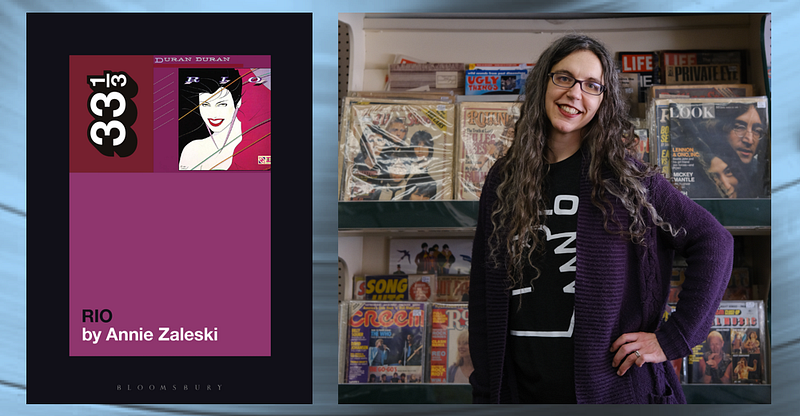
Annie Zaleski is a Cleveland, Ohio-based author, editor and journalist. Her work has appeared in dozens of publications including The Guardian, Rolling Stone, Stereogum, and Cleveland Plain Dealer. She was featured in the 2005 movie Punk’s Not Dead and in a 2014 Ovation TV special on the band Blondie.
Her 33 1/3 book on Duran Duran’s 1982 album Rio was published on May 6.
Interview
As a lifelong music fan and journalist, you must have had a million 33 1/3 book ideas. How did you land on Duran Duran’s Rio?
Believe it or not, Rio has pretty much always been my one and only choice for a 33 1/3 book. It’s indisputable that the album is a classic, from both a musical and aesthetic perspective. (The Patrick Nagel artwork on the cover!) But at some point in the ’00s, I stumbled upon Rio’s unique backstory: It was remixed and reissued a bunch in the U.S. before it became a hit, and “Hungry Like the Wolf” also took a long time to become a smash. I always wondered why that was. And then, of course, the music videos from Rio were closely associated with MTV, so I knew there were great stories there too. Rio wasn’t just a fantastic album; it had a compelling backstory too.
Is it true that you have been submitting Rio to 33 1/3 since 2007?!
True story! I always believed in the book, because I always believed in the story I wanted to tell, as noted above. But besides that, I’ve always believed that Duran Duran deserve the kind of credibility and respect afforded to their influences — to name a few, Bowie, Roxy Music, Velvet Underground, The Beatles — and a 33 1/3 book goes a long way to cementing that.
In your opinion, is Rio their best album?
You know, I think it is — especially in the sense that it’s their most cohesive artistic statement. I’m a big fan of all Duran Duran eras, truth be told, but Rio really is special — and I’ve found it inspires rather deep emotional connections and responses.
You mention in the book that John Taylor originally envisioned the band as a mix between the Sex Pistols and Chic (which I absolutely love). How do you think they did on living up to that goal?
I think they did pretty great living up to this goal, honestly. In terms of Chic, Duran Duran have always nailed dance grooves — I mean, they even worked with Nile Rodgers many times! — and focused on making music that’s a unifying dancefloor force. John Taylor and Roger Taylor are also a tight, propulsive rhythm section and are focused on being dynamic live performers.
As far as the Sex Pistols go, Duran Duran were and are never afraid of ripping up their own blueprint. But they’re also pushing culture forward, whether via their music, a technological advance, or something else. They determine their desired vision, make a plan to achieve it, and then run with it. They have the brash, unfettered confidence of a punk band.
What do you say to people who dismiss Duran Duran as some kind of prefabricated boy band?
After I roll my eyes and huff and puff a bit in annoyance (I’ve never had a good poker face and the term “boy band” isn’t a pejorative), I start to lay out facts that disprove this. For starters, Duran Duran weren’t put together by some Svengali; Nick Rhodes and John Taylor started the group in the late ’70s. Second, the band members have always written all their own songs.
And, third, while they had immense pop chart success, at heart Duran Duran were and are a fierce rock band. Just listen to any concert bootleg from the band’s ’80s heyday; you’ll hear a really excellent live act brimming with confidence.
What was the most difficult thing about writing this book?
Cutting it down! I had so much information (too much information, one might say!) and a limited word count. I ended up having to severely curtail the first chapter, which is about how the band formed and the year before Rio, because the book was already pretty lengthy.
You interviewed several band members. Who surprised you the most?
Honestly, nobody, really! I had interviewed John and Nick before over the years, so knew what to expect, and had read enough interviews with Roger and Andy to have a sense of what they’d be like. I was just impressed, once again, how the band members excel at analyzing not just their music — but Duran Duran’s place in the culture at large. They’re very insightful interviewees.
What are a few of your other favorite 33 1/3 titles?
I like Kim Cooper’s book on Neutral Milk Hotel’s In the Aeroplane Over the Sea, The Smiths’ Meat Is Murder by Joe Pernice, and The Raincoats’ The Raincoats by Jenn Pelly. And he’s my friend, so I’m biased, but D.X. Ferris’ book on Slayer’s Reign In Blood is great.
Any advice for writers looking to submit a 33 1/3 proposal?
So submissions are closed again, but since I’m asked this question a lot, I’m going to answer it! Honestly, think of it like you’re pitching an editor on an article. The proposal needs to not just explain why you’re the right person to write about a particular album — but also why your proposed album matters.
That could be musically, culturally, aesthetically — or a combination of the above — but you have to explain why your chosen LP moved the needle in some way. Ultimately, you have to write well over 30,000 words about the album, so putting some serious advance thought into what a book that length might look like will give you an advantage.
Here are a few of my other music articles you might enjoy: