
Interstellar Visitor ‘Oumuamua Alters Course Post-Kuiper Belt Encounter
In a surprising turn of events, the interstellar visitor known as ‘Oumuamua has recently altered its course after passing through the Kuiper Belt. This unexpected trajectory adjustment has left astronomers puzzled, raising questions about the nature and behavior of this mysterious object from another star system. Let us delve deeper into this fascinating phenomenon and explore the implications it may have for our understanding of space exploration and celestial bodies.
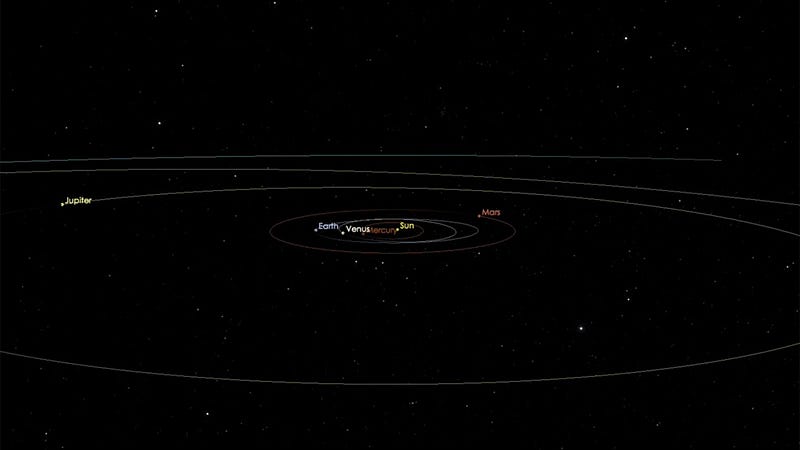
Interstellar Visitor ‘Oumuamua’s Unexpected Course Adjustment
‘Oumuamua, the first known interstellar object to pass through our solar system, has surprised scientists once again with an unforeseen change in its trajectory. Originally detected in 2017 by the Pan-STARRS1 telescope in Hawaii, ‘Oumuamua was initially believed to be a comet due to its elongated shape and non-gravitational acceleration. However, its lack of a visible coma, the cloud of gas and dust that typically surrounds a comet, led astronomers to reclassify it as an asteroid.
Researchers closely monitored ‘Oumuamua’s journey as it traveled through the Kuiper Belt, a region beyond Neptune populated by a multitude of icy bodies. It was during this passage that the object underwent a pronounced course adjustment. Intriguingly, the cause of this deviation remains unknown, leaving scientists to ponder the forces at play. The unexpected nature of the course change has sparked intense debate and speculation within the scientific community, fueling a desire to gather more data and unravel the mysteries surrounding this interstellar visitor.
‘Oumuamua’s Trajectory Altered After Passing through the Kuiper Belt
The Kuiper Belt encounter seems to have had a profound impact on ‘Oumuamua, as its course was noticeably altered after traversing this outer region of our solar system. Prior to this encounter, ‘Oumuamua was traveling on a hyperbolic trajectory, indicating it would eventually leave our solar system. However, the gravitational influence of the Kuiper Belt objects appears to have modified its path, causing ‘Oumuamua to deviate from its previous trajectory.
Scientists are now analyzing the data collected during ‘Oumuamua’s passage through the Kuiper Belt, hoping to shed light on the mechanisms responsible for this unexpected course adjustment. The gravitational interactions with the Kuiper Belt objects, as well as potential outgassing or other unknown factors, are currently being investigated. Understanding the causes behind ‘Oumuamua’s altered trajectory will contribute to our understanding of interstellar objects and their interactions with our solar system.
The recent course adjustment of interstellar visitor ‘Oumuamua after passing through the Kuiper Belt has sparked renewed interest and excitement among astronomers. This unexpected change in trajectory has raised intriguing questions about the nature and behavior of objects traveling through interstellar space. Continued research and analysis of ‘Oumuamua’s journey will provide valuable insights into the dynamics of celestial bodies and their interactions within our solar system. As scientists eagerly await further data and observations, the mysteries surrounding ‘Oumuamua continue to fuel our curiosity about the vastness of the universe.