Internment Camps as a Tool of War
Why do subhuman tools of war continue to be used against civilians?
Since the latest flair-up in the Russo-Ukraine war in February 2022, there have been numerous accounts of Ukrainian citizens sent to filtration camps and then forcibly deported to Russia. USA Today estimates 1.6 million Ukrainians may have been deported into either occupied Ukraine or into Russia while other sources estimate even larger numbers. Some of these citizens are kept in detention and re-programming camps in the far east of Russia where escape is remote.
Survivors of these detention camps in now reclaimed areas of Ukraine in the Kviv, Kharviv, or Kherson oblasts talk about interrogation, rape, psychological, and physical torture at the hands of Russians as a means to force the population to comply and submit to the occupier. Russian soldiers in the field are being told Ukrainians are sub-human and so ill-treatment of the interned is considered acceptable behavior. We saw this first-hand after the liberation of Bucha and the number of mass graves uncovered and countless accounts of rape and torture reported.
Russians have terms for Ukrainians such as: “malenkiy-russyia”/”little Russian” or “malenkiy-brat”/”little brother”. They can have both brotherly and pejorative meanings to them. They’re usually used in the context of a group of people who must be taken care of or to be cared for because they cannot do it for themselves. It’s been used for centuries by the Russian Empire, the Soviet Union, and now Vladimir Putin as their right to rule over Ukraine. Any belief that another nation or culture is inferior comes with risks that this belief will be used as a tool in war to commit war crimes and genocide. This is what we are witnessing today and not unlike, I would argue, what we witnessed during World War II.
The Nazis had their own ethnic dogma — a master race theory. The Third Reich created a doctrine of segregating European people according to a hierarchy of superiority or inferiority. Germans were naturally at the top of the master race. Western Europeans were at the next level down. Slavs were on the third level of the hierarchy and considered inferior to Western Europeans. They were the “slave class” of the Third Reich. At the bottom level of the hierarchy were the Jews, Roma, homosexuals, and handicapped, reserved for immediate extermination.
As a result of these doctrinal beliefs, the Nazis killed over 5 million people in an industrialized genocide we call the Holocaust, and according to The U.S. State Department, Nazis enslaved 12 million people, mostly Slavs, in guarded worker camps, on farms, and in people’s homes. Whether these people were in extermination camps or slave labor camps, they were expected to work at the pleasure of the Third Reich with little food and often, subjected to rape, psychological, and physical torture. Accounts of the death camps rightly permeate our minds with their hideousness and inhumanity. Rightly so, much has been written about them and so I will not recount them here. However, much less is known about the slave labor experience in Nazi Germany.
“The Poles are to be the slaves of the German World Empire,” Governor General Hans Frank proclaimed in 1939 according to the Zwangsarbeit archive.
According to the National WWII Museum, initially, the Nazis recruited Eastern European workers through various marketing tools such as posters, recruiting centers, and within churches. They promised good jobs with good pay. However, these turned out to be false promises. Once these workers arrived, they were sometimes sold at auction to the highest bidder, their work papers taken away, forced to wear a badge identifying their ethnic origin, and then sent to various areas of Germany for forced slave labor. Once the reality of the situation spread across the occupied Eastern European nations, the Nazis were forced to kidnap them and deport them for slave labor instead².
Both my parents experienced this at the hands of the Nazis. They told us of the German recruitment posters and centers and promises of good pay. They both went willingly to Nazi Germany with six-month visas only to have their working papers taken from them.
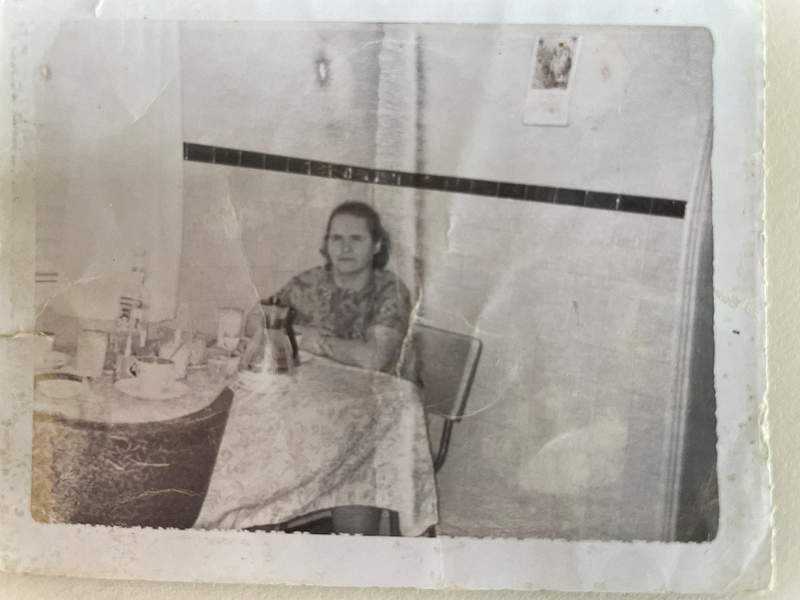
My mother, Sofya, was forced to work in an internment slave labor camp outside of Magdeburg. Her only sin was that she was Ukrainian and not German. She told us of the barracks where she slept with only straw for comfort. Her camp was encircled within high walls with guards and dogs patrolling constantly. She told us about picking potatoes and turnips for 12-hour days knee-high deep in snow with only nylons to keep out the frozen cold. My father, Mykhaylo, was so unwilling to talk about his experience, that we only know he worked on a farm and often told us that we have no idea what it is like to starve, and so therefore, we should never waste food. I am sure he understood what starvation looked like.
While their experiences in war-torn Europe were not pleasant, they both were, thankfully, liberated by American Armies and given refugee status. They both had happy endings of marrying after the War and immigrating to the United States where they raised twelve children and built themselves an enduring legacy in the United States.
While the Nazi “master race” doctrine has mostly been eradicated except for small neo-Nazi movements that still exist in the world, supremacy doctrine itself has not disappeared. It’s still a persistent part of our global psyche and plays out every day on our daily news feeds. I wish I could opine on the conditions of these current filtration and internment camps in occupied Ukraine and in Russia but so little is known or has been written about them. I fear they could be similar to what my parents experienced during WWII. We may not know until the war ends and if Russia wins or earns an armistice at current borders, we may never know.
Why do subhuman tools of war continue to be used on civilians today? Unfortunately, it’s because we, as humans, continue to spread philosophies that some nations, ethnicities, and cultures are somehow less than others. Until we eliminate these beliefs from our own minds and cultures, inhumane tools of war will continue to be utilized against perceived enemies.
Sources:
¹ Karina Zaiets, Arianna Torrey and Roman Padilla [May 31, 2023]‘A Choice without a Choice: An Illustrated Explanation for Russia’s deportation of Ukrainians, from the war zone to a remote camp’ USA Today
²‘”Slave Labor:” Was Nazi forced labor slavery?’ Zwangsarbeit-archive.de
³Jennifer Popowycz, PhD [March 14, 2022] ‘Nazi Forced Labor Policy in Eastern Europe’ The National WWII Museum New Orleans