avatarJake Cutter

Summary

The International Space Station (ISS) serves as a multinational research lab where astronauts conduct experiments in physical science, biology, and the effects of long-term spaceflight on the human body, while orbiting Earth every 90 minutes.

Abstract

The ISS is a collaborative effort of 15 nations, hosting a variety of experiments in disciplines such as physics, biology, and Earth and space sciences. Astronauts aboard the station study the impact of zero gravity on human health, including the cardiovascular system and bone density, as well as on cell growth and plant biology in microgravity conditions. The station is segmented into different modules, each with specific functions, such as the Kibo Module for life sciences, the Columbus Module for European research, and the Destiny Lab for life support systems like oxygen and water regeneration. The ISS also accommodates crew quarters, exercise facilities, and cargo areas for maintenance and scientific payloads. Research conducted aboard the ISS contributes to our understanding of long-duration spaceflight and its implications for future missions beyond low Earth orbit.

Opinions

  • The ISS is recognized as a unique platform for scientific research that cannot be replicated on Earth due to the microgravity environment.
  • The inclusion of different nationalities and modules reflects a spirit of international cooperation and shared scientific goals.
  • The station's design, with features like the treadmill with friction belts and the exercise space in the Kibo Module, demonstrates a thoughtful approach to maintaining astronaut health and morale during long-duration missions.
  • The use of the Progress Cargo Vehicle for disposing of trash and debris indicates a practical solution to the logistical challenges of sustaining a permanent human presence in space.
  • The reference to the Wikipedia article on the Progress spacecraft suggests a reliance on this vehicle for essential cargo deliveries and maintenance supplies, highlighting its critical role in the ISS's operation.
  • The mention of specific research areas, such as studying fire behavior in microgravity and the growth of lettuce and tomatoes, points to the diversity of scientific inquiries pursued on the ISS.
  • The station's contribution to Earth science, including observations of glaciers and urban light patterns, underscores its utility as a platform for monitoring terrestrial changes and addressing global challenges like climate change.

International Space Station — Research Lab

What happens in low earth orbit? What do the astronauts work on in their 90 minutes orbits?
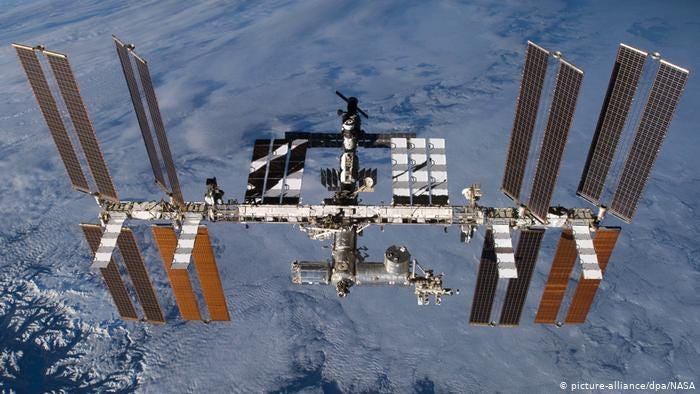
https://www.dw.com/en/nasa-to-open-international-space-station-to-tourists-from-2020/a-49106728 — DW

Flying at 17,500 miles an hour they are studying physical science, physics, biology, and effects on the life of long term space flight. They observe the eyes, cardiovascular systems, and the bodies of some of the ISS astronauts.

The Station

From the front of the station that is manned by 15 different nations. There is a window on the port side that shows one of the robotic arms. Moving backward you find Node 2. This is the Kebo Module made by the Japanese. They do a lot of biology and life science as well as have an exercise space here. They are currently working on cells' attitudes in zero gravity in Petri dishes.

Continuing on, the European Space Agency’s Columbus Module.

Then you have the crew quarters. This is where the astronauts have their own sleeping bag looking areas. Because they are in zero gravity they sleep floating with their computer and other personnel items around their area.

The Destiny Lab is aft of the crew quarters. This is where they make their oxygen and water from urine, CO2, and condensate. They also have a treadmill with friction belts so they don’t float away.

The Unity Module holds the CWC, which is all the contained water for drinking, experiments, etc.

Next is the airlock that leads to the Russian side of the station.

This is where the Pressurized adapter/docking station is. This is where they store FCB.

Next is the docking compartment where the Soyuz and dragon attaches to the station.

The Progress Cargo Vehicle is near the docking area. This is where progress docks. It was not made to reenter the earth’s atmosphere so this is where they put trash and debris. It carries the supplies because they need a constant supply. “plus there was a need for maintenance items and scientific payloads that necessitated a dedicated cargo carrier. Such payloads were impractical to launch with passengers in the restricted space of a Soyuz,” ( Wikipedia).

Finally, you have the Service Module. This is the place they eat and get water. They can also exercise here.

Research

They do research on physical science, physics, and long-duration flight.

Biology

cell growth, lettuce/tomato, petri dish (done in Kebo Lab)

Physics

fire(AN ACTUAL OPEN FLAME), space science, dark matter, meteorites

Earth Science

glaziers, cities, lights, global warming, mountains

Long Duration

eye health, muscle mass/growth/health science, cardiovascular strength in zero gravity, bone mass, brain activity

References:

Space
Engineering
Research
Physics
Science
Recommended from ReadMedium