
Intermittent Fasting: The Surprising Way to Conquer Hunger and Finally Lose Fat
Understand hunger and unlock the key to weight loss.
My daughter heard me sneaking through the kitchen, scavenging for food.
No, not food. Sweets. Or better yet, pastries. Anything with sugar. I thought everyone was asleep. Thought that nobody would hear my silent foraging. I didn’t want them to know what I was doing.
But someone heard.
“Mom? Dad won’t stop snacking. I’m afraid he’s going to die.”
I’d promised her I would lose weight. Promised myself. After doing it so many times, I was practically an expert at the process. Sadly, like so many of us, I was even better at putting the weight back on.
I had no control. It was a failure of my willpower, or so I thought. We get to choose when and what we eat. Right? It follows that overeating must be a character flaw.
Hunger, with a capital H, held me prisoner. I might escape for a time, but it always captured me in the end.
“Dad?” my daughter said. “You promised you were going to eat better.”
“I promise you, I’m going to figure this out,” I told her. Researching and self-learning were two of my strengths. I would put them to good use.
What I didn’t realize at the time was the true nature of hunger. It is more than just a response to not eating.
We’re building up, somewhat ironically, to how Intermittent Fasting helps us to overcome our hunger. First, we need to understand three things.
- Hunger is partly a learned response.
- Hunger is triggered by hormones.
- Hunger comes and goes in waves.
Hunger is partly a learned response.
When it comes to anticipating food, we are all Pavlov’s dog.

In case you’re unfamiliar with the reference, the scientist Ivan Pavlov learned that dogs would salivate in response to anything they associated with food. This included:
- Food being given to them.
- The sound of the person who fed them walking toward them.
- A metronome being played just before being fed.
The dogs learned to associate all of this with food. And we are the same. We anticipate eating at certain times. Sounds, smells, and events can make us want to eat. The expectation of food triggers hunger.
Here are just a few things that could make you feel hungry.
- The smell of your favorite food cooking.
- The sound of bacon frying.
- Watching a movie. (Think popcorn and soda.)
- Just being offered food.
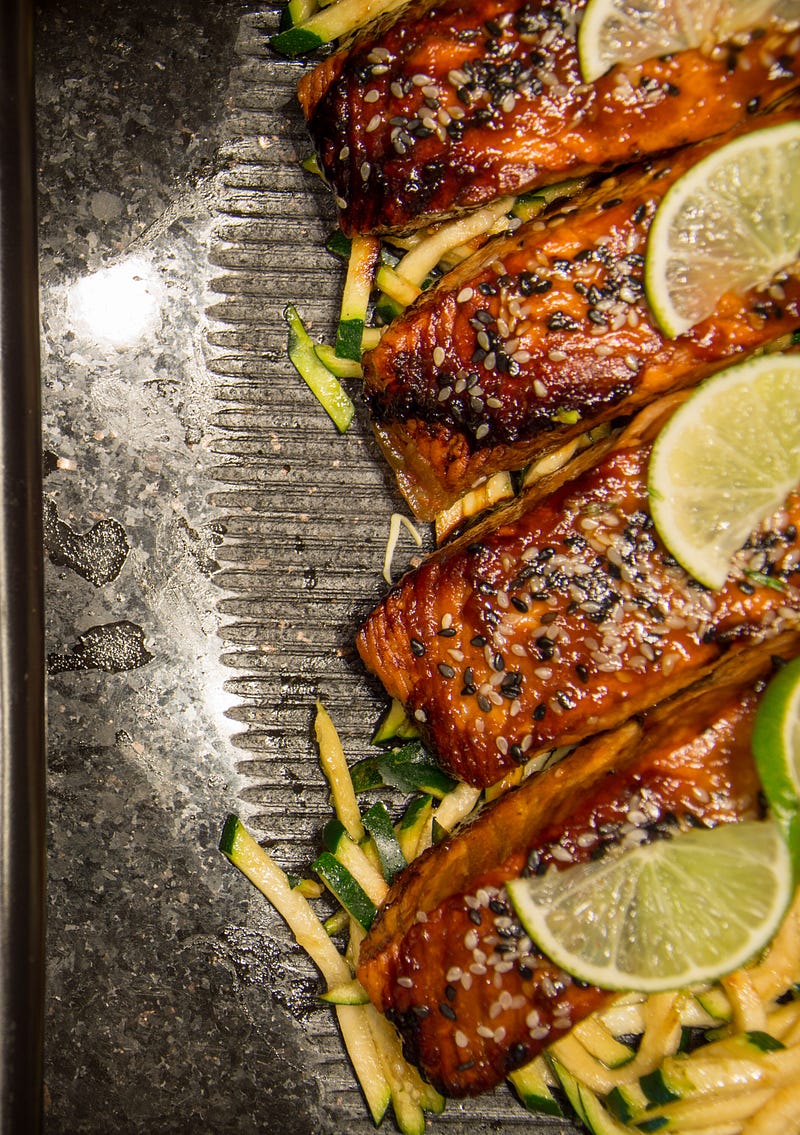
- The picture below (assuming you like salmon. Personally, I love it.)
Hunger is triggered by hormones.
We think of not overeating as simply practicing mind over matter. It’s much more complicated — and as it turns out, easier — than that.
Various hormones in our body control when we experience hunger and when we feel full.
Ghrelin is one of the primary hormones at play. When it is released, you feel hungry. You want to eat.
Remember how hunger is a learned response? It’s physical, too. When those triggers hit, like the bacon frying, ghrelin is released. When the times you are used to eating arrive, ghrelin is released.
And guess what? When you lose weight through dieting, ghrelin is released.
That’s one of the many reasons it’s so hard to stick to a diet. The body hates change. It makes you hungry because it wants you to regain the weight you have lost.
If only there were a way to overcome our appetites. (Spoiler alert: there is.) But before invoking the F-Word (no, not that F-Word,) we need to understand:
Hunger comes and goes in waves.

Most people have a misconception about getting hungry or missing meals.
We know how hungry we get leading up to mealtime. We imagine that the desire for food will only grow stronger the longer we abstain. For instance, if I’m this hungry after four hours without eating, I’ll be twice as hungry after eight.
The good news is, that’s not how it works.
Read anything by my favorite fasting author, Dr. Jason Fung, on the subject. Eventually, you’ll come across graphs and data showing the hormone ghrelin going up and down during the day. That’s the hormone that makes us feel hungry. It goes up around mealtimes. But guess what?
Even if you don’t eat, hunger goes back down. Just like waves rise and fall, our appetite grows and diminishes.
Ever work through lunch? Chances are, at first, you were hungry. But eventually, as you caught up in the tasks at hand, the feeling went away until you forgot to be hungry.
Yes, we get hungry when we are accustomed to eating.
Triggers — like sights, sounds, smells, or times we usually eat — increase our appetites. Even some foods will do the same, such as when you’re stuffed but find there’s plenty of room for ice cream.
If we find a way to ride out the hunger waves, the hormones decrease. Hunger decreases. Let me say that again. HUNGER DECREASES!
And that’s where fasting comes in.
I didn’t lie to my daughter.
I told her I would figure out a way to overcome my overeating. Her legitimate concern for my well-being was one of many catalysts to find a way out of the up-and-down weight cycle.
After studying tons of material, much of it by Dr. Jason Fung whom I mentioned earlier, I turned to Intermittent Fasting.
In case you’re unaware, Intermittent Fasting is the practice of abstaining from food for a set amount of time. It’s done for multiple health reasons, including:
- Gut health.
- Decreasing insulin resistance.
- Improving cognitive function.
- Promoting longevity.
- Fat loss.
There are several reasons people are afraid to try fasting. Chief among the concerns is the fear of hunger.
Personally, I was petrified.
In practice and with proper preparation, I learned that it was relatively easy. Even though I’d read about fasting decreasing hunger, I remained skeptical.
That is, until I tried it. To my delight, I learned this was easier than any approach I’d taken before.
The more often you fast, the less control hunger has over you. Even in extended fasts, lasting over multiple days, studies show that the hunger hormone goes down.
I’d lost weight before. I’d exercised my way to increased muscle. I looked good for stretches of time. But always, a loss of energy and increased appetite torpedoed my efforts.
I started fasting, and for the first time, my energy increased, and my food cravings were manageable. Not only that, the weight has stayed off.
Even over the holidays, I indulged in treats and returned to my fasts with no lost ground.
I controlled my hunger. Or rather, fasting regulated the hormones that influenced it, putting me in a position for success.
How to get started?

There are many approaches to Fasting. In most of them, the emphasis is put on the “fasting window” and the “eating window.”
One of the most common methods, known as 16:8, you eat only during an 8-hour window. So, say you finish your last meal at 7:00 pm. That means you would wait until 16 hours have passed. At 11:00 am the next day, you can resume eating.
Some popular approaches are:
- 16:8- 16-hour periods with no eating, followed by an 8-hour eating window.
- 18:6- 18-hour periods with no eating, followed by a 6-hour eating window.
- 20:4- 20-hour periods with no eating, followed by a 4-hour eating window.
- One Meal A Day (OMAD.) In this, you eat only once a day with no snacks in-between.
- Alternate Day Fasting. You abstain from any food for an entire day. The next day you eat when hungry.
The variations go on and on.
Here are some tips for beginning:
- Drink plenty of water. Thirst sometimes disguises itself as hunger. And you need more hydration during fasting.
- If you’re not ready to jump in right away, begin by cutting out snacks.
- Decide which meal you can most easily skip. For most people, it’s breakfast. We may be conditioned to eat in the mornings, but that is when our hunger hormones are at the lowest. Remember that hunger is a learned response.
- Plan your fast around bedtime. For many, this will mean finishing your last meal of the evening and not eating again until lunch the next day.
- You can drink black coffee, green tea, black tea, and most herbal teas, in most fasting plans.
And what about my story?
Over six months, I lost about 40 pounds and several inches from my waistline. I wish I could be more specific, but I was too ashamed to get accurate measurements at my heaviest.
As mentioned above, the weight has stayed off. My daughter thanked me for “getting back in shape.”
As measured by Fitbit, my average resting heartbeat decreased from a one-month high average of 77 beats-per-minute to consistent monthly averages of 68. And my blood pressure now averages normal, something it hasn’t been my entire adult life.
Blood work also showed that other health factors were now where they needed to be. Average blood sugar, hsCRP (inflammation,) oxidative stress, etc. All markers are healthy. I’ll never know how bad the numbers were at their worst. But now, they are where they should be.
Fasting not only changed my life, it most likely has extended it.
Have you tried fasting, or are you considering it? I hope you’ll share your experiences and thoughts in the comments. I look forward to engaging with you.
Scott Hughey is a geek with social skills. He’s a writer, world traveler, computer engineer, and self-improvement enthusiast. As of this writing, he’s in the midst of a 36-hour fast, and he’s not even hungry.