
Superior Intelligence Harbors High Anxiety and Broken Body
Hyper-brain / Hyper-body Autoimmune Disorders

Someone posed the question: “What are some of the disadvantages of having a high IQ?”
Besides the social awkwardness I experienced growing up, self-sabotaging my education (I tricked the computer and teachers into passing an absent student), and the bad habits I developed when discovering I didn’t have to apply myself as much as others?
There are definite disadvantages. A brain on speed has difficulty slowing down. I tried learning yoga and meditation. When the leader suggested “Clear your mind of intrusive thoughts, be at peace” my sarcastic brain scoffed at the idea: As if that’s possible. There are no peaceful rooms here.
When you’re defined as very smart as a child there’s an inherent expectation that you’ll easily succeed in life, and you accept and adopt that expectation. That can mean an awful lot of pressure put on yourself. If you’re like me, there will never be a point when you can claim success because the bar will always keep moving up. In fact, the bar you thought you had to reach will turn out to be just one in a whole field of wild bars, many of which require skills you’ve never had exposure to before.
That can cause a whole lot of anxiety from a very early age. To an extent and degree I’ve never been able to tame. That anxiety will create stress in your life that will take a physical toll.
One way I discovered to avoid the almost constant companion anxiety is to run straight into the arms of excitement and danger. Having a bit of chaos provides unusual stimulation. Adrenalin-fueled circumstances override the dull ache of worry and stress. Being overwhelmed doesn’t come easily, but when it does the usual barrage of something’s wrong signals is drowned out. Instead, you’re forced to act fast and decisively.
Becoming a responsible parent means avoiding thrill-seeking behavior. For me, parenthood introduced a new kind of anxiety that required more focused thought and attention, put into action to create a safe and nurturing home. Being a mom also introduced more fun, emotional fulfillment, and appreciation of expanded opportunities for my family. I enjoyed it.
Yet the over-active brain creating a heightened sense of awareness generating anxiety remained.
A normal IQ (intelligence quotient) is 100. Mensa, the high IQ society accepts applicants who score in the top 2% of the population overall. That score is around 130. As a young adult, I topped that easily without really trying. While I wasn’t particularly interested in Mensa, my mom was, so I went along with it. Again, that not trying attitude kept things calm(ish).
Intelligence in my view is not related to a person’s character, the knowledge they possess, or their ability to succeed in life. It’s more about how their brains work — a capacity of faster neurotransmitters accessing better filing systems.
Like cars that get from point A to point B, the engine horsepower, cost, construction, and aesthetic features aren’t going to dictate the journey.
Admittedly, I miss driving sports cars.
Brain / Body Experience
There are a few disadvantages to having a highly stimulated brain that over the decades has resulted in a less than ideally functioning body. While it seems obvious to me that an atypically functioning brain might result in abnormal body functions, most medicine focuses on specialized systems. Areas of the digestive system, bones, and joints, heart disease, internal organ diseases, etc. are studied and tested with a practical exclusion of consideration in brain function.
Specialists assume your body works like everyone else’s, same as your brain should. Bring up your brain when discussing digestive issues and you’ll likely be referred to a neurologist. Bring up your digestive problems when talking to a neurologist and you’ll be referred to a gastroenterologist. Muscle pain will likely generate a referral for physical therapy.
Medical research and advancements tend to take place within the specialties and sub-specialties. In my experience, it’s rare to find much cross-over corroboration, so systems and their studies remain isolated.
However, as neuroscientific study has increased, driven in part by gene study and the race to implement artificial intelligence, more is being learned about the brain and how its interdependent functions affect specialized systems and overall well-being.
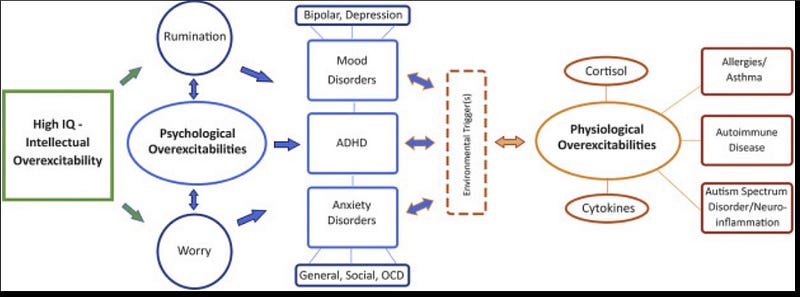
There are some diseases that highly intelligent people are less likely to develop than the general population. They include things like heart disease and diabetes. In the more likely to get column mood disorders rank high.
Psychoneuroimmunology (PNI) researchers investigate how psychological factors such as stress, emotions, and cognitive processes can influence the functioning of the immune system, as well as how the immune system can affect the brain and behavior. For example, studies in PNI have shown that chronic stress can lead to changes in the immune system that make individuals more susceptible to infection and disease. Similarly, research has also revealed that certain immune system molecules can act on the brain to alter mood and behavior.
Psychoneuroimmunology is the study of the relationships among behavioral, neural and endocrine, and immune processes. Bidirectional pathways connect the brain and the immune system and provide the foundation for neural, endocrine, and behavioral effects on immunity. Examples of such effects are conditioned and stress-induced changes in immune function and in susceptibility to immunologically mediated diseases. These data indicate that researchers should no longer study the immune system as if it functioned independently of other systems in the body. Changes in immune function are hypothesized to mediate the effects of psychological factors on the development of some diseases, and research strategies for studying the clinical significance of behaviorally induced changes in immune function are suggested.
Hyper-brain / Hyper-body Experience
The term hyper-brain / hyper-body refers to an area of neuroscience studying whether a brain that appears to operate more efficiently in the area of intelligence might have some correlation to how the brain’s host — the body — works. A revolutionary concept, I know. This personal essay deals mostly with the area of Psychoneuroimmunology — how the overly excited brain correlates with autoimmune disorders.
Among people with high IQ, there’s a much higher incidence of autoimmune disease as well as other physical problems that are typically related to stress and anxiety. The brain may be running too fast, releasing too many hormones that put people in a state similar to the “fight or flight” mode. The adrenalin rushes are hard on the body and tend to wreak havoc on normal internal systems.
Most Commonly Recognized Autoimmune Diseases
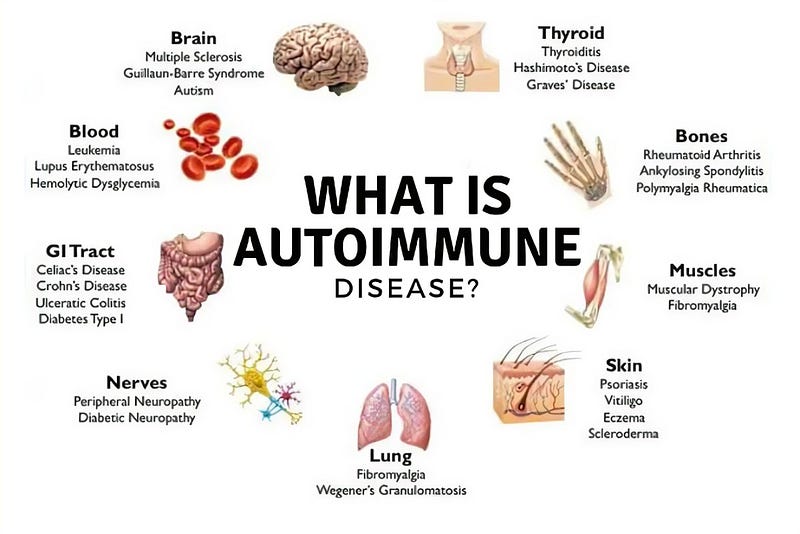
Doctors have historically stated it’s rare to have more than one autoimmune disease. However, recent medical research shows that having one makes you more likely to acquire more. Multiple autoimmune diseases is still considered rare, but I believe research will make the connection between the majority of those currently defined.
It’s a notion similar to cancer when a cell mutates abnormally and spreads. In my case, the brain doesn’t properly recognize what’s good and what’s not so goes on the attack against whatever random system is up for grabs.
The seek-and-destroy attacks come at warp speed when I’m very stressed out. My stomach literally digests itself — an especially painful exercise. The digestive disorder results in acids being released into the blood stream as well as bleeding into the stomach. This causes a cascading effect of inflammation and extra work for the kidneys and liver.
Some researchers believe acquiring a new autoimmune condition may be a result of medical intervention to treat the first problem. While that’s a good possibility — the steroids and methotrexate I tried to treat rheumatoid arthritis and ulcerative colitis (at different times with a long period between the two therapies) were powerful and harmful in many ways. Seeing how one targeted treatment could cause a flare-up of another condition, I swore off disease-modifying drugs quickly and permanently.
As I list the autoimmune disorders I’ve been diagnosed with I think it’s pertinent to disclose that along the way I initially denied diseases an inch. When possible, I kept up a slightly modified schedule, using heat or ice to treat pain. I wasn’t willing to give up a life I enjoyed.
Being a patient is my least favorite role in life. Being independent is important to me. Perhaps the begrudging awareness of the diseases and an underlying recognition of their debilitating features triggered related anxiety and were contributing factors, making me more susceptible to acquiring the next opportunistic disease. Having access to decent healthcare is listed as an assumed advantage to those who are gifted. Choosing not to use it until an emergency arises ranks as pretty idiotic.
Multiple Autoimmune Disorder Diagnoses
I was diagnosed with rheumatoid arthritis — an autoimmune disease when I was 12 and had to quit competing in Track & Field events. Up until then, I’d led a very active, athletic lifestyle.
When I became pregnant my body extended its categorization of body joints as dangerous alien invaders to include the fetus I carried. Miscarriages were the norm. I was finally able to have a child, but the pregnancy was difficult due to preeclampsia, perhaps more aptly described by its first name — toxemia, wherein the pregnancy is seen as toxic to one’s own body. My daughter just barely survived delivery by emergency c-section following severe fetal distress. My autoimmune system doesn’t properly recognize friend or foe.
Recent research shows in fact, RA probably did contribute to miscarriages and pregnancy complications. The whole-body inflammation can cause both preeclampsia and damage the fetus.
In my early 30’s bleeding stomach issues were diagnosed as ulcerative colitis — an autoimmune disease. Later, a bleeding duodenal ulcer made doctors expand the diagnosis to Crohn’s disease which involves the entire digestive system. Those episodes included significant blood loss, so did require a modified diet (yum — butterscotch Ensure!) and considerable down time.
Rheumatoid arthritis is a painful disease that causes bones and joints to become inflamed and degenerate into something hardly recognizable, but it doesn’t usually attack muscles. Severe shoulder and back pain were diagnosed as yet another autoimmune favorite — Fibromyalgia. When lung involvement began, I was forced to use an oxygen concentrator (primarily at night) to keep my oxygen levels within normal range. This while I was still active and running my own consulting business in my 40s.
Peripheral neuropathy, rheumatoid arthritis or fibromyalgia? Whatever it is, I began waking most days with “claw hands” clenched in fists. I was unable to extend my fingers without something to push and pry them open. My cat proved helpful by repeatedly butting her head into them until I was able to properly pet her. The dogs were more considerate.
Psoriasis has been an on-again / off-again companion. Again, worse when I’m very stressed.
I’ve only mentioned the ailments normally attributed to autoimmune disorders. There have also been kidney and liver problems that were chronic but not easily understood.
Conclusion
So, there are disadvantages to being born with a brain that doesn’t operate in a typical manner. I can’t honestly say my life would have been better if I’d been born with an average IQ, but I suspect my body would have worked more like a normal person’s.
It may seem like it would be nice to be able to ace a test or answer the teacher’s question quickly and easily, but it would have been nicer to fit in. When you’re defined as very smart there’s an expectation that you’ll easily succeed in life, and you accept and adopt that expectation. That can mean an awful lot of pressure put on yourself. If you’re like me, there will never be a point when you can claim success because the bar will always keep moving up. Relaxation comes hard for many people like me.


