

Integrating economy and ecology with wisdom
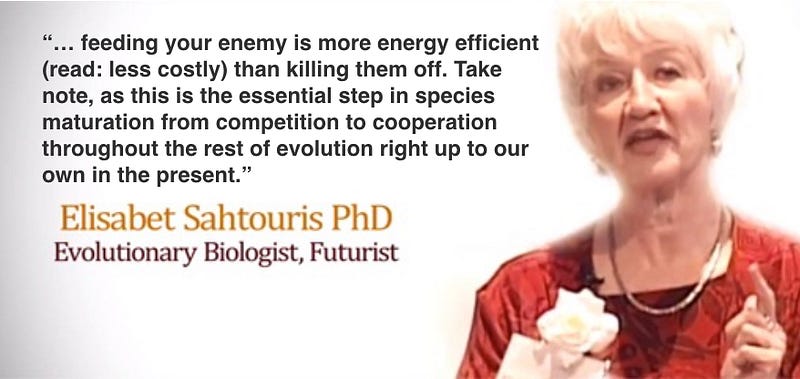
The evolutionary biologist and futurist Elisabet Sahtouris describes how in the evolution of complex communities of diverse organisms a ‘maturation point’ is reached when the system realizes that “it is cheaper to feed your ‘enemies’ than to kill them” (personal comment).
Having successfully populated six continents and diversified into the mosaic of value systems, worldviews, identities (national, cultural, ethnic, professional, political, etc.) and ways of living that make up humanity, we are now challenged to integrate this precious diversity into a globally and locally collaborative civilization acting wisely to create conditions conducive to life.
“We have now reached a new tipping point where enmities are more expensive in all respects than friendly collaboration; where planetary limits of exploiting nature have been reached. It is high time for us to cross this new tipping point into our global communal maturity — an integration of the economy and ecology we have put into conflict with each other, to evolve an ecosophy.”
Elisabet Sahtouris (2014)
The challenge of a fundamental re-design of how we do business, of our patterns of production and consumption, of the types of resources and energy we use, goes hand in hand with the structural redesign of our economic systems. We have to challenge economic orthodoxies and basic assumptions, and find ways to integrate multiple perspectives if we hope to redesign economies at multiple scales and learn how to manage our household with wisdom (oikos + sophia).
If our Homo sapiens sapiens wants to continue its fascinating yet so far relatively short evolutionary success story we have to evolve wise societies characterized by empathy, solidarity and collaboration. Wise cultures are regenerative and protect bio-cultural diversity as a source of wealth and resilience (Wahl, 2016).
We will take a closer look at the social and ecological impacts of the current economic and monetary system, and will explore why the globalized economy behaves as it does before we explore strategies for re-design and inspiring examples of best processes and practices in the transition towards sustainable and regenerative economic patterns at multiples scales.
By revisiting basic assumptions about economics we can begin to integrate ecology and economy in full reconnection of the interbeing of nature and culture. We need wisdom to re-design an economic system fit for life. Here are some insights that can help us:
- The rules of our current economic and monetary system have been designed by people and we can therefore re-design them.
- We have to question the role of scarcity, competition, and the maximization of individual benefit has cornerstones of our competitive economy.
- In redesigning economic systems at local, regional and global scale we should pay special attention to how the system incentivises regenerative practices, increases bio-productivity sustainably, restores healthy ecosystem functioning, while nurturing thriving communities.
- Modern evolutionary biology transcends and includes Darwinian justifications of competition as ‘human nature’, as it acknowledges that complex patterns of collaboration have enabled the evolution of our species and the continued evolution of consciousness towards planetary awareness.
- Our ability to cooperate has shaped who we are in equal and possibly more profound ways than competitive behaviour, hence we need to re-design economic systems to establish a healthy balance between the way competition and collaboration are incentivised in the system.
- Rather than maximizing isolated parameters or the benefit of a select few, a re-design of our economic system to serve all of humanity and all life will have to optimize the health and resilience of the system as a whole (understanding humanity as nature; and the economy as a sub-system of society and nature in interconnected eco-social systems).
- The dominant narrative of separation creates a focus on scarcity, competition and individual advantage, while the emerging narrative of interbeing challenges us to create a win-win-win economy based on the understanding that it is in our enlightened self-interest to unlock shared abundances through collaboration.
…
NOTE: this is an (edited) excerpt from the Economic Design Dimension of Gaia Education’s online course in Design for Sustainability. The first version of this dimension was written in 2008 by my friend Jonathan Dawson, now Head of Economics of Transition at Schumacher College. In 2015–2016, I revised the Design for Sustainability course substantially and rewrote this dimension with more up-to-date information and the research that I had done for my book Designing Regenerative Cultures.
The next installment of the Economic Design Dimension started on March 19th, 2018 and runs for 8 weeks online. You can join the Design for Sustainability course at any point during the year.