
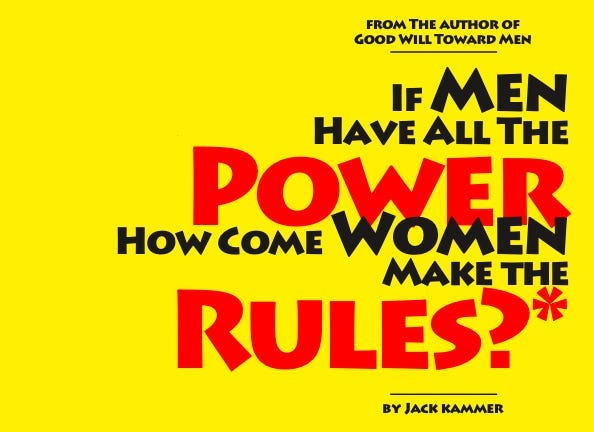
Installment 12. If Men Have All the Power How Come Women Make the Rules?
Share this compelling intro to the Men’s Movement with your skeptical friends.
If, as Einstein said, all things are relative, nothing can be more relative than the relationship between the sexes. Our point of view is as valid as women’s, and is much more in need of being heard.
Taking Equal Control of Dating
Women who use singles telephone chat lines in Australia don’t have to pay for the services but men do because the chat line companies got exemptions from anti-discrimination laws by arguing they would go out of business if they had to treat men and women equally. “Women definitely have the upper hand in the dating game,” said one company official. “Their reluctance to pay for these type of services is a worldwide phenomenon.”
— derived from the Herald Sun (Melbourne), May 21, 2001
- Instead of fretting about whether our dates are the kind of women who want us to open their door, we need to decide whether we’re the kind of men who want the kind of women who want us to open their door.
- And if you’re going to open her door, it might be worth asking what kind of “old-fashioned” things she’s going to do for you.
It is in the minds of at least many women to pretty much blithely do what they want to do and be how they want to be, and then expect us to adjust, to figure out how we can service them, how we can win their favor.
“[The woman] doesn’t have to do anything more on the date than show up… don’t make it easy for him… he has to do all the work.”
— Ellen Fein & Sherrie Schneider, The Rules
We need to turn that situation around-at least half-way. We need to be secure in the knowledge that we have something women want and need: maleness, masculinity, a different way of looking and laughing at the world, different ideas of raising kids, penises attached to fully functioning, autonomous human beings. You want me? Okay, I might want you. What do you have in mind?
Ultimately women find male strength to be much more appealing than desperation, malleability and obsequiousness.
- Do we have to pay for dates because we make more money, or do we make more money because we have to pay for dates?
- Women say the rule is “You ask, you pay.” Why not “You accept, you pay”?
- If “you ask, you pay” is really women’s rule, does that mean that women who place personal ads pay for the dates they get as a result?
- How come “you ask, you pay” or “the person who makes more money should pay” isn’t the rule when “girlfriends” go out together?
And exactly why should we pay for dates?
“It’s just chivalrous… It’s nice of you to care about his finances, but remember he is deriving great pleasure from taking you out.”
— Ellen Fein & Sherrie Schneider, The Rules
“‘The guy should pay [for dates]…’ says [ESPN SportsCenter anchor Rich] Eisen…
“Why is that?… ‘Hey, those are the rules,’ he says. ‘I don’t make them. I just follow them.’”
—Talk Magazine, September 2000
A better question
“Any woman who expects the man to pay for everything all the time is behaving like a spoiled princess… A woman who has the means to pay for a date but refuses to do so is saying the pleasure of the man’s company is not worth the price of dinner. Why should any man want to waste his time with a woman who has such a low opinion of him?”
— letter to the editor from a woman in Silver Spring, Md., New York Times, August 31, 2001
Like this woman, for instance
“‘Of course the men have to pay and buy you presents. Men have to spoil you. You have to be spoiled,’ says [a 26-year-old woman] who works in public relations. ‘If you don’t think you’re a princess you’re not going to be treated like one. You have to make sure you know-and they know-you’re a princess. This is my feminism. It’s the new feminism to say, “I’m expensive. I need lots of attention. I need men to bend over backwards for me.”’”
— article by Rebecca Eckler in the National Post (Canada), August 26, 2000
A man quoted by Maureen Dowd in the New York Times, August 29, 2001 said. “[Paying for dates] is one of the few remaining ways we can demonstrate our manhood.”
Actually, it’s one of the many remaining ways we continue to demonstrate our chumphood.
In the same article, a 33-year-old female TV producer in New York told Dowd, “If you offer [to pay] and they accept, then it’s over.”
One day, when relations between the sexes are more fairly balanced, we’ll say “If she doesn’t offer by the second date, it’s over.”
Wouldn’t that be powerful?
Funny but wrong, wrong but true video sidebar from 2020
Aside from who pays, it’s also important who asks
Suppose you have a wristwatch and you badly need $200. You might go up to someone and say, “I just paid $400 for this watch last week. Look, here’s the receipt. Here’s the warranty card. It’s legit. I need some cash quick. I’ll sell it to you for $200.” The other person says, “I don’t need a watch. I have a watch. I don’t like that watch. I’ll give you $100.” And you say, “$150.” And he says, “$125.” And you say, “Deal! I’ll take it.” And you end up getting $125 for your $400 watch.
Now suppose somebody comes up to you and says, “Man, I need a wristwatch bad! How much did you pay for that one?” And you say, “$400.” And he says, “I’ll give you $500 for it.” And you say, “I don’t need the money. I like this watch. It’s special. It has sentimental meaning to me.” And he says, “I’ll give you $600.” And you say, “It means so much to me.” And he says, “$700.” And you say, “Make it $800.” And he says “$750.” And you say, “$775.” And he says, “Deal! I’ll take it.” And you end up getting $775 for your $400 watch.
What’s the difference between the two situations? Why is the watch worth $125 in one transaction and $775 in another? What’s the difference?
The difference, as Fred Hayward of Men’s Rights, Inc., points out, is that the person who initiates the transaction is almost always in the weaker bargaining position.
Here’s the main point about who pays for dates. The more you pay, the more you’re setting yourself up to be the one who will provide money in the relationship. The more you are the one responsible for providing money, the fewer options you will have in your future to do anything else.
“The feminist freeloading doesn’t change with marriage. Professional women still want their husbands to get the checks at restaurants, pay the mortgage and get home by 6:30 to help with chores and kids.”
— Maureen Dowd, New York Times, August 29, 2001
When it comes time to pay for the first date, pick up the tab, smile at your date and say, “This one’s on me. And I won’t mind a bit if you pick up the next one.” Simple. Easy. Fair. And it’ll help you find out quickly just what she wants you for.
A Hard Man Is Good to Find
“Pre-Nineteenth century Western culture assumed that women, not men, were the insatiable sexual aggressors, with men as vulnerable creatures in need of protection.”
— Historian Peter N. Stearns in his 1990 book Be a Man: Males in Modern Society
- Why is sex thought to be something women give and we get?
- We need to be more selective about whom we have sex with. A woman should give a man an erection at least three times before he gives it to her once.
In 1972, a research project called the Boston Couples Study (BCS) interviewed 462 dating college students. A follow-up study 25 years later found that the men who had not rushed into sex but rather had waited for a committed emotional relationship were more likely to be having happy adulthoods than those who had followed the standard script that says males should have sex as often as they can ‘get it.’
— author’s correspondence with Professor Charles Hill, director of the BCS in 2001
More installments to follow.
Originally published at https://mensturn.substack.com.


