
Inspirational Quotes By Carl Jung
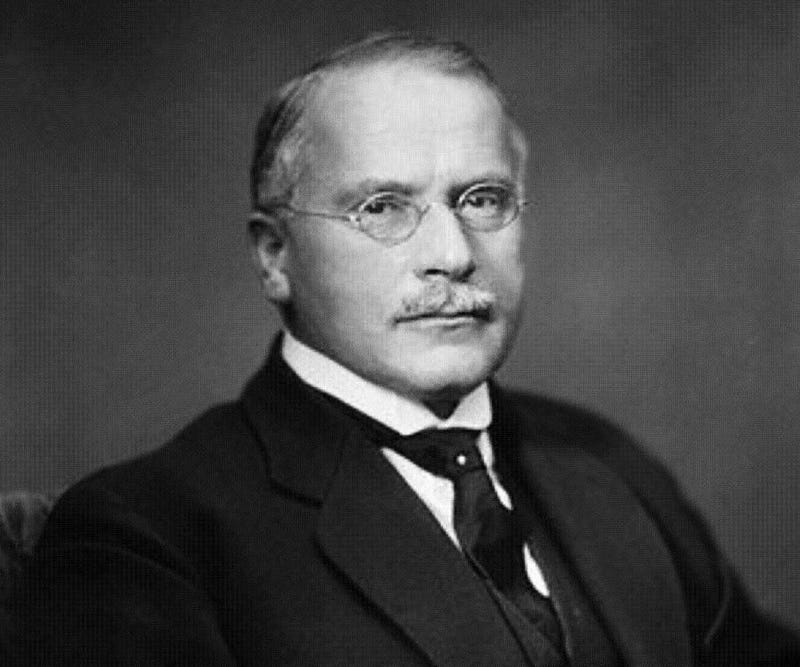
Carl Gustav Jung was a Swiss psychiatrist and psychoanalyst. Due to the wide range of Jung’s interests, his work was influential in the fields of psychiatry, anthropology, archaeology, literature, philosophy, and religious studies. Jung was also an artist, craftsman and builder as well as a prolific writer. Many of his works were not published until after his death and some are still awaiting publication. Given the variety of disciplines Jung drew from when conceptualizing psychology as well as how influential is theory became it is not surprising that he said many things that encouraged and inspired others. Some of the most notable or Jung’s quotes are collected below.

Whenever we meet new people, we usually explore what they have in common with us. Sometimes, although they may seem perfectly nice there is just no desire to get to know them any further. Other times, we meet someone who appears extremely similar to us and really hit it off. We like the same things, come from a similar family and background, went to similar schools, share the same religion, have read the same books etc. We exchange numbers and make plans to have coffee or share a meal.
While this person may go onto become a close friend they aren’t likely to make us think through our thoughts, beliefs, or aspirations as they have almost identical ones. But then there are times we meet someone who challenges the way we view the world. We may get into a heated debate about politics, philosophy, motivations or ethics. In the end, we may feel drawn to the person enough to want to continue the conversation at another time or perhaps we seem too different, so we choose not to engage with them further.
Regardless of the outcome, these are the types of interactions from which we grow and develop our ideals. When our beliefs are challenged and we defend them, explain them and expound on them while the other individual does the same one of three things happen. This exchange lets us further explore our own values leading to us better understanding them such that they are strengthened. While hearing the other person’s point of view we may also consider aspects we hadn’t thought of before.
This may result in subtle or not so subtle changes in our beliefs to the point we incorporate some of the other person’s ideas into our conceptualization. On some occasions we may even learn enough new information that our assumptions are rendered inaccurate or invalid and after thinking through this new information we eventually abandon or initial belief and adopt a new one.
Regardless of the outcome, we can only grow by remaining open to others viewpoints and beliefs, regardless of if we agree with them or not. These challenging interactions can be exciting and sometimes even volatile but they are always formative in some way. These are the reactions and interactions that transform us and make us into the people we are destined to become.
When we feel annoyed by someone else, we can use this as an opportunity to learn more about ourselves by closely examining our reaction to see what it reveals. Our emotional reaction — to perceived flaws in others reflects something going on inside of us.
Though first described by Freud, Jung also strongly believed in the idea of psychological projection. This is the process of projecting our own flaws and insecurities onto someone else so as to disassociate it from us. When we are critical of someone else, this may be in order to avoid confronting these same characteristics in ourselves. Herman Hesse expressed the same idea:
If you hate a person, you hate something in him that is part yourself. What isn’t part ourselves doesn’t disturb us.
When trouble comes into our lives sometimes we may attempt to cope with it by refusing to acknowledge it. Often in current times advice about dealing with difficulties involves focusing on the positive, ignoring or reframing the negative, dealing with the problem in the best way possible while keeping an optimistic attitude and moving past it. While Jung wouldn’t discount these methods, he would also say that there is a major part missing that could cause the problem to return.
According to Jung, in order to handle the trouble that we will inevitably encounter in our lives, we first have to face the darkness, recognize and accept our feelings related to it. It takes courage to recognize the darkness in our lives and in ourselves. It also takes perseverance as we won’t do this successfully the first time. Self-discipline is necessary to focus on self-awareness regularly such that we notice the darkness building before it becomes overwhelming and almost impossible for us to handle.
The problem with focusing exclusively on the positive and problem solving strategies as the darkness that creeps over us is not actually caused by the problem itself. It is caused by our reaction to the problem, our thoughts, beliefs, attributions about causation, self esteem, sense of self-efficacy and emotions. Our reactions to problems are also determined by the struggles we have experienced in the past, how they affected us and whether we feel we handled them successfully.
Jung would also say that the self awareness that we need to overcome the darkness within ourselves is dependent on how much of the necessary resources and information is accessible to us, or how much of it is conscious vs. unconscious. If much of it is unconscious we may need help determining when we are ready to uncover it as well as with bringing it into consciousness. While this whole process may seem beyond our ability to handle, Jung had faith in mankind, in our capacity to ultimately cope with what we need to in order to live a happy, fulfilling life.
All of us have negative things that have happened to us in our lives. Sometimes these things are so difficult we feel that we can’t overcome them. Of perhaps individually, each situation does not seem devastating but when one comes on top of another the cumulative effect makes us feel as if we can’t go on.
Yet the things that have happened to us do not have to define us. While we can’t change the past, we have the ability to choose what our present and our future will be like. This is not to say that determining how to move past difficult situations that occurred in the past is easy. It takes determination and a strong support network.
Finding the support we need may be the logical first step. When we find others who have made similar life changes, or who have learned to think differently about the world around them and their place in it, this can give us the boost we need to alter our own life course by taking control of it.
Everyone feels sorry for themselves at times. This is not the end of the world. But it is important to make sure it is time limited. It’s okay to take an hour or two to let ourselves feel self pity if we need to. But then we need to leave the pity behind and think of what we can do to either correct the situation or if this isn’t possible, to move in a different direction. Taking control means no longer accepting that the world and everyone in it acts on us and instead believing that we act upon the world to create our own reality.
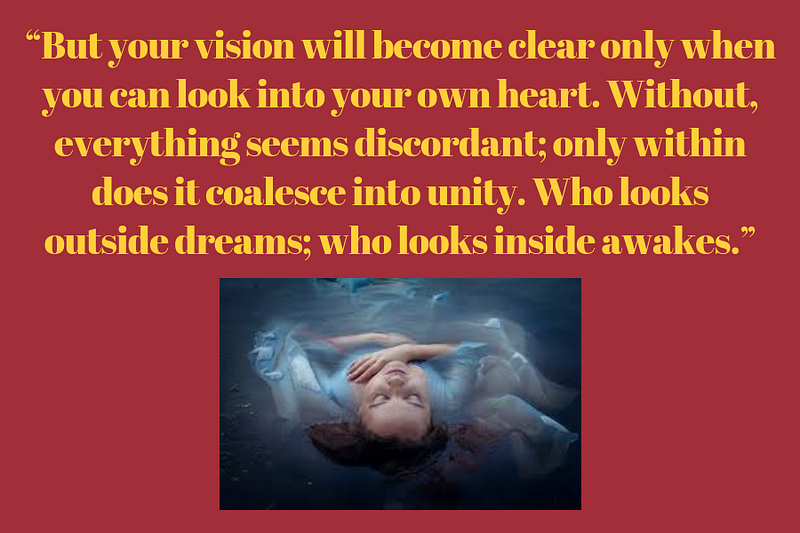
Dreaming is wonderful. It permits us to entertain things that may not be possible in reality given us a sense of freedom from constraints. Dreams also can trigger creativity and let us perceive a possible future that does not yet exist.
However, dreams also allude to a phenomenon that occurs when we are sleeping and unable to have any effect on the real world. This is the same when we daydream. Daydreaming may be pleasant but it often involves fantasies of situations that aren’t truly possible and entails our using our imaginations to explore we’d like to have happen but which is outside the realm of reality.
Jung also alludes to the other meaning of dreaming here, aspiring to achieve something that we will need to put effort into or take a number of steps over time to accomplish. Yet the question is from where do our dreams originate? When looking externally, we may determine our dreams based on popular culture, peer pressure, parental expectations or what the majority of people in our social circle believe to be worthwhile. When we determine our dreams based on external sources, though we may convince ourselves for a time these dreams really are our own, in reality they don’t reflect what we truly want. This means that there will be some sense of dissonance we feel about pursuing these goal.
Our dreams will also be changeable based on the group that is the most prominent in our lives at the time. This will make our aspirations seem fleeting, vague, and elusive like real dreams are. It is only when our dreams match our true selves, our real beliefs based on what we find meaningful, important and worth pursuing. The only way to make sure of this is to search within through self-reflection to determine which dreams we wish to pursue. This will help us make sure that what we spend our life working towards aligns with who we really are.
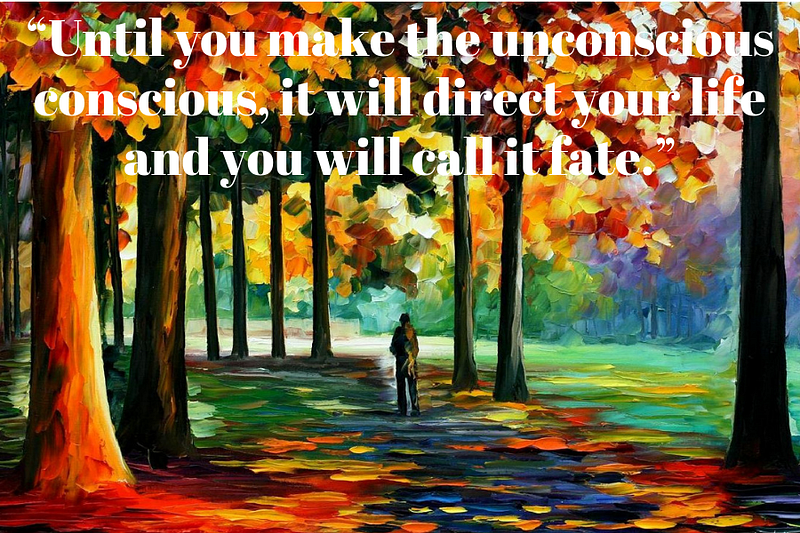
When we push anything difficult into our unconscious and fail to ever take it out when we feel we can deal with it, we will get into the habit of treating our unconscious like an attic. It will become filled with things we should have dealt with, but forgot about. Our unconscious will be capable of causing us to do things without awareness causing outcomes to be generated from within and it will seem like these things just happened of their own accord.
It is only when we are willing to try to process things that seem to have occurred without our input or direction in an effort to discover what caused them that we can reclaim control over our lives. Until then, we will continue to avoid looking too closely at what is in our unconscious and, without any other explanation, call the course our life takes fate.


