
Insights Into Mapping Brain Repair and Remodeling After Stroke
Novel approaches to promoting stroke prevention and recovery gleaned from my research when caring for my mother
It was a lazy Sunday afternoon in April when my mother suddenly had trouble seeing out both of her eyes. She knew something was seriously wrong, but instead of calling 911, my mother left a message at her physician’s regular office number.
She made a critical mistake. During a stroke, every minute counts. My mother suspected she was having a severe health problem, but she waited for her physician to call her back. Since it was a weekend, they didn’t.
When a family member figured out what was happening to my mother, they rushed her to the hospital, but it was too late to reverse the stroke with lifesaving treatments.
A Tragic Ending of My Mother
My mother survived that first stroke but had many disabilities ranging from impaired speech to restricted physical abilities, weakness, and paralysis of limbs on one side of the body.
She had difficulty gripping or holding things and a slowed ability to communicate. My mother continued to deteriorate after the first stroke and eventually died of a massive stroke a few years later.
The type of stroke my mother suffered from was an ischemic stroke, which involves blood clots that block blood flow to the Brain.
Sadly, if my mother had gone immediately to the hospital, she might have been given a clot buster known as a tPA (tissue plasminogen activator). The drug can stop a stroke by breaking up one or more blood clots.
An Overview Stroke Types
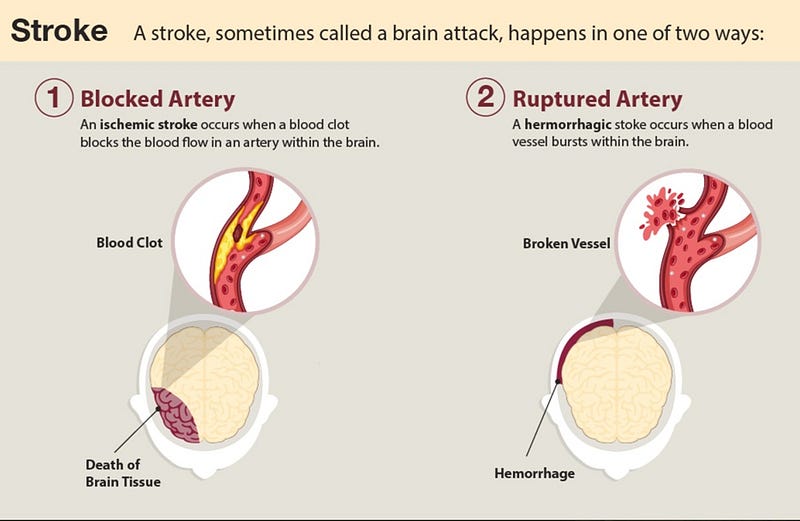
A stroke, which is also called a Brain attack or cerebrovascular accident (CVA), is a severe medical condition that happens when something blocks the blood supply to part of the Brain like a clot, or when a blood vessel inside the brain suddenly bursts.
In either case, parts of the Brain become damaged or die. A stroke can cause lasting long-term Brain damage, long-term disability, or even death.
There are two main types of stroke: ischemic, due to lack of blood flow, and hemorrhagic, due to bleeding. Both cause parts of the Brain to stop functioning correctly.
An ischemic stroke, which involves clots, accounts for 87% of all strokes. When treated promptly and appropriately, they are the easiest to recover from. That is the type of stroke that robbed my mother of her life.
Hemorrhagic strokes are often challenging to treat because they’re difficult to reach directly.
Cellular Response to Stroke
A transient ischemic attack (TIA) is a “warning stroke” caused by a temporary clot. Everyone needs to take this warning sign for stroke seriously — call 911 immediately. Who knows if my mother had a TIA? No one will ever know.
A cryogenic stroke usually occurs when clots block blood flow to the Brain. Sometimes, the cause of a stroke can’t be determined.
Researchers at Weill Cornell Medicine have painstakingly cataloged the cellular response to stroke in a preclinical model, identifying the immune cells involved and the roles they may play in the days and weeks following a stroke.
During a stroke, loss of oxygen leads to brain damage and cell death. It also triggers a robust inflammatory response in which the Brain’s resident immune cells and cells recruited from the blood infiltrate the injured tissue.
Novel Findings for Stroke Recovery
The findings, published in Nature Immunology on January 4, 2024, could point toward novel approaches to fostering stroke recovery and provide insight into why therapies to control inflammation after a stroke have not been successful.
“Nearly every one of us knows someone who’s had a stroke. It’s a huge problem,” said Dr. Josef Anrather, a professor of neuroscience and vice chair for research in the Feil Family Brain and Mind Research Institute at Weill Cornell Medicine and the study’s senior author.
“But in terms of treatment, there is little a physician can do.”
Interventions that successfully restore blood flow to the affected brain region must be administered within hours to be effective. “So, most people, more than 80 percent, receive no therapy at all,” he said.
Understanding how immune cells contribute to repairing and remodeling the brain in the later, chronic phase after a stroke could help doctors minimize the long-term neurological consequences, including dementia and seizures.
In 2016, Dr. Anrather and his colleagues observed that immune cells called monocytes, made in the bone marrow, accumulate in the brain following a stroke.
The Rise of the Monocytes
Once there, they appeared to undergo a physical transformation. Some sprouted spindly arms, adopting the appearance of the brain’s resident immune cells, the microglia.
Others grew more amorphous and amoeba-like. But what, if anything, did this shapeshifting have to do with their behavior?
“We became interested in knowing the function of these different structural characteristics,” said lead study author Dr. Lidia Garcia-Bonilla, the Finbar and Marianne Kenny Research Scholar in Neurology and an assistant professor of research in neuroscience at the Brain and Mind Research Institute, Weill Cornell Medicine.
They also wondered whether these cells contributed to recovery or compounded the damage. “There are always two sides to the coin,” said Dr. Anrather. The same cell type might be harmful in some circumstances but helpful in others.
“That might be why the clinical trials of drugs that reduce immune cell infiltration into the brain and inflammation have shown no benefit for stroke,” he said.
The most direct way to assess what a particular cell is doing is to determine which genes are turned on. Working with a preclinical model, they collected immune cells at two days and 14 days after an induced stroke — the blockage of an artery in the brain.
Cells Clear Away Damage Before Initiating Repair
Then, they sequenced the RNA molecules, which encode proteins each cell produces. Using this approach, the researchers identified precisely each type of cell they had isolated.
It also provided a readout of which genes each cell had switched on, indicating their roles after the stroke. The researchers first noticed that a population of microglia was rapidly proliferating. That made sense, said Dr. Anrather, “because microglia cover the territory of the brain.”
When their numbers are depleted by an injury, such as a stroke, the cells multiply to blanket the damaged tissue. Then, they take out the trash. “For the brain to rebuild itself, you must clean up and remove dead cells,” said Dr. Anrather.
Indeed, two days after the experimental stroke, the researchers detected a cadre of microglia that switch on genes involved in clearing away cellular debris.
In this effort, monocytes and white blood cells joined the microglia that responded to the injury. Dr. Anrather said. “These cells circulate continuously and don’t really have a job until there is a problem, like an infection, trauma, or tissue death.”
Once they’re needed, Dr. Anrather explained, “They are called in to help clean up.”
Tissue Remodeling
The researchers found the monocytes transformed into the type of cell needed to complete the job. “They’re like little kids that get educated in the tissue,” said Dr Anrather
After the acute clean-up phase, the immune response was restructured toward tissue remodeling. Some cellular recruits produced growth factors triggering repair, while immunological professionals like T cells were called in to play a neuroprotective role.
By identifying which immune cells will heed the stroke-induced distress call, the researchers provide a novel vehicle for intervention. Dr. Anrather said, “Because these cells know how to get to the brain.” He explained, “You could use them as a shuttle and engineer them to deliver a therapeutic treatment.”
Understanding precisely what these cells do when they get to the brain could be essential to developing treatments that can be administered weeks or months after a stroke.
Dr. Garcia-Bonilla said, “Finding a way to activate the brain’s natural repair mechanism could improve stroke patients’ outcomes.”
Summary, Conclusions, and Takeaways
In this story, I focused on how innovative novel approaches are being studied by scientists to promote stroke prevention and recovery.
Stroke is a devastating illness. There are two main types of stroke: ischemic, due to lack of blood flow, and hemorrhagic, due to bleeding. Both cause parts of the brain to stop functioning correctly.
If it isn’t a mortal event, a stroke can shatter the remaining lifespans of the victims and their families. It could be an excellent opportunity to save lives if science can uncover new ways to identify potential strokes and intervene before they occur.
Understanding how immune cells contribute to repairing and remodeling the brain in the later, chronic phase after a stroke could help doctors minimize the long-term neurological consequences, including dementia and seizures.
I want to share a few takeaways from my experience with my mother’s stroke and eventual death and my ongoing research into this condition. I’ve continued to study related stroke research since the disease runs in my family. I want to learn as much as possible about the latest research to lower my risks.
1 — New findings could point toward novel approaches in nurturing stroke recovery.
2 — Immune cells contribute to repairing and remodeling the brain in later, chronic phases after a stroke. The brain’s resident immune cells are called the microglia. Immune cells called monocytes, made in the bone marrow, accumulate in the brain following a stroke.
3 — By identifying which immune cells will heed the stroke-induced distress call, researchers may be able to provide a novel vehicle for intervention
4— Understanding precisely what these immune cells do when they get to the brain could be essential to developing treatments that can be administered weeks or months after a stroke
5— Activating the brain’s natural repair mechanism could improve stroke patients’ long term outcomes.
Apart from a preventative approach to a healthy lifestyle and regular checkups for cardiovascular issues, the key takeaway of this story is that when we have noticeable symptoms of a stroke, we must call 911 immediately to increase the chance of recovery.
You might also check out a story by Dr. Yildiz titled How to Lower the Risks of Strokes in 5 Steps.
Thank you for reading my story. I wish you a healthy life.


