
“Insecure”: A Remarkable Series Comes to a Remarkable End
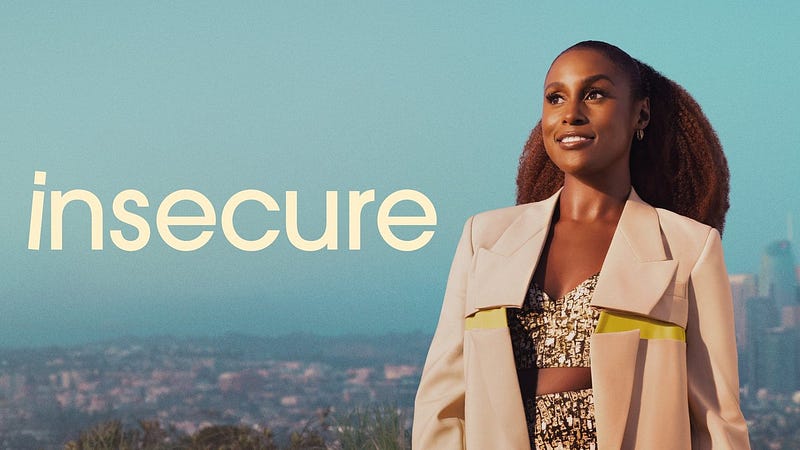
On December 26th, HBO’s critically acclaimed comedy series Insecure came to an end after 5 seasons and 44 episodes. The series was brilliantly written, performed, and directed right up until the end and was a joyous, thought-provoking, and profound celebration of the modern experience of Black Americans.
I almost did not write this article.
Insecure is such a landmark series for Black Americans that I figure the opinions of a white man like me should be inconsequential. I figured I should let Black critics, fans, and social commentators deconstruct and celebrate the show’s legacy. But, then I started to wonder if white people staying silent about the brilliance and impact of Black art actually does any service to the artists involved or whether it just further contributes to the marginalization of Black artists and their art.
So, I decided it was worth adding my voice to the chorus of people paying tribute to Insecure. But there are other, more important perspectives you should read. (A great place to start is this Time Magazine article about the impact of Insecure on the Black creative community.)
After reading some rave reviews and getting some pressure from my best friend, I decided that I would binge watch the series and get caught up by the series finale, which aired on December 26, 2021 on HBO. I watched all 44 episodes in less than 3 months and found it to be a remarkably entertaining, rewarding, and enriching experience.
In this article, I give a season-by-season review and analysis of the show. Naturally, spoilers are included so if you have not finished the show and wish to, I strongly recommend that you bookmark this article and return to it once you are caught up.
Season One (2016)
In 2016, HBO brought a new comedy series to the air that was created by Issa Rae (most famous at that point for her popular web series Awkward Black Girl) and Larry Wilmore (most famous at that point for his role as the “Senior Black Correspondent” on The Daily Show with Jon Stewart). Based in part on Awkward Black Girl, Rae and Wilmore sought to create a series about contemporary African American life that was raw and relatable. And boy did they succeed.
The show centers on two Black women — Issa Dee (Issa Rae) and Molly Carter (Yvonne Orji). They have been best friends for many years when the show begins and they have a remarkably deep sisterhood. They have each other’s backs no matter what, but they are not above judging each other’s choices and boldly call each other on their shit. Issa works for a nonprofit organization called We Got Y’All that aims to help low-income youth in Los Angeles. She works with mostly “social justice warrior” white people, most of whom are spectacularly tone deaf and self-aggrandizing. However, they also work a bit harder and are more inspired than her, creating a very interesting dynamic. She is in what seems like a dead-end relationship with her longtime boyfriend Lawrence (Jay Ellis), who has been unemployed for two years while he tries to get his dating app off the ground. Issa feels stuck personally and professionally and spends the season making questionable choices as she tries to figure out what she wants and where she is going.
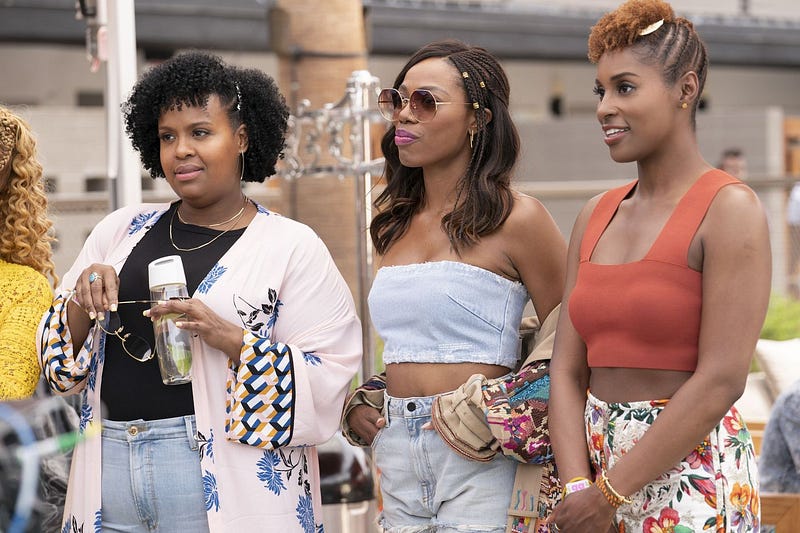
Meanwhile, Molly is thriving professionally. She is an associate at a high-profile law firm and is well-paid and well-respected. However, her dating life is a disaster. She perpetually misreads the signals from men and comes on too strong. She is frustrated and humiliated and spends much of the season coming to terms with her own baggage. Issa and Molly have two female friends that round out their quartet but they both get very little action in the first season. The first is Kelli, played by the brilliant and scene-stealing Natasha Rothwell. The second is the (intentionally) cloying Tiffany, played by Amanda Seales. The other main character is actually Lawrence. Interestingly, the pilot writes him off as a deadbeat boyfriend that Issa will quickly leave behind. But, the show is actually deeply interested in and compassionate toward his character. We realize that he, too, is depressed and stuck and harbors a deep and abiding love for Issa as well as an impressive intellect and drive.
Most of the first season rolls along pretty smoothly, with episodes that flow into the next smoothly and maintain a consistent level of quality. The show rarely soars (the season’s penultimate episode is a notable exception), but it also never flags. Rae and Orji are utterly brilliant and award-worthy with Rae’s character feeling quite singular in the television landscape and Orji putting a fresh, passionate, and edgy spin on the unlucky-in-love-but-successful-at-work single woman we have seen countless times before. The show is also a visual and sonic treat. The show makes great efforts to showcase “Real Los Angeles,” bringing us to neighborhoods that television and movies rarely do. The show also heavily utilizes contemporary R&B and Hip Hop in a way that blends seamlessly into the show’s style and narrative without becoming distracting. Ultimately, the first season of Insecure is great and is made greater by how clear it is that it will grow into something even more special.
Classic Episode: “Real as F***”
Season Two (2017)

A notable step up from the already-strong first season, Insecure becomes a better and deeper show in its second season. The focus is primarily on Issa and Molly’s romantic journeys. Now that she and Lawrence are officially over, Issa decides to try life as a promiscuous, care-free woman. Accordingly, she garners a number of suitors for her “hoe-tation.” However, it never works for her. She finds herself very sensitive to rejection and prone to humiliation and deep down she is always longing for Lawrence. An ongoing subplot of the season that is particularly interesting involves Issa’s work. She and her white coworker Frieda are dispatched to a diverse high school and find that the Black vice principal is deeply racist toward the Latinx students. Issa is forgiving but Freida is enraged leading to a following out between the two and a rich exploration of racism within minority groups.
Meanwhile, Molly gets into a number of different relationships. There’s the one who is perfect on paper but fails to enamor her (Sterling K. Brown’s Lionel), her ex who is now in an open marriage (Sarunas J. Jackson’s Dro), and a supportive fellow lawyer (Lil Rel Howery’s Quentin). But Molly has a lot more going on than just her romances. She is begrudgingly going to therapy, fighting for equal pay at work, and gets her world thrown into chaos when she realizes that her parents’ not-so-idyllic marriage is not so idyllic after all.
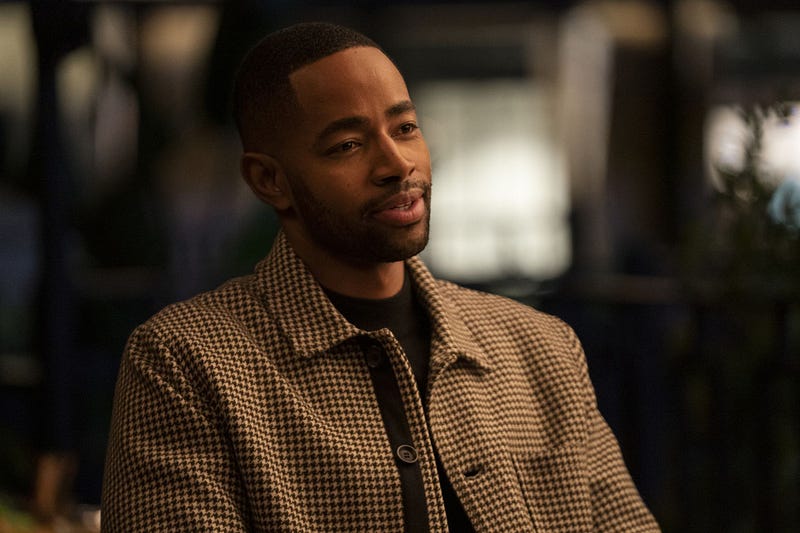
As was the case with the first season this season also tracks Lawrence in equal measure. His flings with Tasha and his coworker Aparna end disastrously and he finds himself repeatedly drawn back to Issa. He also gets a new job and significantly increases his confidence.
The show is light on comedy for comedy’s sake, mostly focusing on character and situation-based comedy and often playing more as a serial dramedy. However, like the first season, the second season has a very amusing running gag in the form of a fictional period drama on television called Due North, which stars Regina Hall and Scott Foley as a slave and slave master having an illicit affair. The characters are shown watching it at various points throughout the season and it hilariously sends up the subgenre of slavery movies. This is similar to the first season, when several characters were seen watching the reality show Conjugal Visits, where female inmates awaited their booty calls.
The acting continues to be uniformly excellent in this season. Issa Rae has a couple of terrific showcases, mostly in her showdowns with Lawrence, Molly, and Daniel; her mea culpa at the school; and every time she engages in a cathartic rap expressing her inner feelings. Molly becomes increasingly likable and nuanced throughout the season and that is a testament to how Yvonne Orji nails every aspect of this character. Similarly, Jay Ellis becomes much more dimensional this season even if he lacks a distinctive comic persona. He’s all charm and depth with few laughs, an interesting move for a comedy series. Kelli’s role expands notably this season, with Natasha Rothwell getting some of the season’s best and funniest moments.
The second season definitely has more sex than the first, at times coming off like a Black and LA-based Sex and the City. Some of these scenes are entertaining and narratively important, while others just feel gratuitous and derivative. Another flaw of the season is that it is quite overstuffed. There are over two dozen significant characters, which is a lot for a 30-minute show with only eight episodes per season. Many are nondescript and fairly unimportant to the narrative, yet they keep taking up valuable airtime. But these minor issues aside, Insecure remains one of televisions’ most bold, original, and important shows in its second season. The season finale, which is split into three parts told from Issa, Molly, and Lawrence’s perspectives is particularly innovative and a good example of what the show can accomplish, especially when it pushes itself creatively.
Classic Episodes: “Hella Disrespectful” and “Hella Perspective”
Season Three (2018)
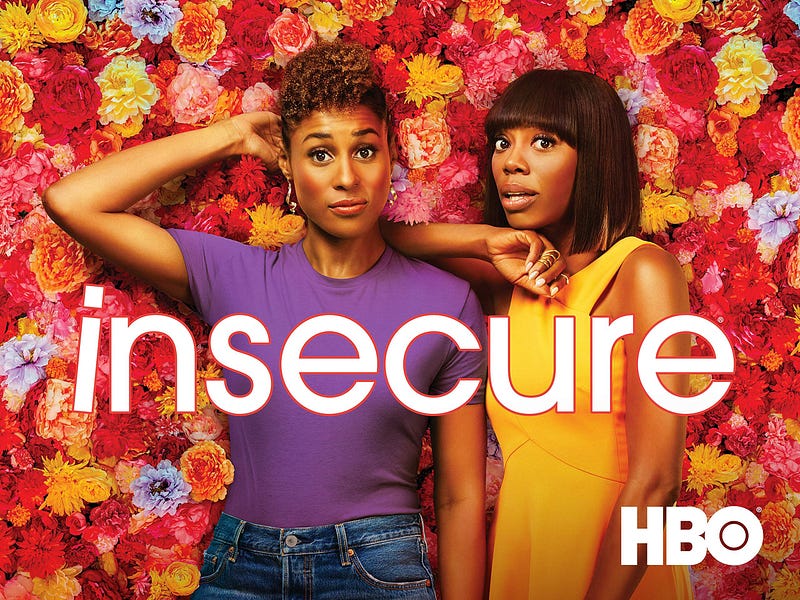
Insecure matches its excellent second season in terms of quality with this eight-episode third go-around. Whereas the second season was equally about Issa, Molly, and Lawrence (as evidenced by its cleverly framed finale), this season is decidedly about Issa. In fact, she’s the only character that appears in all of the episodes. She goes through an impressive and affecting journey throughout the season. When it begins, she is still sleeping on Daniel’s couch after being priced out of her old apartment and is driving Lyft to make extra cash. She has become increasingly disillusioned at work, where she is repeatedly silenced despite being the only person of color at an office devoted to serving people of color. Halfway through the season, she makes some very big changes. She quits We Got Y’All (which means the show also leaves behind the mostly dead-weight coworker characters behind) and leaves Daniel’s place to move into a new apartment where she works as the apartment manager. The tragedy and comedy of her Lyft and apartment manager jobs are never milked for all they are worth (although both elicit some very funny moments), underscoring how this show is first and foremost about character-based comedy not situation-based comedy.
As she is shedding the dead weight in her life, Issa strikes up an intense romantic relationship with a Lyft passenger named Nathan (Kendrick Sampson) who has recently moved to LA. They forge a deep and meaningful connection only for him to painfully ghost her and return unceremoniously, blaming it on his depression. The ghosting leads Issa to go into full obsessive stalker-mode, allowing Issa Rae and her fellow writers to explore the most neurotic, unhealthy parts of the character.
Oh, and during this time she is also trying to plan a huge Inglewood block party as a way to give something nice to Black people. This theme becomes increasingly prominent with each passing season, as the series increasingly showcases the beauty and rich culture of LA’s oft-overlooked neighborhoods. Issa Rae plays this all fantastically, with a more natural, less self-conscious performance than she gave in the prior two seasons. She leans into the more emotional, darker aspects of the character and does wonders.
All this focus on Issa is not to say that it’s a one-woman show. Far from it, in fact. Molly has a major plot arc of her own as she decides to lean into her work. She joins a predominantly Black law firm hoping for some major changes and finds that it is not all that different from her old one. She struggles to fit in due to her competitive nature and is forced to do some soul-searching. Meanwhile, she continues to get over Dro and strikes up a relationship with an Asian man named Andrew (Alexander Hodge) whom she doesn’t give a fair shot.
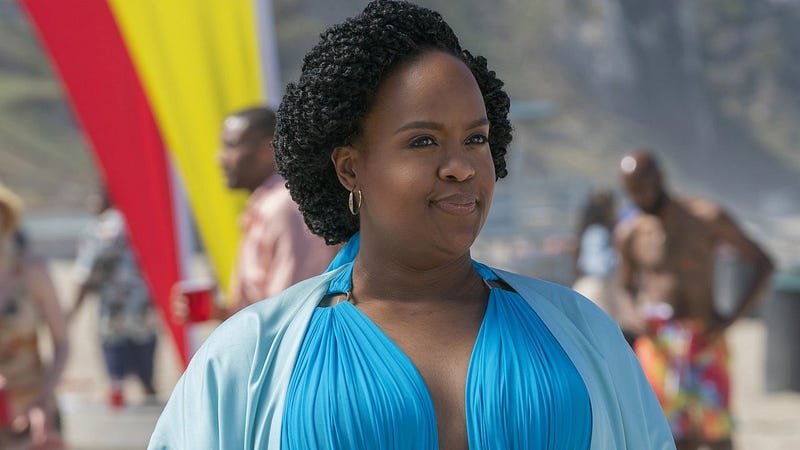
Kelli has a delightfully expanded role this season, with two knockout showcases. The first is on the girls’ trip to Coachella where she takes an edible, fights with a white woman, and gets tased. The second is at Tiffany’s baby shower, where her insecurity about losing her best friend to a baby is explored. Natasha Rothwell knocks it out of the park. The plotlines also give some nice depth to Tiffany, who had been a bit cloying and one-note throughout the first two seasons. Lawrence reappears in a big way in the second half of the season right after Daniel exits the picture (and he enters with a montage of the shady things he has been up to). The focus on Lawrence in the final three episodes after an unexplained five-episode absence is a bit of a head scratcher, but it is a welcome return.
As with the previous seasons, there is a show-within-a-show conceit. This time it’s a reboot of a 90s style Black sitcom (think Martin) with Bill Bellamy playing the main role. It’s not quite as audacious as the last two but it gets some laughs and clever commentary, nonetheless. Ultimately, Insecure continues to be something unique, highly entertaining, and socially important — even if the third season feels like it’s consistently falling just a hair short of its full potential.
Classic Episode: “High-Like”
Season Four (2020)
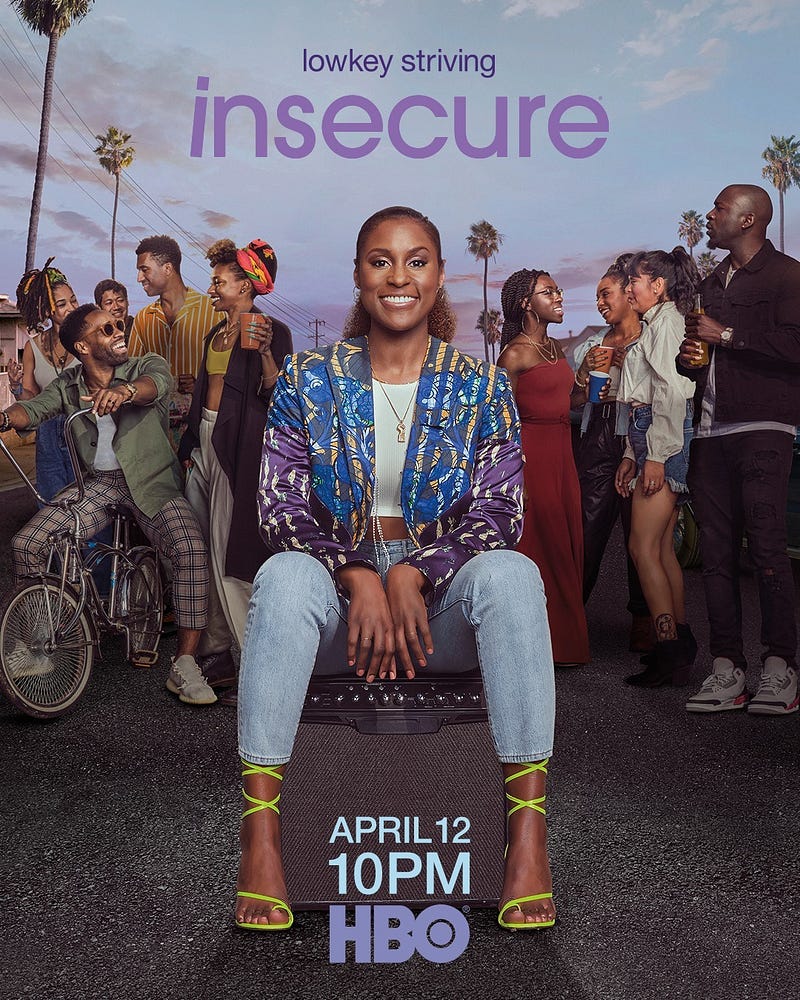
The fourth season of Insecure stands out for numerous reasons. At the most surface level, it expands beyond the 8-episode run of the first three seasons to 10 episodes. Narratively, it finds the show in a difference place as well with Issa having made a major career change and the central relationship of the series (Issa and Molly) being disrupted for the entire season. And the reaction to the season was different as well, as it was when the show really got respect from the industry, as noted by its 8 Emmy nominations (including Outstanding Comedy Series).
The series doesn’t necessarily get better in its fourth season — it was already pretty damn great as comedy, drama, character study, and sociopolitical commentary. But it does get richer and deeper. The most notable aspect of the season is how it chronicles the strained relationship between Issa and Molly with such remarkable attention to detail. In the season’s early episodes, a series of harsh criticisms, passive aggressive behaviors, and outright misunderstandings cause an awkwardness and tension to develop between the two women that is both realistic and incredibly painful. Things come to a head in the season’s fifth episode, which takes place at Issa’s long-awaited Inglewood block party and finds the two women coming to blows. The two episodes that follow chronicle Issa’s reaction to the fallout in a Molly-free episode and then Molly’s reaction in a (mostly) Issa-free episode. Although Issa’s episode works better than Molly’s it is a bold and successful experiment that gives the actresses great material and explores psychologically complex territory.
In the eight episode, Issa and Lawrence have a long-awaited reunion where they talk it out. The episode is brilliantly written by series co-star Natasha Rothwell and is one of the most effective half-hours exploring the complexities of modern romance ever filmed. The season ends with Issa and Molly finally reconciling following a dramatic twist in which a postpartum depression-suffering Tiffany goes missing and the women have to help Derek track her down. It feels a bit rushed and contrived, as does the season finale revelation that Lawrence’s ex-girlfriend Condola (Christina Elmore) is pregnant with his baby. However, both twists succeed at creating effective drama and advancing the plot.
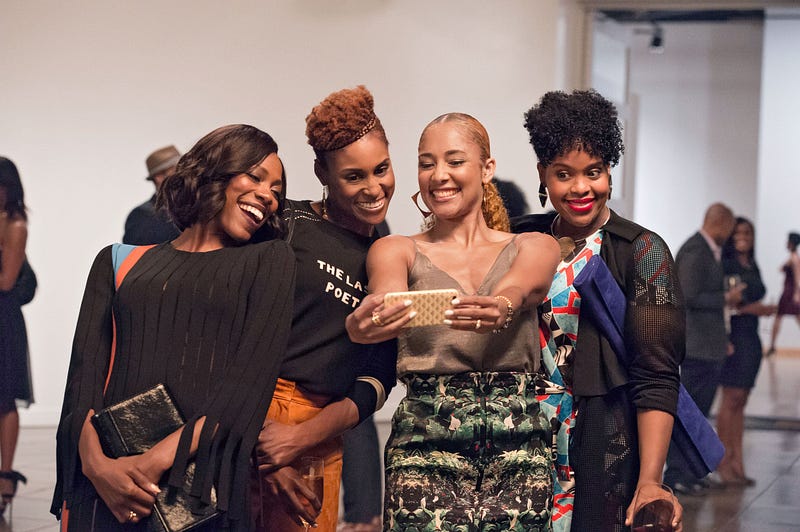
Issa Rae and Yvonne Orji are spectacular throughout the season. Rae gives a much more dramatic and introspective performance than in prior seasons, as she examines her own faults and tries to find her way forward. She is so remarkably expressive that she engenders empathy even when her behavior is frustrating. Molly is also on a major journey, moving outside of her comfort zone professionally and personally. Like Issa, Molly makes some significant missteps as she tries to grow and like Rae, Orji makes every step in the right direction and every error wholly believable. Jay Ellis also gets some great material this season, particularly in the season’s third and eighth episodes where he gets much more focus. And, although she doesn’t get much in the way of meaty material, Natasha Rothwell absolutely steals virtually all of her scenes and provides much needed comic relief for the season.
As was the case with the first four seasons, the show features a show-within-a-show that gleefully skewers Black entertainment. Here, it is the docuseries Looking for LaToya in which tabloid journalist Rose Cranberry tries to get to the root of a missing persons case. In addition to providing laughs and easter eggs, the show allows for the show to subtly comment on the historic mistreatment and abandonment of Black communities by the police and the media. And this isn’t the only way the show gets bolder about its depiction of the Black experience in its fourth season. By having Issa quit her job and embrace a mission to truly serve the Black community and by having Molly explore a relationship with an Asian man, the show moves into complex and fascinating territory that examines racial dynamics previously unexplored by the series.
The season may not be perfect, there are a couple of episodes that fail to cohere into anything truly compelling and some plot elements that feel a bit underdeveloped, but the fourth season contineud Insecure’s run as one of television’s finest and most important series.
Classic Episodes: “Lowkey Movin’ On” and “Lowkey Happy”
Season Five (2021)
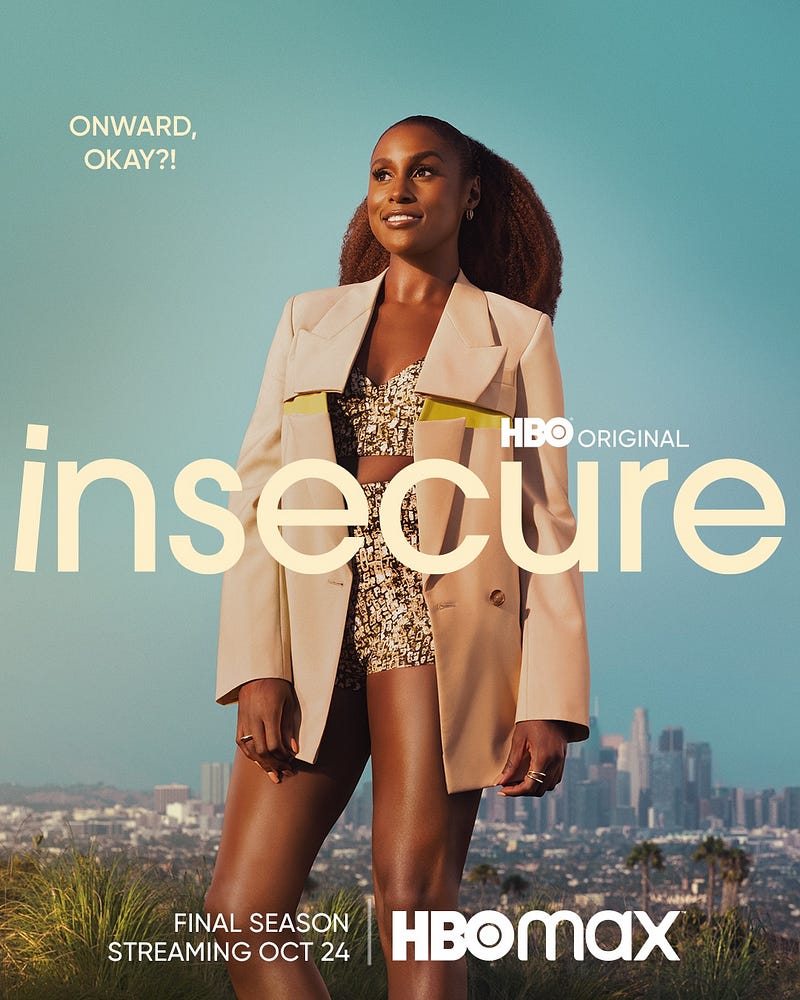
The fifth and final season of Insecure is a thing of genuine power and beauty.
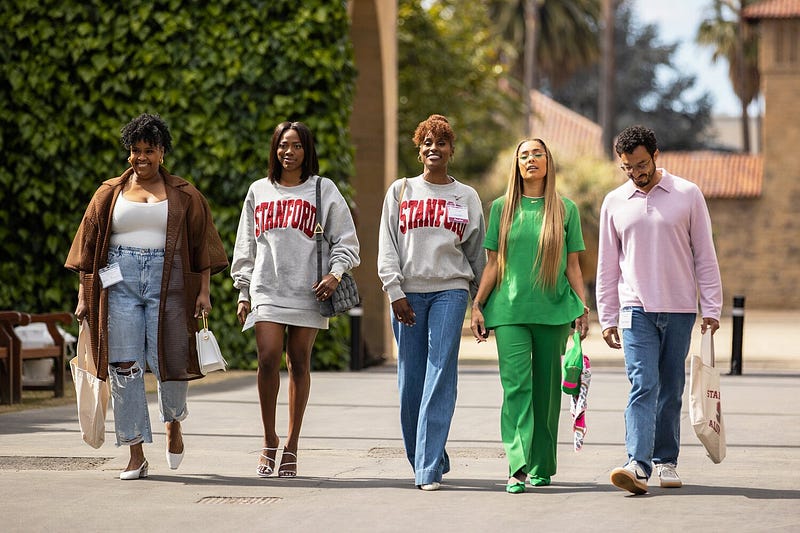
It begins and ends with two of the series’ best episodes and the ones in between are consistently strong gems that tie up loose ends, significantly advance the plot and characters, and delve into rich themes. The season begins with Issa, Molly, Kelli, Tiffany, and Derek returning to Stanford for their 10-year reunion. Issa is at a career crossroads and suffering from “impostor syndrome,” Molly is looking for love, and Kelli is grappling with the fact that due to an error she has been listed as deceased. The episode is hilarious and poignant and delves into the group’s history in interesting ways.
Various plot threads run through the remainder of the season, all of which work well. Issa tries to make some critical decisions about her new business and her romantic life, particularly being caught between current beau Nate and Lawrence, who she just can’t shake. Speaking of Lawrence, he is struggling greatly with trying to do fatherhood long distance. (His baby was born during a major time jump that occurs between the first and second episodes of the season.) The third episode of the season centers almost exclusively on the struggles he and Condola face trying to coparent from 500 miles apart. It is raw and at times excruciating and undoubtedly one of the more accurate depictions of the trials of becoming a parent seen on modern television. He eventually gives up his job not to be with Condola romantically, but to be a better father to his son. It is a touching and realistic conclusion to his character arc.
Well, actually, it’s not the conclusion. The conclusion comes in the final two episodes when he finally decides to fight for Issa, with the two touchingly reuniting at the series’ end. Like Ross and Rachel eventually ending up together on Friends, I always knew it was how the show would end. But, that doesn’t diminish the satisfaction of seeing it actually happen. Equally unsurprising is the fact that Molly’s long and tumultuous journey ends up with her marrying fellow lawyer Taurean. Since his first appearance in Season Three, there was a smoldering tension between them that took up more time and space than it would have if they weren’t going to end up together.
Throughout its run, the writers of Insecure were always very deliberate to not make the ladies’ romantic and sexual conquests be the only focus of the show. In that vain, Molly’s main plot line in the final season really isn’t her romance with Taurean. Rather, her main plot line involves her mother’s stroke and her attempts to get her parents to do estate planning (with the help of Kelli). It’s a heartbreaking detour that really shows Molly’s growing maturity and adds real power to the final season.
The supporting players get some real action in the final season, too. Kelli’s “near-death experience” (as she perceives it) puts her life into perspective and she makes a major change to her job (joining Molly’s law firm), giving up alcohol, becoming more spiritual and philosophical, and eventually partnering and deciding to have a baby. Tiffany and Derek move to Denver for his job and struggle with the transition. And Nate deals with family and work drama, deals with his bipolar disorder, and ultimately lets Issa go. The rich material given to all the actors results in what may just be the acted season of the series. Issa Rae, Yvonne Orji, Jay Ellis, and Natasha Rothwell all deliver awards-caliber performances and with any justice will receive Emmy nominations for their work. Examining their work in the final episodes against their work in the early episodes of the show, it is impossible not see tremendous growth both in their characters and their embodiment of them.
The season oscillates between quiet, slower episodes that have the laid-back feel of earlier seasons and grander episodes (like the final two of the season) that feel more like a long-running cultural phenomenon coming to an end. As with all the episodes of the entire series, the ones in Season Five work. The consistency that the show maintained during its run is truly remarkable and exceedingly rare. This is a testament to the show’s excellent writing staff and stable of directors who keep the show top-notch. The final season is the first to not have a running gag in the form of a background television show that the group is obsessed with. Although somewhat disappointing (as it was always a very funny gag), it is fitting with the more dramatic tone of the final season. And the show still has plenty of rich sociopolitical commentary about the modern experience of Black people in America and continues to highlight the tremendous contributions of Black people to society and culture. Ultimately, Insecure’s fifth season makes the perfect cap to the show’s fantastically high quality and exceptionally important run.
Classic Episodes: “Reunited, Okay?!,” “Out, Okay?!,” and “Everything Gonna Be, Okay?!”
Conclusion
Over the course of 5 superbly crafted seasons, Insecure consistently entertained and evolved. I suspect that Insecure will only grow in esteem as people discover it on HBOMax and as its impact on the Black creative community persists. Right now, I just feel thankful for the whole creative team for this remarkable gift and HBO for investing in it. I also feel hopeful that the Emmys will finally give the show some much-deserved love this year.
Follow the author on Medium and Twitter.
Check out other articles by this author about television and streaming: