
Innovation in the Time of Pandemics
Constraints inspire innovation until they don’t

Winston Churchill once said:
“Never let a good crisis go to waste.”
How should we innovate in a crisis, what elements should we focus on?
Constraints improve innovation, to a point— according to an article published in the Harvard Business Review.
This concept may seem counter-intuitive as innovation is defined by the free flow of imagination without any limitations. Yet, science suggests that individuals, teams, and organizations can benefit from a healthy dose of constraints.
Can we class pandemics as healthy constraints?
In an ideal environment, three key variables affect the innovation process:
• Time • Resource • Objective
So what are the effects of constraints on these variables, and how should individuals, teams and organizations innovate during a pandemic?
Let’s first look at theories about innovating with constraints.
Time as a constraint
“The more limited you are, the more creative you have to be. Time constraints eliminate second guesses. Constraint is a unifier.”
— Chris Denson, Director, Ignition Factory.
Crises can drive creativity. Apollo 13’s expedition and its famous statement, “Houston we’ve had a problem,” is a heavily-documented example. The Apollo 13 team had to improvise with a solution for their safe return home. Away from the rulebooks, they used practices that would have otherwise been considered unacceptable in the industry. With a serious time constraint and their survival on the line, they saw it through.
Resource and objective as a constraint
Although this may sound contradictory, by having constraints, a person’s attention span and ability to focus can improve — resulting in a general increase in productivity.
An abundance of resources can sometimes be counterproductive. Ravi Mehta (University of Illinois) and Meng Zhu (Johns Hopkins University) concluded in 2015 that with excess resources, people have less incentive to use what’s available to them in a novel way. Having a constraint of limited resources can push people to create using less conventional methods.
A narrow objective, limited resources, and strict deadlines can be an effective combination to drive innovation.
Biological evidence has shown that constraints help with performance.
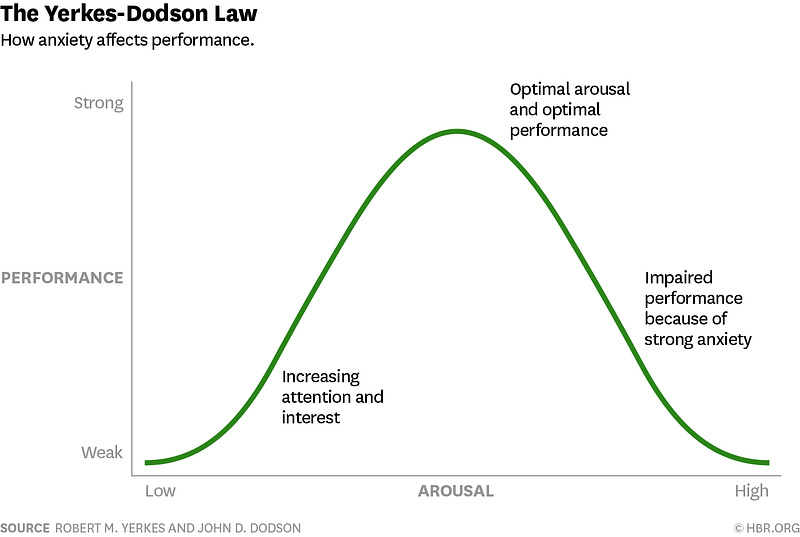
The benefit of constraints can be seen in human nature in the form of stress. As our stress levels increase — measured by the amount of glucocorticoid hormones that our body produces — our attentiveness and ability to focus can improve proportionally, to a point. We can perform more complex tasks when we are mildly under pressure. After a certain threshold, glucocorticoids become harmful and can destroy neurons. Such a pattern follows an inverted-U function. This relationship between changes was proven by psychologists in 1908 and is recognized as the Yerkes-Dobson Law.
From an economic standpoint
Competition and innovation also follow an inverted U-curve relationship — according to The Quarterly Journal of Economics at Oxford University. It was proved mathematically and economically in a particular study.
As competition increases in the market, it can drive innovation. After a point, too much competition hinders innovation.
This kind of relationship surfaces in many scenarios. Malcolm Gladwell talks about the U-shaped curve in his David & Goliath book. He described that an increase in income could help with an individual’s happiness, but after a certain point, income is no longer considered the deciding factor happiness. Even worse, beyond the threshold, an extreme increase in money can negatively impact the level of happiness.
This analogy applies to innovation vs constraints.
With no constraints, innovation does not tend to thrive. With some primary “useful” limitations, innovation can flourish. After a certain point, more constraints can be detrimental to the process of innovation.
So how does one innovate during a pandemic?
When the constraint is too substantial, such as being faced with a pandemic, then it becomes detrimental as a constraint to innovation.
A pandemic that affects countries by causing death, unemployment, and economic recession, will require a different approach to innovation.
The following is a widely-used approach and is aptly explained by this Charles Darwin quote:

“It is not the strongest species that survives nor the most intelligent that survives. It is the most adaptable to change”.
When there are extensive disruptions globally, focusing on resilience, strength, or intelligence can consume far more energy than figuring out ways to adapt to the change.
During such a time, all rules regarding innovating with constraints can become irrelevant. Instead, successful innovation becomes more about how quickly a country, company or individual can adapt to the change.
This is why following a world war, major recession, or pandemic, the companies that tended to survive had gone through transformations — some more radical than others — a company that was once in the aerospace industry could find themselves venturing into the medical industry. Companies that were not able to adapt fast enough disappeared in the annals of history.
When considering the aforementioned innovation variables of the time, resource and objective, time constraints, and lack of resources have been inherently dictated by the dire circumstances. Therefore, the best tactic during a pandemic is to completely change the innovation objective and to innovate in a completely different space with a new and improved goal.
“The riskiest thing we can do is just maintain the status quo.” — Bob Iger, CEO, Walt Disney Company


