
Initial Impressions of India: My First Day Back After a Three-Year Hiatus
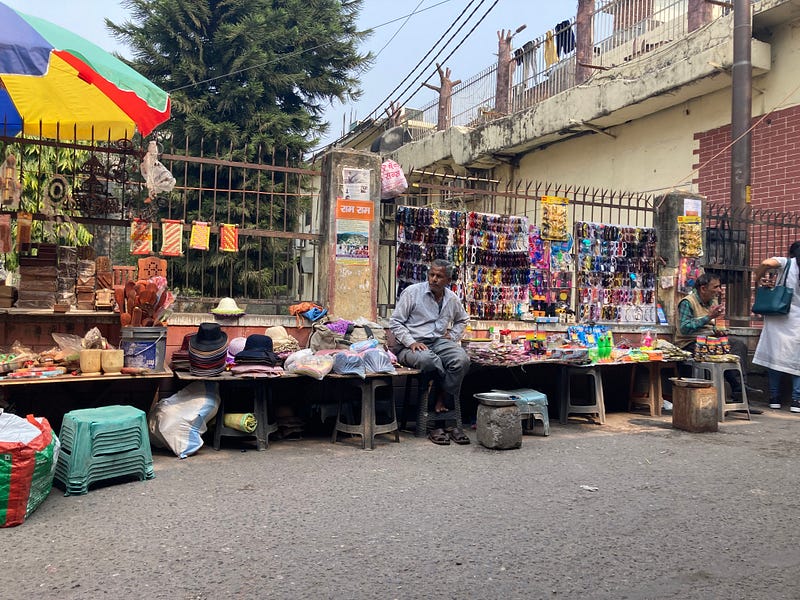
In mid-March of 2020, I abruptly left Rishikesh, India amidst the start of the pandemic. I remember the day ever clearly — the sun was out and although the pandemic had made its way around the world, the people of Rishikesh were unfazed and were going about business as usual.
I, on the other hand, had just booked a NYC-bound ticket the night before for fear of border closure and not being able to leave India if things got really bad. I left Rishikesh not because I wanted to, but out of fear. My trip felt incomplete and I promised myself that I would come back.
I kept the promise I made to myself — three years later, I’ve made it back to Rishikesh. After a five-hour plane ride from Vietnam to New Delhi, followed by a six-hour drive, I woke up and found myself in Rishikesh at 3:30 AM. I got into my room and couldn’t figure out how to work the hot water tank. I resorted to dousing myself with cold water instead. As I got ready for bed, I took a whiff of the blanket laid out on the bed. It reeked of some sort of body odor — I’m almost certain they didn’t wash the blanket after the previous guest. I couldn’t help but think to myself, “Why did I decide to come back to Rishikesh??”
This feeling was further compounded when I stepped out onto the street a few hours later. The honking was incessant and I found myself weaving between very aggressive motorcyclists. The volume and intensity of the noise revved up my nervous system and I just felt incredibly tense and on guard walking down the street. Not to mention the various men who approached me throughout the day. One motorcyclist just pulled up next to me and asked if I wanted to go with him to the waterfall. I’m struck by the audacity of some of the men here — What has led them to believe that I’m going to follow a stranger on a motorbike to a remote location??
Later on during the day, whilst walking down a road, another man accosted me and told me “You have good energy. Can I have your contact information?” This time around, I decided to play that game with him. I asked, “You don’t know me. How do you know I have good energy?” “I can sense it,” he replied. I can sense that you’re being creep, I thought to myself. He would not relent. Knowing that I wasn’t going to give him my contact information, he then proceeded to ask me to connect on Instagram. I told him that I don’t use Instagram, which is half true, wished him well and continued on my walk. Less than 12 hours in Rishikesh and I felt so overwhelmed — by the noise, random men and scorching heat. Why did I decide to come back here again?
But then I came across a woman giving satsang (spiritual talk) at an ashram. I had attended her satsang three years ago and remembered that she had helped me consider the term “surrender” in a different light — that surrendering is not a sign of weakness or loss. Rationally, I didn’t feel compelled to sit in on another one of her talks. In fact, she had been running late and we had to wait for her arrival. But for some odd reason, I felt compelled to stay and wait for her. I’m glad I did.
During satsang, people had the option of sitting in, what I call, the “hot seat” to ask her anything that was on their minds. One guy asked about how he can address his depression without medication. One guy asked how he can balance his desire to give to the desolate on the streets of Rishikesh with his desire to maintain his own financial stability. I decided to approach the hot seat.
“Why am I here?” I asked.
I’d been processing this question on my own for a while and have arrived at different answers at different points in my life.
I am here to experience joy. It is my birthright to lead a happy and joyous life.
I am here to experience the entirety of the emotional spectrum. You can’t have the good without the bad. How can you know what happiness is without experiencing sadness?
I am here to remember why I came here — my soul already knows.
I wondered how she was going to answer my question. Was she going to reinforce one of my aforementioned responses? To my surprise, she said that the asking of the question indicated a certain level of consciousness, that the question itself, though common on the spiritual path, is still ego-driven because the question is about me. She said that once I start focusing on the experiential aspect of my life, there will be a certain level of expansiveness in my life and as a result, the conceptual questions like “Why am I here?” will start to feel limited and begin to fall into the wayside.
Did you find it challenging to wrap your head around that last paragraph? It’s not just you! Her response was quite abstract and the ego mind doesn’t like that. The ego mind craves rationality and clear answers.
So, what does it mean to focus on the experiential? She said that it requires us to ask ourselves, moment to moment, is what we’re about to do what the soul actually wants us to do? And of course, it’s not as simple as just asking our souls because we also need to have the discernment to know whether the response we receive is actually from our souls or our ego minds. But the more we practice, the more we’re able to feel what is coming from our soul and this is what she meant by focusing on the experiential aspects of our lives, rather than focusing on conceptual questions.
We continued to have a back-and-forth exchange, which was profound in other ways. Before I knew it, someone rang a bell, signaling the end of her satsang. As people shuffled out, we were given the option to stay and end the session with some chanting. I don’t know why but it felt as if my body was rooted to the mat on which I was sitting and I couldn’t and didn’t want to get up. Two boys parked themselves to the right and left of me, with the one on the left of me looking as if he was only 3 years young. As the chanting began, I heard these two boys chanting alongside me.
I’m not sure what it was — perhaps I was moved by their devotion, perhaps I had been moved by satsang, perhaps I was moved by the fact that I finally made it back to India, three years later, but I started crying. I don’t know how to describe these tears — they weren’t tears of joy nor tears of sadness. Just tears that have, perhaps, been bottled up inside for me for far too long and have wanted to make their way out. And in that moment, I was reminded of why I am in India. India has healed me and continues to heal me in ways I don’t expect and it’s this healing that makes everything else that comes with being in India worth it.


