avatarBill Petro

Free AI web copilot to create summaries, insights and extended knowledge, download it at here

2103

Abstract

mphlets, extending the existing single-page “broadside” to multiple pages in quarto and octavo sizes. He featured pictures using the finest woodcuts and engravings of the times.</li><li>Graphical Web browsers that take advantage of open, standard HTML make information pictorial and, with advanced Java capabilities, dynamic, and multimedia.</li></ul><h2 id="006d">3) Mass Distribution:</h2><figure id="5c00"><img src="https://cdn-images-1.readmedium.com/v2/resize:fit:800/1*B1KU2nGZDa36dsZ8foLmHw.jpeg"><figcaption>Recreation of Gutenberg’s press, International Printing Museum, Carson, CA. Image: <a href="https://upload.wikimedia.org/wikipedia/commons/thumb/c/c3/PrintMus_038.jpg/330px-PrintMus_038.jpg">Wikipedia</a></figcaption></figure><ul><li>Luther’s 95 Theses, with the aid of the movable type printing press, invented a few decades before his birth, were distributed to the masses. Within two weeks, it had spread throughout Germany. Within a month, it was all over Europe. By the end of the year, it had spread beyond the Holy Roman Empire.</li><li>With the availability of interconnected computer networks, like those offered by Sun, information is quickly distributed all over the World Wide Web.</li></ul><h2 id="8be6">4) Unprecedented Growth:</h2><ul><li>Between 1517 and 1523, publications in Germany increased seven times. Half were Luther’s writings.</li><li>The growth of the Internet and the availability of information on the Web has grown phenomenally, with a growth curve that appears almost biological.</li></ul><h2 id="5621">5) Broadcast Marketing</h2><ul><li>Luther took advantage of the new printing press to “evangelize” his views on theology and detract from his competitors with his pamphlets.</li><li>Many companies, organizations, and individuals now take advantage of Internet home pages to “market” and promote their products, offerings, and views.</li></ul><h1 id="dba7">Reformation Background:</h1><figure id="d9ad"><img src="https://cdn-images-1.readmedium.com/v2/resize:fit:800/0*zi5k-6H_ZY2sm-ml"><figcaption>By Ferdinand Pauwels — <a href="https://www.amazon.co.uk

Options

/Kunst-f%C3%BCr-Alle-Print-Poster/dp/B017H3UNJ0">https://www.amazon.co.uk/Kunst-f%C3%BCr-Alle-Print-Poster/dp/B017H3UNJ0</a>, Public Domain, <a href="https://commons.wikimedia.org/w/index.php?curid=70222309">https://commons.wikimedia.org/w/index.php?curid=70222309</a></figcaption></figure><blockquote id="4980"><p><i>In the 16th century, as a result of a dispute concerning certain Church practices, a German University professor posted a call for debate on their equivalent of a bulletin board, the door of the Castle Church. These 95 Theses were not intended as a call to reformation but a quiet, scholarly discussion of theological issues.</i></p></blockquote><blockquote id="9258"><p><i>So it was, on October 31, 1517, that this 33-year-old Augustinian monk named Martin Luther nailed the 95 Theses on the Wittenberg Door, marking what historians conveniently use as a coat hanger for the beginning of the Reformation.</i></p></blockquote><blockquote id="2386"><p><i>But it was two significant things that changed history: first, one of Luther’s friends took the original Latin 95 Theses and translated them into German, the language of the common man. Now they were available to anyone who could read.</i></p></blockquote><blockquote id="bfcc"><p><i>Secondly, with the aid of the movable type printing press, invented not far away in Mainz by Gutenberg toward the end of the previous century, copies were distributed to the masses. It became a veritable manifesto for change.</i></p></blockquote><p id="6559">Thus, it is with the spread of the <a href="https://billpetro.com/history-of-the-internet">Internet</a>. So, one could say we’re currently experiencing more than an Internet Explosion or Revolution, but an <i>Information Reformation</i>.</p><p id="563a">Bill Petro, your friendly neighborhood historian <a href="https://billpetro.com/">billpetro.com</a></p><p id="a566"><a href="http://g003.enterprise.ipost.com/billpetrofriend/prefs"><i>Subscribe</i></a> to have future articles delivered to your email. If you enjoyed this article, please consider leaving a comment.</p></article></body>

History Series: Information Reformation

Information Reformation

How the Web Is Like the Reformation

Photo by Roman Kraft on Unsplash

I wrote the following article almost three decades ago when I was a technology evangelist at Sun Microsystems.

Back in the mid-’90s, we experienced the early part of the first wave of “The Web.” Today newer Web technologies have expanded what was largely a “reader-oriented” phenomenon into a dynamic read-write participatory social platform.

While the mantle of managing information has passed to a new generation of companies, the basic principles of information production and exponential growth remain the same.

Every October 31, we observe the anniversary of the German Reformation. Presently, there is a lot of talk about the Internet Explosion. There are several significant similarities between the two.

Indeed, one could call it the “Information Reformation.”

Highlights:

1) Common Language:

  • Martin Luther made previously exclusive information accessible to the common man by publishing in the common language (German), not the language of scholars (Latin).
  • With the aid of graphical tools like Mosaic, Netscape, or the HotJava browsers (a Java-based browser from Sun), anyone can easily read the Internet and discover new information without knowing classical Geek.

2) Common Format:

  • Luther published pamphlets, extending the existing single-page “broadside” to multiple pages in quarto and octavo sizes. He featured pictures using the finest woodcuts and engravings of the times.
  • Graphical Web browsers that take advantage of open, standard HTML make information pictorial and, with advanced Java capabilities, dynamic, and multimedia.

3) Mass Distribution:
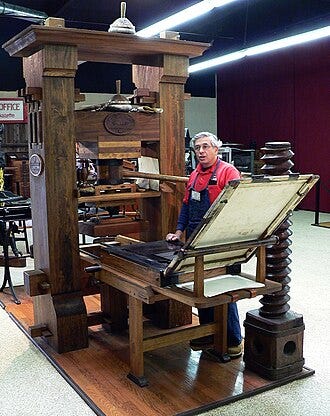
Recreation of Gutenberg’s press, International Printing Museum, Carson, CA. Image: Wikipedia
  • Luther’s 95 Theses, with the aid of the movable type printing press, invented a few decades before his birth, were distributed to the masses. Within two weeks, it had spread throughout Germany. Within a month, it was all over Europe. By the end of the year, it had spread beyond the Holy Roman Empire.
  • With the availability of interconnected computer networks, like those offered by Sun, information is quickly distributed all over the World Wide Web.

4) Unprecedented Growth:

  • Between 1517 and 1523, publications in Germany increased seven times. Half were Luther’s writings.
  • The growth of the Internet and the availability of information on the Web has grown phenomenally, with a growth curve that appears almost biological.

5) Broadcast Marketing

  • Luther took advantage of the new printing press to “evangelize” his views on theology and detract from his competitors with his pamphlets.
  • Many companies, organizations, and individuals now take advantage of Internet home pages to “market” and promote their products, offerings, and views.

Reformation Background:

By Ferdinand Pauwels — https://www.amazon.co.uk/Kunst-f%C3%BCr-Alle-Print-Poster/dp/B017H3UNJ0, Public Domain, https://commons.wikimedia.org/w/index.php?curid=70222309

In the 16th century, as a result of a dispute concerning certain Church practices, a German University professor posted a call for debate on their equivalent of a bulletin board, the door of the Castle Church. These 95 Theses were not intended as a call to reformation but a quiet, scholarly discussion of theological issues.

So it was, on October 31, 1517, that this 33-year-old Augustinian monk named Martin Luther nailed the 95 Theses on the Wittenberg Door, marking what historians conveniently use as a coat hanger for the beginning of the Reformation.

But it was two significant things that changed history: first, one of Luther’s friends took the original Latin 95 Theses and translated them into German, the language of the common man. Now they were available to anyone who could read.

Secondly, with the aid of the movable type printing press, invented not far away in Mainz by Gutenberg toward the end of the previous century, copies were distributed to the masses. It became a veritable manifesto for change.

Thus, it is with the spread of the Internet. So, one could say we’re currently experiencing more than an Internet Explosion or Revolution, but an Information Reformation.

Bill Petro, your friendly neighborhood historian billpetro.com

Subscribe to have future articles delivered to your email. If you enjoyed this article, please consider leaving a comment.

Information Reformation
History
History Of Technology
Martin Luther
Reformation
Recommended from ReadMedium