
Inequality, Distrust, And the Myth of the “Far Left” in America
How the GOP works hard to make sure most Americans can never have nice things
It’s a well-known psychological fact that we humans do not interact directly with the world around us. Rather, we create models in our minds about how the world works, or ought to work, and we evaluate and filter all the signals that flow into our sensory organs (sights, sounds, smells, tastes, touches) under the influence of these models.
The models in our heads include various level of detail and abstraction. For example, you probably have a model for how to open a wine bottle. That is something you know because, at some point in the past, you learned it. So now you can retrieve it from memory when you need it.
At a higher and more abstract level, you have a model in your head about how America works. It’s a much more complex model, probably in the form of a narrative — a story with heroes and villains, victories and defeats, an origin story about how we got here, a situational story about where we are now, and an alternative-futures story about where we’re heading, including models of futures we want to achieve and futures we want to avoid.
These models inevitably and involuntarily shape everything we think and do, from brushing our teeth to voting for a President of the United States. They are literally how we see and make sense of the world around us.
In a previous article, I described the closed-loop lie machine Republican Party and its media allies use to manipulate the models in the heads of their receptive followers. In this article, I want to discuss the content of the models the Republican lie machine is designed to instill in GOP loyalists, as well as some of the biggest “inconvenient truths” (aka facts) those models are meant to hide from their followers at all costs. We will focus on three topics and the interrelationships among them:
- The reality of inequality in America (which the GOP desperately wants to hide from its followers).
- The wave of distrust at all levels in American politics and society (which the GOP has promoted and amplified to hide its real aims, which do not benefit its followers).
- The myth of the “far left” (which the GOP uses to inoculate its followers against ever learning how poor their living standards are when compared to citizens in other modern western democracies).
Inequality in America
Most Americans have no idea how unequal their society really is. Republicans like it that way.
In a study conducted in 2011, researchers asked a representative sample of Americans to guess how much of America’s total wealth was held by the 20% richest Americans (called the top quintile in statistics-speak). The average guess was 59%. The actual figure at that time was far greater, 84%. By 2020, the figure had increased to 86.6%. Given that billionaires’ wealth increased by 62% during the pandemic, while workers’ wages grew by only 10% over the same period, this disparity has only continued to grow since 2020.
The researchers then asked what people thought would be a fair and equitable distribution of wealth across the five quintiles. On this question, the average preferred percentage of wealth for the top 20% of Americans was 32%, a figure that was fairly consistent across political, demographic, and income groups.
Finally, the researchers asked people to compare the attractiveness of two unlabeled wealth distribution “pies”, shown here:
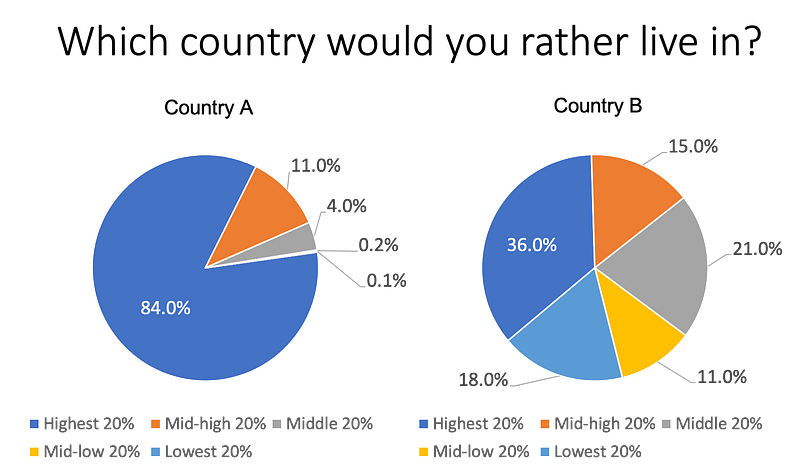
When presented in this way, 92% of Americans across all political, income, and gender groups said they would prefer to live in Country B rather than Country A. This was an interesting result because Country A showed the most recent distribution of wealth in the USA, while Country B showed the most recent distribution of wealth in Sweden.
This leaves us with three important findings about the models in peoples’ heads that filter how they think about wealth distribution in America:
- Americans vastly underestimate the amount of wealth concentration in the United States.
- Even their underestimates are far higher than their preferred levels of wealth distribution.
- When not distracted by labels and stereotypes, Americans of all stripes show an overwhelming preference to live in a society where wealth is distributed more like it is in Sweden than in the US.
In addition to not knowing how unequal American society really is, most Americans have no idea how much it costs them to live in a society where the rich continue to siphon off greater and greater proportions of the wealth produced by the country as a whole.
In 2020, two researchers from the RAND Corporation asked another interesting question: If the distribution of taxable income that existed in American society in 1975 had remained the same until 2018, how much more income would have remained in the bottom 90% of earners, as opposed to being transferred to the top 10%?
Here’s how this calculation works. In 1975, the top 10% of American income earners received about 34% of all income earned in that year. The bottom 90% earned the rest, 67%. By 2018, the top 10% were earning 50% of total income, leaving the other 50% for everyone else.
Suppose that in 2018 those proportions were the same as in 1975. How much more income — in current dollars — would the bottom 90% have if they were still sharing 67% of total income in 2018, as opposed to the actual figure of 50%? The answer for 2018 alone is $2.5 trillion. Making a similar calculation for each year between 1975 and 2018 and adding them all up, the authors reach a truly mind-blowing conclusion:
If the distribution of taxable income in the United States had remained constant at its 1975 level, by 2018 the bottom 90% of American income earners would have earned an additional $47–48 trillion between 1975 and 2018.
As one commentary on the RAND study reported:
“the RAND report brings the inequality price tag directly home by denominating it in dollars — not just the aggregate $50 trillion figure, but in granular demographic detail. … whatever your race, gender, educational attainment, urbanicity, or income, the data show, if you earn below the 90th percentile, the relentlessly upward redistribution of income since 1975 is coming out of your pocket.” (emphasis added)
Imagine what kind of country we would be living in today if $50 trillion had been distributed across all working Americans over the last four decades, as opposed to being siphoned off by the very rich.
Imagine what the current MAGA crowd would think of their precious Republican Party if they knew exactly how much their party’s dedication to increasing income inequality was costing them — not millions, not billions, but trillions of dollars over the course of their working lifetimes.
I’m guessing it probably wouldn’t sit well.
For Republicans, the key phrase in the last paragraph is “if they knew”. The underlying purpose of their closed-loop lie machine is precisely to make sure their followers never know these facts, nor any other inconvenient facts that might reveal the true nature (and the true beneficiaries) of their policy agenda. The model of America they want in the heads of their followers is one built on a mountain of lies they believe are necessary to mobilize the votes they need to stay in power.
If Republicans want to hide the fact that they are committed to expanding wealth and income disparities in America — disparities that all Americans, including Republican voters, both underestimate and reject as fundamentally unfair — they need to give their followers something else to think about.
The Republican solution? Instill in their followers a model of how America works that sees most Americans as existential enemies, not to be trusted, not to be listened to, not to be treated as equal participants in the American experiment. Once these enemies have been identified, they can be invoked as the cause of any discomforts Republican voters might experience in their lives. In other words, to distract their followers from the true GOP agenda, elites and their media allies must inject the poisons of distrust, suspicion, contempt, and hatred into the American bloodstream.
Distrust: The Poison that Kills Democracies
In a Pew Report released just this month, Americans’ trust in the federal government remained historically low. Just 20% of polled Americans said they trusted the government in Washington to do the right thing “always” or “most of the time”. This result is quite similar to what I found in the 2020 American National Election Study (ANES) data, in which only 14% of the weighted sample reported similar levels of trust in government. Even with their hero Donald Trump in the White House, only 20% of Republican voters in 2020 expressed trust that the government would “do what is right” always or most of the time.
While distrust in government and suspicions about the motives and competence of political office holders is widely shared across the American political spectrum, Republican elites need to spread that distrust and suspicion deeper if they are to achieve their aim of distracting their followers from recognizing the party’s real agenda.
Rising inequality makes that easier to do. As inequality increases, more and more Americans get left behind, facing stagnating incomes, mounting debt, and chronic economic insecurity. Those conditions, in turn, exacerbate peoples’ fears that they are competing against each other for their fair share of a shrinking economic pie. Social cohesion and any sense of shared community are lost. Over time, this produces a “zero-sum” perception that any gain made by someone else in America must be a loss for me. It creates an “us versus them” mentality that is ripe for exploitation via scapegoating. And that is precisely the project the Republican Party and its media allies have taken up with gusto.
Has the Republican Party been successful in selling distrust, suspicion, and hatred to its followers? You bet it has.
As I reported in a long and largely unread piece published late last year in Medium, the GOP has bred a voting base animated and motivated by a wide variety of biases and prejudices against “others”, both those already in American society and those seeking to join it. Thanks to the inclusion of multiple belief scales in the 2020 ANES surveys, I was able to precisely measure the extent to which these toxic beliefs animated Trump voters in 2020. Here’s a taste:
- Of the 20% most racist Americans, 90% voted for Trump (vs. 2% of the least racist Americans).
- Of the 20% of Americans most opposed to equality values, 89% voted for Trump.
- Of the 20% of Americans most willing to reject science and expertise, 83% voted for Trump.
- Of the 20% most anti-minority and anti-immigrant Americans, 81% voted for Trump.
- Of the 20% most misogynistic Americans, 72% voted for Trump.
- Of the 20% of Americans least empathic toward the needs of others, 73% voted for Trump.
Clearly, America’s “deplorables” know which political party welcomes them, and that party knows all the dog whistles and megaphones at its disposal to stir the cauldron of animosity on which its political power depends.
The Myth of the “Far Left”
How do Republican elites make sure their followers never believe a word Democrats say? How do they ensure that Republican voters will dismiss any effort to enlighten them about the giant confidence game being played against them? With one magic word: socialism.
Using socialism as a cudgel to attack just about anything you don’t like is a long and well-established tradition in the Republican Party. Indeed, Harry Truman described it perfectly 70 years ago:
“‘Socialism’ is the epithet they have hurled at every advance that people have made in the last twenty years. Socialism is what they called Social Security. Socialism is what they called farm-price supports. Socialism is what they called bank-deposit insurance. Socialism is what they called the growth of free and independent labor. Socialism is their name for almost everything that helps all of the people.” (quoted in The New Yorker, 2019, emphasis added.)
Republicans want their followers to believe that socialism is a kind of prison within which an evil cabal called the “Far Left” wants to trap all Americans. Socialism is Venezuela and Russia. It is failed states, planned economies, empty store shelves, secret police, and corruption. It is a form of government designed to ensure that everyone is miserable, sick, and starving.
What is important here is that this is the model Republicans want their supporters to have in their heads when they hear the words “socialism” or “far left”. That this model is a giant fabrication is beside the point. It is absolutely critical to Republicans that Americans think of socialism as a dangerous threat and the Far Left as a bunch of crazies who want to turn America into Venezuela.
One wonders: why invest so much effort in creating a false mental model all about words? For Republicans, these words are their equivalent of a hazardous materials symbol. These horror stories are the final, insistent warning to all Republican followers: do not look behind the door labeled “socialism”.
If Republicans did look behind that “socialist” door, what would they find?
Socialism is one of several terms (“democratic socialism” is another, “welfare state” is another) used to describe a form of government implemented by several countries, mostly in Europe, based on a simple proposition: that the purpose of government is to increase the overall happiness and quality of life of the country’s citizens … all of them.
Contrary to the message blasting from the Republican lie machine, socialism works. Countries that could accurately be called “socialist” are widely and consistently judged to have the happiest citizens and highest quality of life on the planet.
Happy citizens! This is the biggest threat the Republican Party faces in America.
If Americans were not weighed down by the risks, uncertainties, and anxieties of our dog-eat-dog, scarcity-driven society, what need would we have for the GOP to “protect” us from all the enemies the GOP conjures up for us? How much harder would it be to manipulate and exploit us? “Happy” is the last thing Republicans want Americans to be.
As an example of socialism in action, let’s take a look at the “socialist hellhole” called Denmark. Consistently ranked among the top 5 places to live in the world, here are some benefits that Danes receive as a matter of course:
- Education is provided cost-free, including tuition-free college for all Danes who want to attend.
- Parental leave is provided for up to 52 weeks, with 32 weeks of monetary support for new parents.
- Childcare is subsidized.
- Most healthcare is provided at no cost.
- The elderly receive generous pensions and funding for care providers to help them live at home.
- Danes work an average of 33 hours per week.
In terms of outcomes, Danes live longer than Americans, are healthier than Americans, and are happier than Americans. Indeed, far happier than Americans. What’s the secret? Nothing too surprising:
“People are more satisfied with their lives when they have a comfortable standard of living, a supportive social network, good health, the latitude to choose their course in life, and a government they trust. The highest echelon of happy countries also tends to have universal health care, ample paid vacation time, and affordable child care.” (Joe Pinsker in The Atlantic, 2021)
In socialist countries, these kinds of programs and services are called investments, not entitlements. They are paid for by collecting significantly higher taxes than Americans pay today. In 2019, for example, Denmark’s tax-to-GDP ratio was about 46%, compared to about 25% in the United States. So Danes are willing to invest almost half of their GDP to support the quality of life of their citizens. In contrast, the American government is deliberately underfunded so the rich can continue to enjoy supersized tax benefits, and any programs that might improve Americans’ quality of life can be dismissed out of hand as too expensive.
Here is where our three topics intertwine.
Inequality in America is at its highest level since the1920s. It has shifted $50 trillion from the bottom 90% of Americans to the top 1% over the last four decades. This transfer of wealth from the American middle and working classes to the country’s richest citizens has been the biggest single accomplishment of the Republican Party since the election of Reagan. And it has been successfully hidden from the very people it hurts the most, Republican MAGA followers.
To make sure its voters never notice how or how much they are being robbed, the GOP and its rightwing media allies have adopted a strategy to promote distrust, suspicion, and (more recently) outright demonization of various “enemies” to distract, anger, and mobilize its followers. But distrust is like a poison in the veins of a democratic system and it is killing this one. Republicans know this, but welcome it because it successfully distracts from the inequality debacle.
Finally, to make sure the party’s followers never even consider the benefits they are missing, Republicans and their allies have invented an imaginary opponent called the “Far Left”, a mythical and terrifying bogeyman that wants to impose a horrible economic system on Americans called “socialism”. By demonizing any effort to invest in the American public as “socialism”, Republicans have for decades successfully blocked government social spending programs and protected their prime directive: to keep the wealth of America out of the hands of most Americans and into the hands of only the richest and most advantaged in our society.
It is all built on lies, deceptions, and diversions, but it is perhaps the greatest long con in the history of American politics. So far, it’s working just fine.
The Bottom Line
Sometimes it takes an observer on the outside, looking in, to see what should be obvious to anyone on the inside, looking out. But when a whole society is relentlessly bombarded by false mental models and distractions, seeing the obvious is not so easy. But here it is, put simply and clearly by Canadian author Thomas Homer-Dixon in a powerful critique of America’s ongoing slide into rightwing authoritarianism:
“The wealthy and powerful in America are broadly unwilling to pay the taxes, invest in the public services, or create the avenues for vertical mobility that would lessen their country’s economic, educational, racial and geographic gaps.”
So there you have it. The bottom line is this:
Americans cannot have nice things like other modern democracies because American elites are greedy and selfish. These elites have shaped and funded a streamlined, rapacious Republican Party whose core purpose is to protect those selfish interests. If doing so requires destroying democracy, well, so be it.


