
Industrial Automation, Rapid Change and the Automotive Industry
A 6th 2023 report by McKinsey, “Is industrial automation headed for a tipping point?” describes the tipping point of industrial automation is appraoching where the players, technology and societal forces are all reaching a crashendo that will set the stage for massive and rapid change.
Highlights:
- Industrial automation, once a slow and steady evolution, is now accelerating due to technological disruptions and global trends such as reshoring, labor shortages, and ESG efforts.
- Advanced manufacturing technologies are becoming commonplace, leading to a “software-defined” paradigm for industrial automation.
- Four vendor archetypes — hyperscalers, automation players, software players, and specialized players — are evolving their strategies, with hyperscalers disrupting the most.
- A majority of automation users believe digital solutions will be crucial to their future automation efforts, leading to a shift towards partnerships with OEMs.
- Two potential scenarios for the future of industrial automation are identified, differing by the speed of technology adoption.
- Different players in industrial automation can take steps today to prepare for the future, with hyperscalers expanding their domain know-how and automation players moving up the technology stack.
The Tipping Point of Industrial Automation
The industrial automation industry, once a slow and steady evolution, is now at a tipping point. Technological disruptions and global trends such as reshoring, labor shortages, and environmental, social, and governance (ESG) efforts are accelerating the pace of change. Advanced manufacturing technologies like digital twins, self-teaching robots, and self-programming devices are becoming commonplace, leading to a “software-defined” paradigm for industrial automation.
This shift is turning shop floors into “smartphones with robotic arms”, a future where the physical and digital worlds merge. However, the timeline for this future is uncertain, with estimates ranging from five to fifteen years, depending on the speed of technological advances and their adoption in different industrial sectors.
In this rapidly changing landscape, four vendor archetypes — hyperscalers, automation players, software players, and specialized players — are evolving their strategies. Hyperscalers, or cloud-service providers, are disrupting industrial automation the most. They are moving into the embedded software and hardware part of the automation stack, grabbing a larger share of industrial automation spending. The market for connectivity and industrial IoT (IIoT), a key revenue source for hyperscalers within industrial automation, is expected to grow faster than any other part of the industrial automation market.
However, no provider segment is static. Automation players, software players, and specialized players are all making investments in parts of the digital stack they don’t currently occupy. For instance, automation players might consider moving up the technology stack, strengthening their positions in software and in cloud or IoT platforms.
A survey of automation users reveals that 94% believe digital solutions will be important to their future automation efforts. There has been a shift away from self-developed digital solutions towards partnerships with OEMs to develop standardized industrial IoT platforms.
The report discusses ten key technologies that are ushering in the future of automation, including soft programmable logic controllers (PLCs), digital twins, and teach-less robotics. It also identifies the inflection points that may cause these technologies to take off.
Finally, the report presents two potential scenarios for the future of industrial automation. The first scenario is one of gradual market development, where the adoption of technology progresses at a steady pace. The second scenario involves a much faster transition, necessitating dramatic changes for both suppliers and manufacturing plants by 2030.
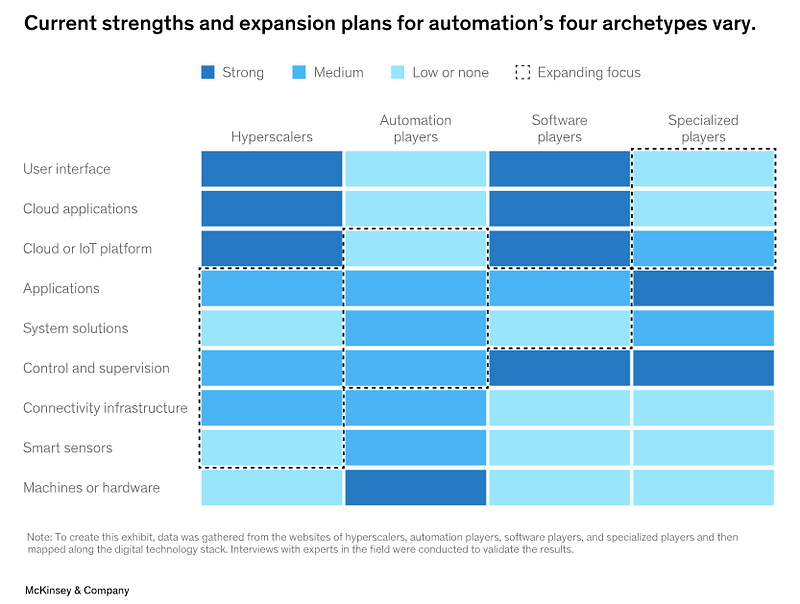
Regardless of the scenario, different players in industrial automation can take steps today to prepare for the future. Hyperscalers might expand their domain know-how and set up partnerships with established automation players and system integrators. Automation players might consider moving up the technology stack, strengthening their positions in software and in cloud or IoT platforms. Automation users, the manufacturing plants themselves, may want to take steps to expand their digital capabilities, as they will need these capabilities no matter what comes and when.
The Automotive Sector and the Impact of Automation
The automotive sector, a cornerstone of global manufacturing, stands at the precipice of this automation revolution. The industry’s complex supply chains, high-volume production lines, and relentless pursuit of efficiency make it a prime candidate for the transformative power of automation.
Three Scenarios for the Automotive Sector
- Conservative Scenario: In this scenario, automotive manufacturers gradually adopt automation technologies, focusing on improving efficiency and reducing costs. The use of digital twins, self-teaching robots, and self-programming devices becomes more common, but the transformation is slow and steady. The focus remains on incremental improvements rather than radical changes.
- Transformative Scenario: In this scenario, automotive manufacturers aggressively adopt automation technologies, leading to significant changes in their operations. They form partnerships with hyperscalers and other technology providers to leverage their expertise and accelerate the transformation. The use of advanced technologies becomes widespread, leading to significant improvements in efficiency, quality, and speed.
- Revolutionary Scenario: In this scenario, automotive manufacturers not only adopt automation technologies but also reshape their entire business models around them. They leverage advanced technologies to create new products and services, redefine their relationships with customers and suppliers, and even disrupt their own traditional business models. The impact of automation is profound and far-reaching, leading to a complete transformation of the automotive industry.
Revolutionary Concepts for the Future
Distributed Manufacturing for On-Demand Micro Mobility: In a revolutionary scenario, automotive manufacturers could leverage automation and advanced manufacturing technologies like 3D printing to create a distributed manufacturing model for on-demand micro mobility. This would eliminate the need for large-scale production and inventory management, reducing costs and environmental impact.
Circular Manufacturing and Recycling Process: Automation could also enable a highly efficient circular manufacturing process. In this scenario, vehicles would be designed for easy disassembly at the end of their life cycle. Automated disassembly lines would break down the vehicles into their component parts, which would then be cleaned, sorted, and recycled using automated processes.
Personal Flying Drones: Perhaps the most revolutionary scenario would be the advent of personal flying drones. Automation and AI would play a crucial role in this scenario. The drones would be controlled by AI systems, which would navigate a web of wireless radio signals for location tracking and traffic control. High-speed data links would provide infotainment and productivity tools for passengers.
The automotive industry stands at the crossroads of a profound transformation. The changes brought about by industrial automation will be particularly acute for this sector and its suppliers. This is not just due to the evolving manufacturing processes, but also because of the radical changes in the nature of the product itself.
The shift towards electric propulsion is revolutionizing the very heart of vehicles, replacing complex internal combustion engines with simpler and more efficient electric powertrains. This shift is not just changing how vehicles are powered, but also how they are designed and built, with implications for the entire automotive supply chain.
At the same time, digital connectivity is turning vehicles into mobile data centers, capable of communicating with each other and with the infrastructure around them. This is opening up new opportunities for services and business models, but also new challenges in terms of data management and cybersecurity.
Furthermore, the increasing integration of software operating systems and applications is transforming vehicles into platforms for digital services. This is blurring the boundaries between the automotive industry and the tech industry, leading to new forms of competition and collaboration.
All these changes are happening simultaneously, creating a complex and dynamic landscape for the automotive industry and its suppliers. Navigating this landscape will require not just technological expertise, but also strategic foresight and the ability to adapt and innovate. The road ahead may be challenging, but it is also full of opportunities for those who are prepared to seize them.
Daniel Davenport is an Atlanta-based automotive expert specializing in software-defined vehicles, connected mobility ecosystems, and smart manufacturing. With nearly three decades of experience, he currently serves as a Hybrid Network & Cloud Solutions Specialist at NTT and is an AWS Certified Cloud Practitioner


