
Politics | U.S. Election | TV News
Inductive Reasoning & the Seductive Power of Fox News
What Polling Shows About Fox and the Myth of Voting Fraud

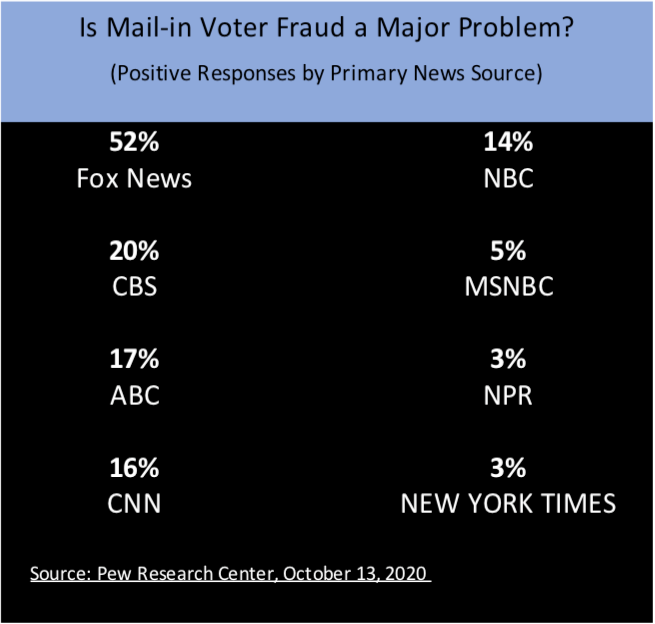
During the second week of October, three weeks before the November 2020 election, the Pew Research Center released the results of a recent poll asking viewers for their opinions regarding mail-in voting fraud.
Respondents were asked to indicate the degree to which mail-in voting has been a problem in U.S. Elections.
The choices included 1) Major Problem; 2) Minor problem; 3) Not a problem at all; 4) Not sure; and 5) Refused to answer.
The respondents were also asked to indicate their primary source of news. Today’s snapshot shows percentages for those who believe mail-in voter fraud has been a major problem.
Source: Pew Research Center, October 13, 2020
Fact versus Fiction
Extensive Studies Have Found Scant Evidence of Voter Fraud
The Brennan Center for Social Justice, a nonpartisan law and policy institute, has reviewed elections that had been meticulously studied for voter fraud. Its report found incident rates between 0.0003 percent and 0.0025 percent.
Given this tiny degree for voter-impersonation fraud, it is more likely, the report noted, that an American “will be struck by lightning than that he will impersonate another voter at the polls.”
This finding is supported by numerous other studies cited by the report, including: state government investigations, independent studies, and numerous court decisions. All conclude that voter fraud is extremely rare. This includes voter impersonations at the polls and during mail-in voting.
The New York Times and National Public Radio have cited these evidence-based findings on many occasions. Responses to the Pew Research poll indicate that most of their readers and listeners tend to accept the reporting by these outlets.
Why Do So Many Fox News Viewers Believe Voter Fraud Is a Major Problem?
There are two possible answers to this question:
- Fox News viewers are not aware of the evidence-based data.
- They have been made aware but do not believe it.
Reasons for Not Believing Evidence-based Data
Here are two possibilities:
- Evidence-based data may be provided but is downplayed by on-screen chyron messaging with unrelated or opposing information. Example: The news anchor says, “The data does not support this view.” But while he is talking, a message appears at the bottom of the screen in large letters, which says, “President Cracks Down on Voting Fraud.” What sticks in the viewer’s mind are the words on the screen, not the anchor’s voice.
- Fox News viewers often receive information based on inductive reasoning.
What Is Inductive Reasoning?
Inductive reasoning is a method of reasoning in which the premises supply some evidence, but not full assurance, for the truth of the conclusion.
It’s a method where one’s experiences and observations are synthesized to come up with a general truth. This includes hearsay, i.e., what a person has heard from others.
Inductive reasoning uses a connect-the-dots approach. It also uses anomalies, as well as anecdotal and apocryphal data to form a general theory. This “general truth” approach is the basis for numerous conspiracy theories.
Example: Nine discarded ballots were found in a polling-station waste basket in Pennsylvania. Without examining how they got there, inductive reasoning could use the incident to claim wholesale election fraud.
President Trump seized on this particular incident to do just that. The president has often stated, without evidence, that mail-in voting will result in a rigged election. In this case, the president used a single incident to support his general theory. That is inductive reasoning.
While deductive reasoning, in logic, refers to the necessary outcomes of a set of conditions, inductive reasoning is concerned with determining the likelihood of an outcome. With inductive reasoning, only possible conclusions can be drawn, since not all of the conditions influencing or determining the outcome of a given situation are known. (F. Klix, in International Encyclopedia of the Social & Behavioral Sciences, 2001)
Regarding the nine discarded ballots in Pennsylvania, Fox News reported the president’s view. The station’s opinion commentators amplified this view.
Although Fox has long maintained that its news is separate from opinion stars like Sean Hannity, Tucker Carlson, and Laura Ingraham, a different view came to light the same week the Pew Research Center revealed its poll results on mail-in voting. Former employees of Fox’s “Brain Room” told the Daily Beast that the group was pressured to focus less on fact-checking for its straight news segments and more on providing anomalies like the discarded ballots in Pennsylvania in support of the president’s claims.
Thus, as a result of this singular example and others that follow a similar pattern (e.g. ballots the president claimed were thrown in an undisclosed river), viewers of Fox News have been left with the belief that mail-in voting fraud is a major problem in U.S. elections, when in fact the exact opposite is true.
What Really Happened with Those Discarded Pennsylvania Ballots?
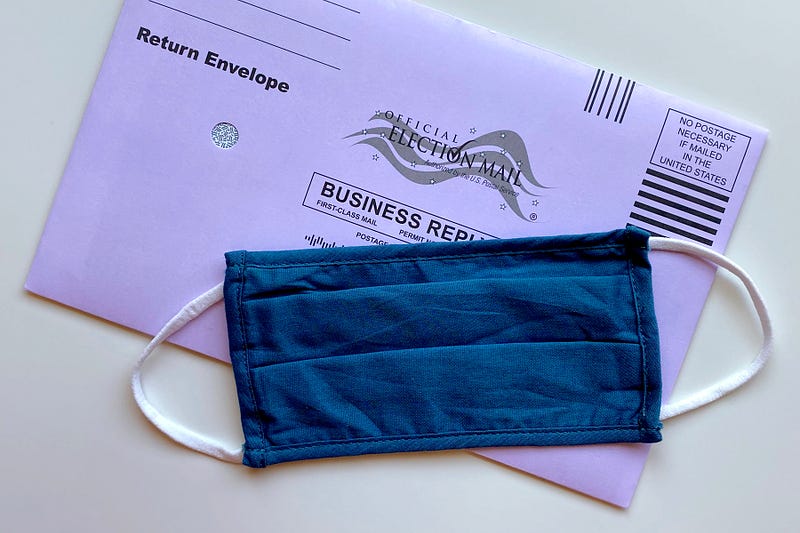
The County Manager where the incident occurred eventually released a report indicating that the ballots in question arrived in envelopes that closely resembled the envelopes used to request a mail-in ballot.
An error in discerning the difference was made by a temporary employee who was immediately dismissed. The mistake occurred because the affected ballots were not enclosed in the required secrecy envelope.
Upon discovering the mistake, county officials immediately called federal officials to investigate. Although seven of the discarded ballots appeared to be for Trump, they would have been discarded anyway because they were not enclosed in the secrecy envelope.
County election officials believe the incident underscores the effectiveness of their procedures to provide secure and accurate election results.
Additionally, the discarded ballots accounted for only nine of the state’s total number of registered voters, which is 8.5 million.
Were Fox News viewers updated on the story in a manner that corrected the false impression of mail-in voter fraud? The results of the Pew Center’s poll indicate that they were not. The details were eventually released in the Washington Post and other mainstream media outlets, which many Fox News viewers regard as “Fake News.”
Since Fox News recently made history as the most watched news outlet in the nation, what conclusions can we draw from this recent polling data about its role as a key influencer in U.S. elections? And given our constitutional right to a free press, what can be done about it?
Originally published at https://www.jazprose.com on October 14, 2020.
Thanks for reading. Here are a few of my other stories.