
Indigo Bunting
GiaB prompt #20 animalia
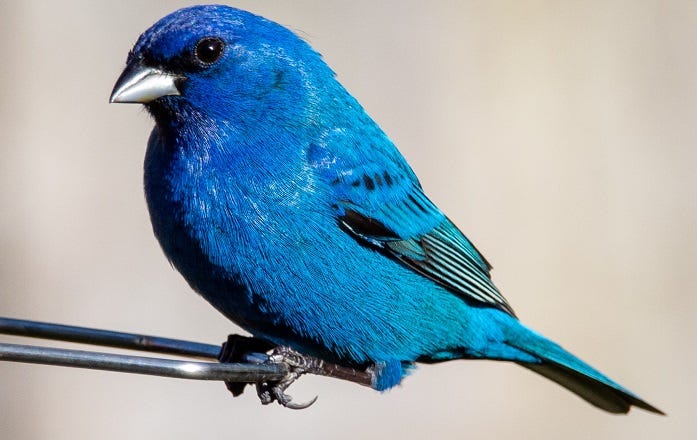
I learned today from a birding guide that the male Indigo Bunting isn’t really blue. Rather, its individual feathers are the same drab, brown color as the female of the species. The male’s feathers have evolved to refract the light in a certain way as to project that beautiful, powder-blue shade. It’s a trick.
But wait. Isn’t that the very definition of color? When a material reflects or refracts certain wavelengths of light, we say it’s that color. A rose is red because it reflects light whose wavelength is in the 620–750 nanometer range. A bird is blue because it reflects much shorter wavelengths in the 450–495 nanometer range.
Ignore him. That’s the science nerd, the boring analytical me, talking. This morning I watched a pair of these gorgeous birds and marveled at their loving playfulness. Underneath, they are just alike. But the male has found a way to make himself stand out — to be more attractive —only to impress his mate. And I wonder, how does the female appear to the male Bunting? To me, she is drab, mottled, and unattractive. Perhaps his keen eyes see something different — a spectrum of glittering hues, maybe. Even a colorless prism holds within it all the colors of the rainbow.
Stop it! You are anthropomorphizing again. Poets are such imprecise beasts. The two birds are together to mate, to perpetuate the species. That’s all. It’s a biological imperative that drives them, not emotion.
You’re the image in the back of my eye And if your beauty exists only so
Argh, just shoot me.
We’ll still soar together against the sky And paint it in wavelengths of indigo.
That’s it. I am outa here.
Thanks, Victor Sarkin for this fun prompt. And thanks to the whole GiaB gang — editors, writers, and readers. You guys make this so enjoyable and instructive.
Jim Dutton © 2021