
Indicators of Productivity Trap And How to Overcome It.
There’s always a threshold when more becomes less, and less becomes more.
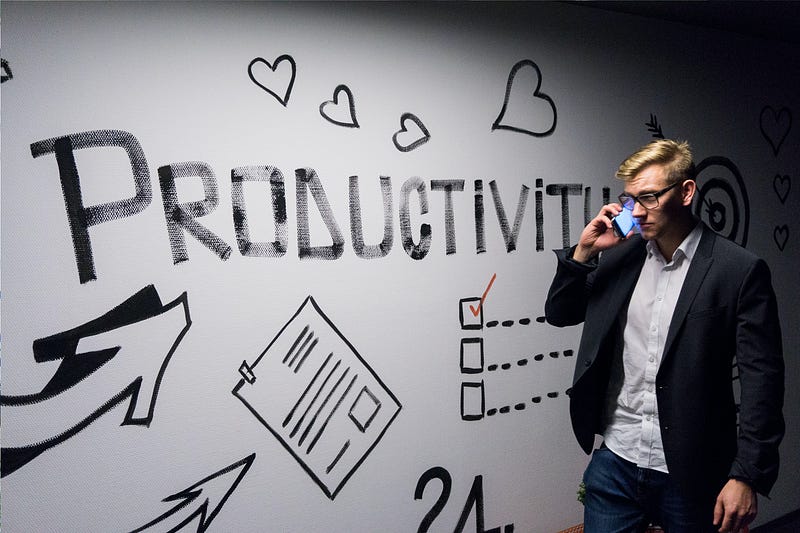
We live in a world that praises high productivity. Your annual performance may be measured by how productive you are, and there are plenty of people on the internet teaching you how to be more productive.
Eventually, we would have the constant urge that we must utilise all our waking hours to be the most productive, and that means working harder, faster, and longer.
It seems that the over-embracing of this productivity culture has made us subconsciously feel that we should always work harder than we are, and there is no limit.
Sooner or later, we might (or might not) realise that we are not the same as before anymore. Since how long ago did we have time to really fully immerse ourselves in a movie or some TV series?
We seemed to be so focused on productivity that we just could not do anything that was non-productive anymore.
In fact, what we are seeing here is that we are slowly falling into the productivity trap. The productivity trap is an endless loop of being more productive, which eventually leads to burnout.
Here are a few indicators of you potentially falling into the productivity trap:
1. You just can’t relax and chill out.
To be honest, I think this is one of the main indicators that you are trapped in the world of being productive.
Imagine you are back from work, and the day is going quite well. Your tasks at work have been done and completed, and some of the monthly tasks are also done in advance.
What do you first feel? From our third-party perspective, we would think that you are a productive person, and you probably should feel accomplished, right?
But no. Instead, after chilling for a while, maybe watching some TV series on Netflix, or some videos on Youtube, you would start to feel that you are kind of wasting your free time, as you are not doing anything ‘productive’.
Then, you will start to push yourself to find more tasks to do, and if you do not manage to have motivation to complete the new tasks, you will feel devastated.
Well, the hustle culture that has been trending for such a long time does not help much either. You would feel that you are just missing out and not living the best of your life when you are not hustling or creating value. This is certainly wrong, and you are for sure in a trap — an endless trap.
2. Busy Is Good, More is Good
You may also think that being busy is good, and signals being “productive”. It’s actually quite similar to the above, which is you feel that being ‘free’ is non-productive. But this is focusing more on your concept of ‘productive’ itself.
Imagine a person who hasdone their task in 3 hours, instead of 8 hours. Additionally, he used the extra hours to rest for the day. Is he more productive, or is the person who spent 10 hours doing the same task?
You must take note that being busy is not always good, and blindly chasing the feeling of ‘busyness’ will not get you anywhere, and is anything but being productive.
Being productive saves you time for other hobbies or some free time, and not the other way around (sacrificing supposed free time to be busy is definitely not productive). This other way would only fasten your route to the inevitable burnout.
Bonus: Less is More
Besides, this constant chase of busyness would lead you to have no free time at all.
Free time, or ‘boring time’ for the mind is pretty important, no matter whether you are on the creative or more technical side of things. This free time is the only chance to let your mind wander freely, and this is the time that could generate new or refreshing ideas, instead of you being constantly trapped in the same problem over and over again.
The best ideas come in the shower, and this saying may not be wrong. Activities such as jogging or exercising in general can also relax our minds. While our bodies are kind of in autopilot mode, this is the time when we can really let our minds go off.
How to Overcome it?
1. Knowing when to stop
First thing that you can do, is to select the most important few tasks to do in the day. For example, instead of listing a whole list of tasks, you just need to choose 3 of the important tasks that you should focus.
This minimises the chance of you doing infinite number of tasks and feel not accomplished by the end of the day. When you have done, maybe you can treat yourself, by having some dessert or whatever, to kind of signal yourself that you have actually accomplished the goals that you had set.
Note that productivity is really kind of get things done. So, if you had done the real important stuff, you should recognise it and don’t just hide it in your mind as it was nothing.
2. Break your tasks into smaller and quantifiable tasks
Besides prioritising important tasks as above, the task itself is also important. If the task you chose is too large, eventually you will also find out that the tasks that you have done simply cannot be done, and will feel devastated.
The important question about this is: Is your definition of the task suitable, and is it quantifiable?
If your important task is to just ‘finish it as soon as possible’, you cannot grasp the time and effort needed for the task. So, if it’s too big of a task, you may have the feeling that it’s unachievable, and just don’t want to do anything.
This is a frequent negative effect of setting our goals too high, and we should definitely avoid it. Choose some metrics that are measurable, with specific numbers in mind.
For example, instead of the task being something like ‘finish the investigation on a topic’, you can change it to ‘investigate 5 points of the topic and choose the 3 most valid points’.
With the quantifiable task in mind, you will not fall into the trap of endless investigation, and you can also have a sense of progression.
3. Set up a Free Time for Yourself
Self-care is always important, and you will definitely avoid burnout if given the time to do so.
Take the free time to explore some new activities or hobbies. You can hang out with your friends, have a cup of tea, or do anything.
That’s why having clear boundaries between work and your own life is also important (the infamous work-life balance). For example, you could set a rule for a no-work session (for example, 9pm-11pm) or a non-working room (e.g. never work in your bedroom).
This prevents you from jumbling your boundaries together, making it hard to isolate work and life. This was especially easy to notice during the pandemic, where some people mentioned that their lives were not the best, due to them finding it hard to isolate both lives in the same environment.
Spare out free time, and you will thank yourself in the future.
Conclusion

While living in a fast-paced world nowadays is certainly hard, with the constant bombardment of information and workload, it is definitely important that we have the ability to tune it down, or slow it down.
Overcoming the productivity trap is more of a journey about finding and treating yourself, and acknowledging your progress. Slow it down, and just recognise that everyone has their own pace in life.