
India’s covid calamity (and the silence of its ‘saviors’)
No one really knows how many people are dying of coronavirus each day in India. In some states, like Modi’s Gujarat, the discrepancy between fact and fiction is stark. On April 16, for example, official figures put total deaths at 78. But disaggregated data from seven cities — Ahmedabad, Surat, Rajkot, Vadodara, Gandhinagar, Jamnagar and Bhavnagar — show that 689 bodies were either cremated or buried following COVID-19 protocols. The same is true for most of the country. Dr. Bhramar Mukherjee, a professor of biostatistics and epidemiology at the University of Michigan, recently told Reuters that many parts of India were in “data denial.”
From the outside, however, all seems well. In West Bengal, the Bharatiya Janata Party (BJP) is hosting mega election rallies, speeches replete with the usual Islamophobia. In Uttarakhand, millions of Kumbh Mela attendees have been allowed to congregate with little regard for social distancing. In keeping with the national theme, it is unclear how many devotees have tested positive for covid, but according to news reports, more than 1,600 cases were confirmed between April 10 and April 14. Unlike one year ago — when Tablighi Jamaat was singled out for flouting public health guidelines — Kumbh Mela has escaped the wrath of Indian media. As of today, April 19, #covidbomb and #coronajihad are not trending, but the phrase ‘holy dip’ has been effusively used.
Away from the upper air, closer to the ground, the hypoxia is growing. The daily rate of infections is at 270,000, six states including the capital are under curfew, and hospitals are overflowing with the dead and dying. Doctors, underfunded and overworked, are pleading for support to tackle “a tsunami of cases.” Day laborers — hosed down and beaten by police during last year’s surge — are being buffeted around again. Almost 100 million migrants are being asked to leave, but no one really knows where to go.
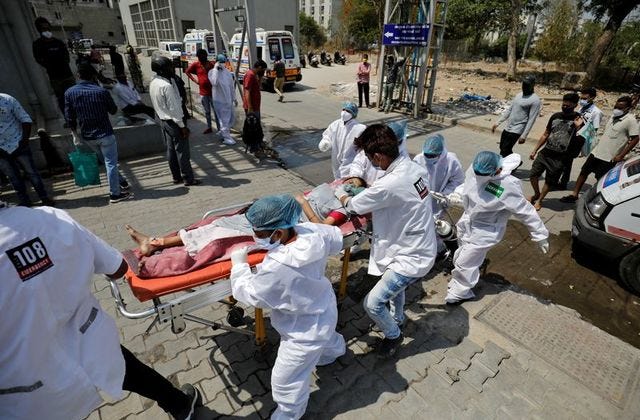
The stats — overwhelming as they are — provide a dignity to patients that the Indian state is seemingly unable to. The stories on social media shock one back to sense, highlighting the scale of indifference and suffering undergirding a massive public health emergency. In Jharkhand, a covid patient recently died outside a hospital while the state’s health minister was overseeing operations inside. On Friday, April 16, a journalist from Adityanath’s Uttar Pradesh, Vinay Srivastava, tweeted a plea for help: “I am 65 years old. Plus I have spondylitis, due to which my oxygen has reduced to 52.” “Help will come to you very soon,” tweeted one man. Srivastava responded, “For how long should I keep the faith? Now my oxygen level is 50, and the guard at the Balrampur hospital is not letting me enter.” On Saturday, Srivastava tweeted that his oxygen level was at 31. That was his last tweet.
Even for the BJP, this catastrophe — this march of death and destruction — will be hard to spin. The central government, and the significant swathe of India it controls, had almost a year to plan for this surge. It could have spent that year expanding public healthcare, stimulating a faltering economy, and working with state and local governments to raise public awareness and community resilience to covid. Instead, it spent that year like it has spent much of the last eight — in a frenzied scramble to hold on to power with no conceivable clue on how to use it for good. It did so by stoking communalism, deporting refugees, attacking political opponents and rights groups, villainizing Muslims, jailing teenagers, decrying science, and promising a future because it cannot deliver the present.
Here, the BJP — like many of its South Asian counterparts — exemplifies the tragic flaw of the autocrat and ultra nationalist. These leaders, these demagogues, mask weakness with vitriol, their incapacity to govern only matched by their propensity for hypocrisy. Welcome, then, to these new gods, the supreme leaders of COVID Rashtra, drunk on power with no regard nor recognition for its responsibilities. Indifferent of suffering, these gods plan pogroms better than they plan policies, and feel no shame in standing before a nation, while the nation dies before them, and lying through their teeth.
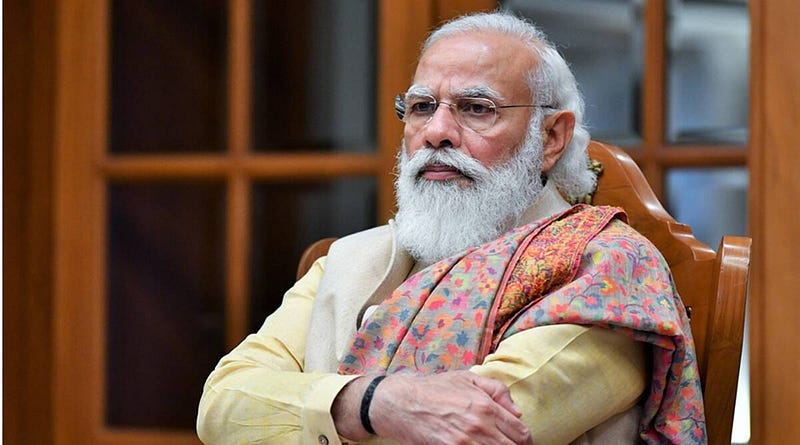
Isn’t this odd? For years, the BJP pawned off one existential threat after another to the Indian voter. Strongmen — Modi, Shah, Adityanath — told their constituents that only them, and their brand of populist politics can save the motherland. They were on a crusade against history itself, against injustice (against facts). How curious, how ironic then, that it is the sitting government that is the most present, most pernicious existential threat facing India today.
For now, as India endures, as grief turns to rage and back into grief again, the grills at the crematorium are melting. The graveyards are full. The dead have nowhere to go. The only message meted out from the top? Be brave. Keep banging the pans.


