
India: This is what democracy looks like on its way out. A lesson for the the USA
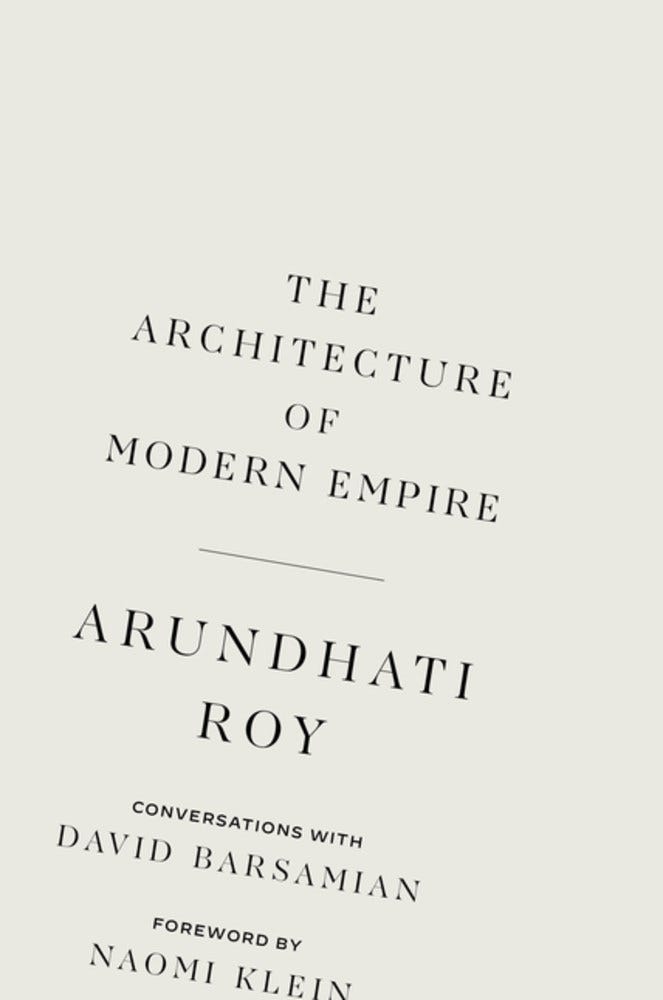
Arundhati Roy can see quite clearly, as her books, essays and speeches continually demonstrate. David Barsamian, who many know best as Noam Chomsky’s prime interviewer, has collected 21 years’ worth of his interviews with Roy, and presents them in The Architecture of Modern Empire.
Roy is a trained architect, but prefers writing novels. Her truthtelling however, has overtaken her life, sending her around the world speaking truth — not to power, which already knows and doesn’t care — but to everyone else who will listen, so they can piece together the why and not just the what (if they even know that much).
She is very sensitive to the environment. She witnesses the removal of mountains, the pollution of drinking water, the elimination of species and whole ecological systems, and the intense human suffering they all engender: “When human beings don’t respect something they don’t understand, they end up with consequences that you cannot possibly foretell.” But it’s an endemic condition for mankind: “Most of us are completely enmeshed in the way the world works. All our hands are dirty.”
Apparently, her country is dam-crazy. One river alone is undergoing the erection of 3,300 dams. There is an insane policy to connect all the rivers of India together. Millions are continually displaced, mostly without sufficient compensation, and never any for women. Roy points to madness like less acreage receiving new irrigation than the acreage flooded by the dam — displacing tens of thousands to start over, somehow, somewhere, with no help. They gravitate to the cities, there being no land open to them, causing massive ghettos all over the country.
She points to absurd contradictions in modern India, such as workers near her home in New Delhi, laying fiber optic cable at night — by candlelight. And despite the posh hotels, huge cars and uniformed guards everywhere, India hosts the 500 million poorest people in the world, worse than Africa, a continent.
But here’s the real story of this book: India is touted as the largest democracy in the world. If it can work this well in India, it can work anywhere, we hear repeatedly. But the truth is, as she discovered, it does not work at all in India. This Disneyesque reputation of yogis and wisdom, peace and harmony is totally false. The reason Kashmir is still Indian is because India refuses to hold the independence referendum it promised. No other government is allowed to win an election there. And no one is allowed to complain about it. India and Pakistan are constantly threatening nuclear war against each other, allowing for high alert on both sides — excuses for repression and violence. And unimaginable corruption by the elite twist society out of any recognizable shape.
The extreme right is in power nationally, and everything destructive they do reinforces their popularity. Prime Minister Modi, an extremist’s extremist, sent no one and nothing to stop the slaughter of Muslims in the state of Gujarat he was running. Police stood by and watched, when not participating themselves. This should have been reason to never win an election, anywhere, ever again. But in India, he was swept into national power because of it. She says “To my mind, the bulldozing of homes and businesses of Muslims marks the moment when a deeply flawed, fragile democracy has transitioned — openly and brazenly — into a criminal, Hindu-fascist enterprise with tremendous popular support.”
The biggest contradiction remains caste. It still pervades everything, preventing India from moving forward. Instead, it is totally focused on ranking everyone — the very essence of fascism. It goes right down to natural disaster relief, where “They have seventeen different categories of tents for the seventeen different castes.” Equality and freedom are nowhere to be found.
The road to fascism is paved with extremists leading the way. Slaughters of Muslims go on all the time. Women are suppressed to the point where some revolutionary armies count them as 40% of their soldiers. Rape is not merely tolerated, but rewarded. Everyone must be kept in their place assigned by the Hindu religion’s fanatics.
The result is the government does not control as much as 25% of the country, she says. Local militias and other insurgents have taken over. Other areas need to be massively occupied to maintain control. Kashmir is occupied by 700,000 soldiers, watching everyone — physically, electronically, using spies or software. Everyone, she says, “is a walking barcode.” The slightest suspicion means the end: prison, torture or death.
Worse, recent laws absolve the police from murder charges. They have the right to kill anyone for any reason, and not be prosecuted for it. Political assassinations result in no charges, gang rape-murders rarely do, and giant corporations instruct the government in who to have in the cabinet. The Bhopal poisoning by Union Carbide has resulted in nothing to the tens of thousands of victims, as even the trivial settlement they won in court has never been distributed to them. India’s biggest asset is people, and they are totally disposable in the eyes of government.
Terrorists are anyone the government says, from farmers to protesters, as needed, according to the Prevention of Terrorism Act, and subject to summary execution. The poor, as everywhere, are the most liable of all: “So terrorism and poverty are being conflated. And states are becoming very sophisticated in their repression.” This, she said in 2004, can be seen in how George W. Bush and Osama bin Laden are actually on the same side: “They both hold people responsible for the actions of their governments. They both believe in the doctrine of collective guilt and collective punishment. Their actions benefit each other greatly.” This is what sees when she looks at the world. It is the model for the Indian government today, where the extreme right Supreme Court doesn’t validate laws, it makes them itself, and deals with any criticism of the Court existentially.
A blatant error is India’s sidling up to the USA. India used to lead the non-aligned nations. It was developing self-respect among countries independent of America. No more. But she says this will backfire: “Does anyone care to study the history of former allies of the United States and what happens to them when they’re kicked over like an empty pail? The world is full of these examples, whether it’s Iraq or Pakistan or Chile. The list goes on and on and on, and I don’t think anybody should have illusions about how much America loves India.”
There is a real Deep State in India, called the RSS. It is out in the open, with millions of paying members, managing politicians and legislation, running schools, its own militia, and women’s and farmer’s organizations. She says foreign diplomats come to RSS offices to pay their respects, as if it were the sovereign government of India. Its whole essence is making Hinduism the official and sole religion of India, and will gladly kill anyone who doesn’t support that. And behind it all are the billionaires: “This country stands for nothing except the self-interest of its elites now.” It is a real life horror of a conspiracist’s wet dream.
For all her observations and criticism, it is remarkable Arundhati Roy is not in prison herself. But she is so high profile, so respected and so loved, the Supreme Court did convict her, but then sentenced her to just one day in prison. She knows that she could be put away for life, and that she should weigh her words. “Every time I write something, I have to brace myself, in India anyway, for three weeks to a month of insults.” But she insists she will tell it like it is regardless, because she must, and what comes of it will come of it. “I’m the kind of person who will always be on the losing side, by definition. I have to be, because I’m on this side of the line. I’ll never be on that side of the line.”
For all the damning revelations about life and politics in India, it is possibly even more dramatic how these eleven interviews cascade. As we get closer to the present, not only has Roy learned more about the criminal corruption of society, elections and democracy itself, but it gets darker and denser as we catch up to today. Today it is on the verge of hopelessness, as reflected in her answers to Barsamian’s questions in 2022. “But I insist on the right to be emotional, to be sentimental, to be passionate. If displacement, dispossession, killing and injustice on the scale that takes place in India does not enrage us, then what will?”
These interviews turn out to be a profile of post-democratic dystopia, hiding in plain sight.
David Wineberg
(The Architecture of Empire, Arundhati Roy, David Barsamian, March 2024)
.
If you liked this review, I invite you to read more in my book The Straight Dope. It’s an essay collection based on my first thousand reviews and what I learned. Right now it’s FREE for Prime members, otherwise — cheap! Reputed to be fascinating and a superfast read. And you already know it is well-written. https://www.amazon.com/Straight-Dope-learned-thousand-nonfiction-ebook/dp/B07Z48VQMT/