
India in the Quantum Debate: Exploring Samkhya Philosophy
Kapila’s Duality: Echoes of the Quantum Observer
My perspective
From the core of my being as a writer, an unconventional approach flows through my words — a deeply heartfelt and authentic style that strives to peel back the veils separating our perceived realities. I aim to rekindle a childlike sense of wonder in the reader, awakening them to the marvellous interconnections woven through all existence. For in this modern age, mere words often divide rather than illuminate the ultimate oneness underlying all things. With an open mind and sincere heart, I endeavour to transcend artificial boundaries and spark a fresh, unified perspective.
Samkhya
In my constant striving to unveil the unifying harmonies that permeate all domains of knowledge, I find today’s exploration into the ancient Indian philosophy of Samkhya distinctly aligned with that integrative quest.
By weaving together the insights of this spiritual tradition with the revelations of modern quantum physics, I endeavour to birth a cohesive tapestry that transcends the boundaries between ancient wisdom and contemporary empiricism.
Could not such a meta-synthesis, fusing transcendent intuitions with rigorous science into one seamless symphony, catalyze a renaissance in our cosmic perception? An enriched vision oriented around the fundamental oneness underlying the flourishing of all consciousness and material reality.
Kapila
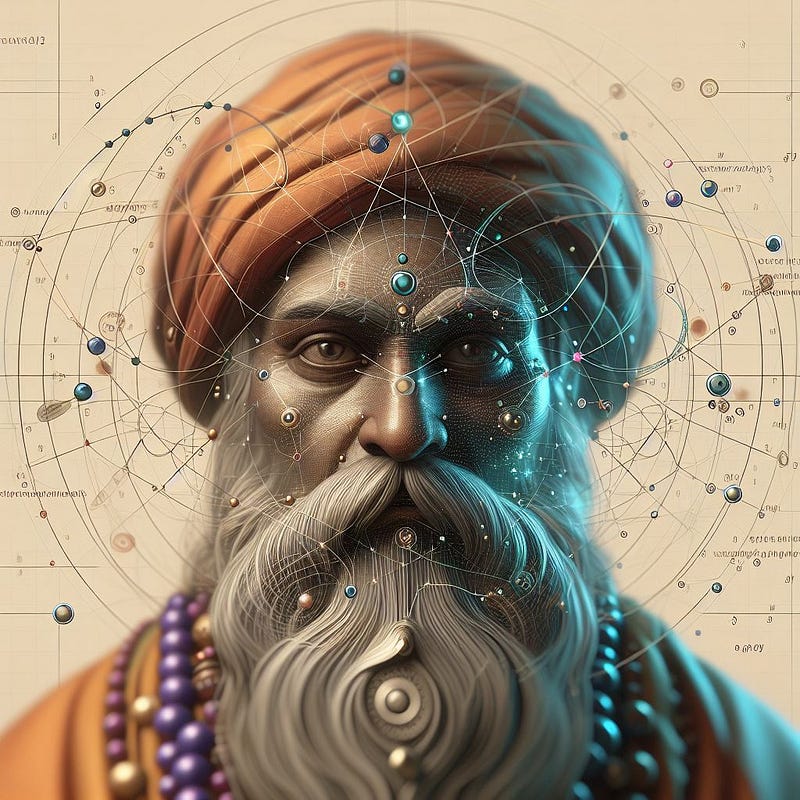
In the eternal quest to understand the nature of reality, humanity has long sought answers from spiritual philosophies and scientific inquiry alike. More than two and a half millennia ago, the Indian sage Kapila put forth a remarkable conceptualization of the cosmos that presaged core tenets of modern quantum theory in uncanny ways. Kapila’s Samkhya philosophy described the world as composed of two foundational substances: purusha (consciousness) and prakriti (matter).
Purusha represented the non-physical, transcendent consciousness that eternally observes prakriti — the physical, manifested natural world. This radical dualism between spirit and matter, the watcher and the witnessed, consciousness and the material realm forms the beating heart of Samkhya. As we shall explore, Kapila’s vision bears profound similarities yet crucial differences to our contemporary understanding of quantum physics.
Prakriti
At the core of Kapila’s metaphysics is the concept of prakriti — the primordial, primeval matter or nature that is the source of the manifest physical universe. Yet prakriti is not an inert, lifeless substance, but rather a dynamic interplay of three fundamental gunas or constituents: sattva (purity, equilibrium), rajas (energy, activity), and tamas (inertia, darkness). The constant flux between these three forces generates the ceaseless movement and change we observe in the natural world.
This idea of an inherently vibrant, energetic matter perpetually transforming itself evokes clear parallels with the modern notion of a quantum vacuum — not a static void, but rather a roiling sea of fleeting virtual particles and energetic fluctuations that give rise to all manifested physical reality. The three gunas seem to prefigure wave-particle duality and the uncertainty principle that governs the quantum realm.
Moreover, Kapila’s depiction of the non-physical purusha (consciousness) that silently witnesses the constant flux of prakriti is highly reminiscent of the indispensable role the observer plays in collapsing the quantum wavefunction and manifesting reality from superposition in contemporary interpretations of quantum mechanics. This “consciousness” shapes and brings definiteness to the formless potential of matter — an uncanny foreshadowing.
Pervasive impact
To fully appreciate the remarkable foresight of Kapila’s Samkhya system, some historical context is warranted. The teachings and verses outlining Samkhya philosophy were first compiled around 200 BCE in the ancient Sanskrit text the Samkhya Sutras, though Kapila himself is estimated to have lived several centuries earlier around 600 BCE. This would place him roughly contemporaneous with other seminal figures like the Buddha and the ancient Greek philosophers.
While relatively obscure in the modern West, the influence of Samkhya on Indian philosophical and spiritual thought over the millennia cannot be overstated. It is one of the oldest surviving philosophical systems of thought originating in ancient India, its teachings deeply embedded within the earliest Upanishads and exerting a profound impact on the fundamentals of Hinduism. The non-dualism of Advaita Vedanta emerged partially as a reaction and response to Samkhya’s radical dualism.
Concepts like purusha and prakriti, the three gunas, and the cyclical cosmic processes of evolution and dissolution were widely incorporated into Hindu theology and tradition. Samkhya’s influence even extended to Buddhism, with the Buddha himself initially studying Samkhya philosophy before developing his teachings.
Given this pervasive impact on the rich tapestry of Indian religious and philosophical traditions over thousands of years, the apparent resonances between Samkhya metaphysics and the modern scientific conception of quantum reality uncovered in the 20th century are all the more remarkable.
Purusha
To explore these resonances, let us examine some core parallels and key divergences between Samkhya and quantum theory.
The concept of purusha as a non-physical, transcendent consciousness that merely observes and shapes the physical domain of prakriti finds a fascinating echo in the pivotal role observation and measurement plays in the famous double-slit experiment. According to the Copenhagen interpretation, it is the very act of observation that seemingly “collapses” the probabilistic quantum wavefunction and causes a definite particle state to manifest from an extended wave-state. This seems to resonate with purusha’s act of perception giving concrete reality and definiteness to the fluid, everchanging manifestations of prakriti.
However, there is an important caveat — the quantum observer need not be a conscious human observer, but can be any form of measurement or interaction with the external environment. Quantum physics makes no claims about any transcendent consciousness required.
Purusha in Samkhya is a truly subjective, non-physical consciousness or soul separate from the material world, making it distinct from impersonal observation in physics.
Three gunas
Another area of similarity lies in Samkhya’s three gunas that govern the dynamics of prakriti. These can be mapped respectively onto the quantum wave-particle duality (sattva as the wave aspect, tamas as the particle aspect), and the uncertainty principle (rajas as the active energy interplay creating quantum indeterminacy). Just as the three gunas are in constant flux, generating the ceaseless movement of the universe, so too does the quantum realm exhibit inherent probabilistic uncertainty and complementary wave-particle flux.
However, a key difference is that in Samkhya the three gunas are innate qualities of an underlying concrete substance (prakriti), whereas quantum theory does not posit any substantive primordial matter but simply precise predictive equations governing interactions between quantum entities like fields and particles.
Adhisthana
Another profound connection can be found between the notion of Adhisthana (‘supportive cause’) in Samkhya and the concept of the “implicate order” developed by theoretical physicist David Bohm.
In Samkhya metaphysics, Adhisthana refers to the unmanifest, latent state of prakriti — the undifferentiated primordial matter/energy that precedes all manifest forms in the cosmos. It is the source, support, and material cause from which all of manifested nature arises in cyclical cycles driven by the interplay of the three gunas.
This shares a remarkable parallel with David Bohm’s proposal of an “implicate order” — a deeper level of objective reality that enfolds intermingles, and contains all seemingly separate and distinct things and entities in an indivisible wholeness.
According to Bohm, the explicate world of manifest physical forms and objects we perceive is merely a limited projection outwards from this underlying implicate domain of unbroken completeness. Both Adhisthana and the implicate order suggest our ordinary perception of discrete separate objects is an illusion founded upon a more fundamental unified ground of existence.
Divergences
However, there are some key metaphysical divergences as well.
In Samkhya’s view, this undifferentiated Adhisthana is not a dynamic process but a static primordial substance or essence — an eternal material cause that interacts with purusha (consciousness) to manifest the cosmos. By contrast, Bohm viewed the implicate order as a ceaselessly flowing unbroken process without any dualistic separation into consciousness and matter. For him, both were enfolded together within the universal implicate order.
And..so?
Does the striking resonance between Samkhya and quantum theory represent a mere coincidence, an inexplicable ancient knowledge transfer, or a glimpse of universal truths rediscovered across history?
As I reflect deeply on the profound resonances between the ancient insights of Samkhya and the modern revelations of quantum theory, I am struck by a sense of awe at the timeless, universal yearning of humanity to unveil the fundamental nature of existence. Though separated by vast stretches of history and culture, both of these great traditions seem to be groping towards a singular, transcendent truth — that the manifest world of physical reality we perceive is merely the outermost, dualistic veil obscuring an underlying unified oneness.
Perhaps by synthesizing the empirical rigour of contemporary science with the transcendent intuitions of ancient philosophies like Samkhya, we may finally part the veils and glimpse the radiant, ineffable essence that subsumes all consciousness and material realms into one holistic cosmos.
What do you think about my article?
Feel free to leave a comment.
Thanks for reading.


