Incel uprising
The internet is a new form of communication and grouping for those who wish to meet like-minded individuals. Unfortunately, this same internet has reinforced inequality among women as the suggestive nature of social media can perpetuate radical ideals through the screens of millions within seconds. Radical ideas that reveal anti-feminist masses who promote and support patriarchal movements.
They are self titled incels: involuntary celibate, “involuntarily celibate (incels) blame women for their perceived loss of masculine power.” Incels are searching for male domination as well as women’s demise. They believe they are judged by women, and they often attribute this to their lack of intimacy and relationships. The internet has created a space known as the “manosphere” where males may gather and fight for their rights. Providing a negative platform for the dissemination of dangerous and repressive ideologies. The internet acts as a gateway for those with privilege to strengthen the patriarchy as the anonymity of the world wide web allows them to feel encouraged and empowered.

What is an incel?
Incels or involuntary celibate is a term coined by a Toronto woman named Alana in the late Nineties, Alana started the movement as she struggled with find loving and being intimate with a partner. She had no idea what her concept would later be attached to this anti-women movement. Despite having the name involuntary Celibate, incels are not seeking sex but male supremacy. The views of incels have become extremists as subcultures on the internet allow men with deep anti-feminist sentiments to converse and share their plight of inadequacy that was believed to be caused by their lack of relationships with women. New America details that incels believe their rejection from women they deem attractive is ultimately caused because women fail to see their true characteristics and often fall for conventionally attractive and wealthier men. They blame physical attributes for their lack of intimacy with women and grow increasingly scary sentiments based on their preconceived notions.
The internet’s influence on incel subcultures.
Incels have coined terminology and constantly refer to these terms to make sense of their perception of the world. Most of these terms are in reference to the 1999 film Matrix. Anne Speckhard, Molly Ellenberg, and Alexander Ash define the “inceldom” terms of “red pill” awakening to the reality around them by being socially aware and ““black pill,” which refers to acceptance of their inceldom as a permanent and hopeless state of being, a negative outcome attributable to the current societal order including the rise of feminism, women’s rights, and women’s abilities to support themselves financially without a man, online dating and women’s superficiality in choosing a mate based on prestige, earning power and good looks.”” New America describes the red pill awakening as incels holding the sentiment of men holding “no systemic power or privilege”.
Incels also refer to others either as Normies, Chads, Beckys, and Stacys. “Normies” are classified as non-incels, the stereotype of blonde attractive women are described as “stacys” and typically attractive rich men that are successful with women are coined as “chad”. Beckys are women that are viewed as attainable and as sexually desirable. Misogynist incel men have invented a myriad of degrading and threatening language for women, in addition to the omnipresent systematic oppression.
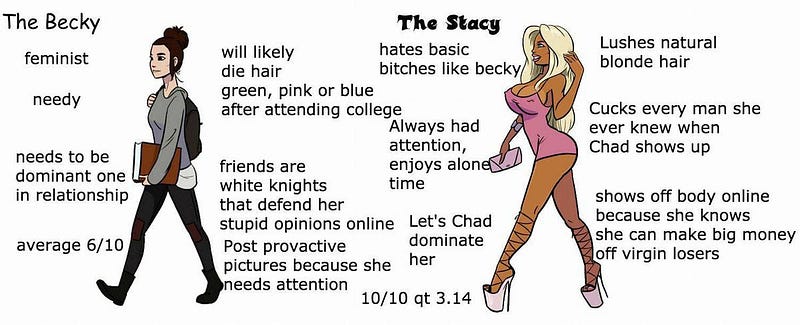
Why is this subculture so prevalent and strongly held?
The cumulation of mob mentality, toxic masculinity, and anonymity via the internet allows these parties to vocalize such hateful sentiments. Mob mentality plays an essential role in creating these niche communities as they feel empowered within online forums. Mob mentality allows individuals to feel safe whilst sharing an opinion because they are protected among a community.
Toronto Sexuality director James Cantor says ‘incel’ members lack social skills and “those who often have very poor social skills, this becomes their only means of social input”. Cantor reflects that when incels are surrounded by those who share their frustrations they lose a sense of what typical discourse is and drive themselves into more extreme beliefs. These individuals feed off each other as they share stories of their societal oppression inflicted upon them by women and ultimately continue to develop their views within this mob of people. Anonymity on the internet can shield the identities and ease those who wish to distribute anonymous and pseudonymous messages. Moore from the journalism site the Dartmouth delineates “the internet’s capacity to offer anonymity is — at least theoretically — one of its greatest strengths” but “online anonymity also tends to empower the worst among us, enabling cyberbullying and defamatory gossip.”. Anonymity on the internet provides a platform for individuals with opposing and controversial viewpoints, such as the incel community. Incel extremists thrive on the fact that they can remain anonymous while sharing misogynist views without fear of external repercussions. Incels hold the notion that they are oppressed as women have denied them validation and are ultimately subjugating their success. Those within these communities often lack social cues and have created online personas that reflect their hidden agendas.
Why is this dangerous for women?
These seemly dormant subgroups have dangerous ideology that lead members of these groups to radical plans. Recently news headlines reveal that these incels are no longer just spreading misogyny on the internet but have real-life plans to exact revenge on those who have caused this so-called plight.
One incel in particular has become the figurehead of the incel movement, Elliot Roger. Elliot Roger is a Santa Barbara man who executed a plan to cause murderous destruction on his school campus as a result of his self-titled loneliness and inadequacy. Elliot Roger murdered six people and injured fourteen in his plan to overthrow the “Chads” and the “Stacies” that had caused his allegded misery. Before he engaged in his plan, he released a 141-page manifesto that revealed his deeply preserved sentiments upon women and his life as an incel. This manifesto has later been spread amongst incel groups and essentially added fuel to a fire. Elliot was seen as a hero among the manosphere community and later coined the term the “ultimate gentleman”. Elliot is a prime example of how dangerous internet facilitations of these radical groups can prove to be fatal as just days before Elliot was seen chatting on Incel forums. Extremist ideas of this discourse community encourage incels to spread their sentiments further than the internet and conclusively this has dangerous consequences for women.