Summary
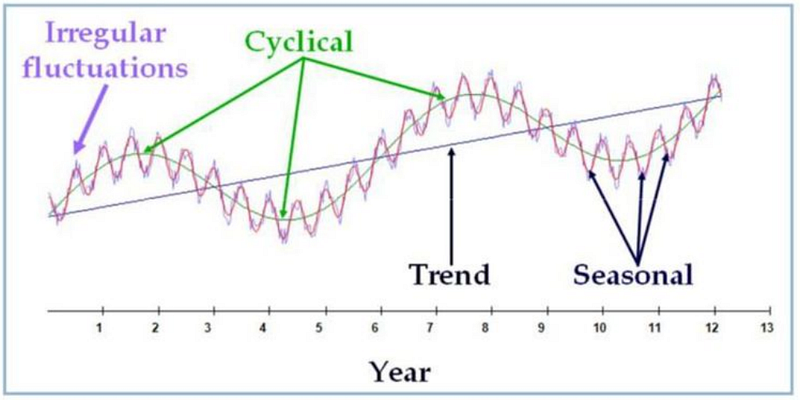
Time series analysis distinguishes between seasonality, which refers to patterns that repeat over a fixed and known period, and cyclicality, involving patterns that repeat over an unknown or irregular period, often lasting longer than a year.
Abstract
Time series analysis involves understanding two key concepts: seasonality and cyclicality. Seasonality refers to patterns that repeat over a fixed and known period, typically within a year or less, and are often linked to natural or cultural events. These patterns exhibit regular, predictable fluctuations with consistent shape and amplitude each year. Seasonal decomposition or seasonal ARIMA models can effectively capture and model seasonality.
Cyclicality, on the other hand, involves patterns that repeat over an unknown or irregular period, often lasting longer than a year. Cycles can be influenced by economic or business cycles, technological advancements, or long-term trends. Unlike seasonality, cyclicality is less predictable and challenging to model due to varying cycle length and timing. Modeling cyclicality requires advanced techniques like spectral analysis or state space models.
Bullet points
- Seasonality refers to patterns that repeat over a fixed and known period, typically within a year or less.
- Seasonal patterns are often linked to natural or cultural events and exhibit regular, predictable fluctuations with consistent shape and amplitude each year.
- Methods like seasonal decomposition or seasonal ARIMA models are effective in capturing and modeling seasonality.
- Cyclicality involves patterns that repeat over an unknown or irregular period, often lasting longer than a year.
- Cycles can be influenced by economic or business cycles, technological advancements, or long-term trends.
- Cyclicality is less predictable and challenging to model due to varying cycle length and timing.
- Modeling cyclicality requires advanced techniques like spectral analysis or state space models.