
In the Beginning…
How a story begins matters
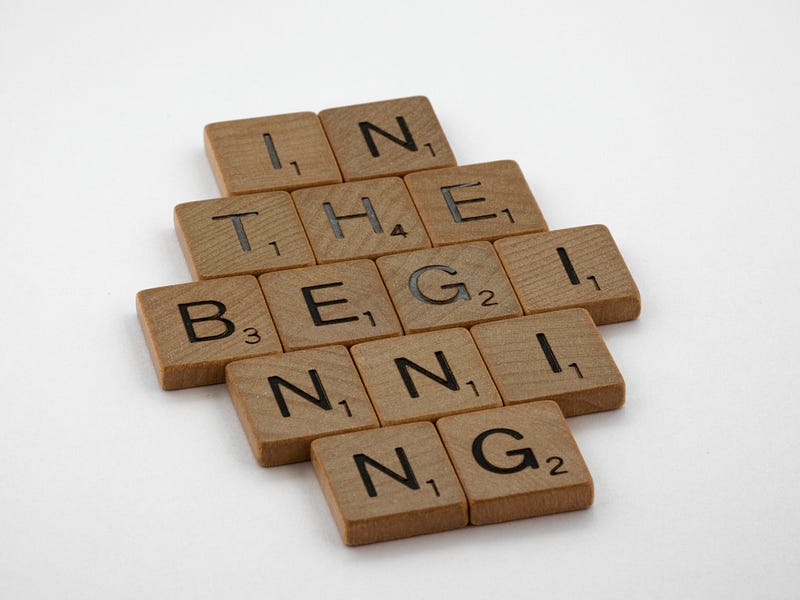
The idea of grabbing the attention of readers and drawing them into your story with an intriguing first line was the topic of recent writer’s group I attended. In that meeting a member suggested looking at the first lines of some of your favorite books. Since I have quite a stack of books I’m reading or have recently read, I thought, why not take a look at them?
And why not start with possibly the best known of all books and first lines:
“In the beginning when God created the heavens and the earth….” Famous though it is, how does it stack up as a first line? Does it make you want to read further? Does it entice you to buy the book? I suspect that opening is a stumbling block to many.
First lines are important. If the first sentence or two doesn’t grab us and draw us in, chances are we’ll return the book to the shelf or click on another selection.
So, here’s what I found in the books on my shelf:
“Duke Russell is not guilty of the unspeakable crimes for which he was convicted; nonetheless, he is scheduled to be executed for them in one hour.” John Grisham. The Guardians. After that opening, you’ve just got to read on to see if Duke is executed.
“On a cold morning in early October 1946 Pete Banning awoke before sunrise and had no thoughts of going back to sleep.” John Grisham. The Reckoning. Why did Pete wake up so early? Was he a farmer used to rising early? Why no thought of going back to sleep? What was he thinking about? As you read on you realize Banning is thinking about the murder he’s about to commit.
In The Chamber, John Grisham writes, “The decision to bomb the office of the radical Jew lawyer was reached with relative ease.” Who decided? “Jew lawyer”? Do they, whoever “they” are, carry out the decision? If so, what are the consequences. From the title, you might surmise that the gas chamber is involved. So, do “they” get caught and convicted? Got to read to find out, right?
“Perhaps once in a decade, or even once in a generation, a book like The Power of Now [by Eckhart Tolle] comes along.” However, since this line was not written by the author, I read on and found this at the beginning of Chapter 1: “I have little use for the past and rarely think about it; however, I would like to briefly tell you how I came to be a spiritual teacher and how this book came into existence.” Not a particularly strong beginning, is it?
“In Mississippi, where I now live, people still talk about God in everyday communications.” Nevada Barr. Seeking Enlightenment Hat by Hat: a skeptics path to religion. I know this wouldn’t be a draw for many, but two things attract me. First, I’ve read and enjoyed all of Nevada Barr’s many books. A retired National Park Ranger, she sets most of her fiction in one of the National Parks that she has worked in. Since I love good writing AND the National Parks, I find her work fascinating. Finding this book, I jumped at the opportunity to learn more about her and her faith journey. Faith journeys always fascinate me. I guess it goes with my love of biography and memoir.
“I think it started with bees.” Bill Nye (the Science Guy). Undeniable: Evolution and the Science of Creation. Why bees? Where do they fit in with evolution and creation?
Though I believe in God, consider myself a Christian and read the Bible, I think the jury is still out on how the Universe, our solar system, planet earth and we humans came to be. I think creation and evolution can coexist. In my view, God created it all, just not in six earth days as we know them today, not that He couldn’t. Since the earth has an age of about 4 billion years and the universe dates to the Big Bang about 13.7 billion years ago, God took considerably longer than six days to create our physical universe. Also, it appears human-like beings have been around and developing here for some six million years, and humans for perhaps 200,000 years. All this fascinates me and Bill Nye does a good job of presenting the case for evolution.
[Sorry, I just had to throw that little sidebar in. I haven’t finished Nye’s book yet, either.]
“Small moments? It is often those little gestures — a knowing look, a pat on the back, an unexpected kindness — that makes a big impression and shapes ones favorite memories.” Tim Russert. Wisdom of Our Fathers. I love Tim Russert’s stories about fathers and the men of the Greatest Generation.
In Yogadevotions: Practicing in the Presence, Pastor Cindy Senarighi and Heidi Green start with: “Chronic stress, cancer, heart disease, arthritis, eating disorders, and addiction — these are just some of the conditions in the Western world for which doctors are recommending yoga.” Having attended a few of Pastor Cindy’s yoga classes, I know she is dedicated to harmonizing the practice of yoga with her Lutheran Christian beliefs. I haven’t read all of the book, but it provides many good devotions to go along with the various yoga poses.
“On that first weekend in December there must have been twenty or twenty-five boats getting ready to leave.” Jeanne Wakatsuki Houston and James D. Houston. Farewell to Manzanar. What kind of boats are these? Where are they going? Why is Jeanne watching them? Wait, isn’t Manzanar located in the high desert on the opposite side of California from the ocean. Why are there boats? Are they coming to America or leaving it? These questions are answered as bombs fall on ships in Pearl Harbor and Jeanne’s nightmare begins. Having endured internment at Manzanar, Jeanne writes with the realism of firsthand experience.
“I was a goody-two-shoes all through school.” (Introduction) Writing Down the Bones. Natalie Goldberg. Why would Natalie be pegged that way? How did that influence her writing and her teaching of writing?
In Getting in the Gap: Making Conscious Contact With God Through Meditation, Dr. Wayne W. Dyer starts with “ The Gap is an exquisite Place (Introduction).” And, in chapter one he challenges us with this opening: “Why meditate?” What’s exquisite about a gap? How does that tie in with meditating?
[Sorry, another sidebar.]
In this short book Dr. Dyer answers the question and provides a technique that I like to use. It involves repeating the Lord’s Prayer, “Our Father who…” and pausing and focusing on the spaces between the words. So, we try to stay in the gap between “Our” and “Father” for as long as we can. Then we go on to the gap between “Father” and “who.” We continue on like that for as long as we need to or until we finish the prayer with “Amen.”
In Living in a Mindful Universe, Dr. Eben Alexander and Karen Newell open with this: “Morbidity and Mortality (M&M) conferences are the medical communities way of sharing the stories of hapless patients who end up maimed or dead from various illnesses and injuries.” Whoo boy, where is that going to lead? Dr. Alexander has devoted himself, since his Near-death Experience (NDE), to convincing his fellow physicians and others that consciousness is non-local. He says the fact that he returned with memories intact and was even able to recall his medical training, that consciousness cannot be something that resides solely in the human brain. He writes about this in another book: Proof of Heaven, which he wrote after his NDE.
Anne Lamott starts Travel Mercies: Some Thoughts on Faith with, “My coming to faith did not start with a leap but rather a series of staggers from one safe place to another.” I love Anne Lamott. Her opening line streams from her honest, humble, and insightful approach to life.
Jim Klobuchar begins Pursued by Grace: A Newspaperman’s Own Story of Spiritual Recover with, “Trying to meet God in the mining town where I grew up was a hair-raising walk through the graveyards of the child’s imagination.” I haven’t read Jim’s book yet, but I do want to know about that hair-raising walk.
“Excuse me, sir, but may I help you?” opens Mohsin Hamid’s The Reluctant Fundamentalist. Hamid writes in first person and tells of how he became “radicalized” by discussing his life and experience with the man he’s befriended. I enjoyed the unique style that leads to seeing many things in Western culture from Hamid’s character’s point of view.
I love Mary Roach’s work. In Stiff: the Curious Lives of Human Cadavers, she starts with this sentence: “The way I see it being dead is not terribly far off from being on a cruise ship.” Then, of course, she goes on to explain what she means. In the opening to Chapter 1, she says, “The human head is of the same size and weight as a roaster chicken.” I haven’t finished Stiff, but I’ve enjoyed what I’ve read. She does dig deep in researching her books. She packs them with tons of interesting facts. Trivia anyone?
Stephen King in Doctor Sleep opens the prologue with “On the second day of December in the year when a Georgia peanut farmer was doing business in the White House, one of Colorado’s great resort hotels [the Overland] burned to the ground.” [The Overland, you may recall, is featured in The Shining.] Then King opens Chapter 1 with “Her name was Andrea Steiner, and she liked movies but she didn’t like men.” Why doesn’t she like men? What happened to her to make her feel that way?

“My journey with photography began when I was a young girl.” Christine Walter Paintner writes in Eyes of the Heart. Someone who’s spent a lifetime behind the lens of a camera can tell us how to see with it. But Christine wants us to experience the scene. She wants the subject to speak to our hearts. She wants us to contemplate the scene before us and receive the image with love.
And, from Ansel Adam’s memoir, An Autobiography, in the Introduction: “If one feels inclined to embark on a journey into memory after eighty-two years the experience promises to be kaleidoscopic and, perhaps, willfully colored.” And from the first chapter: “Recently I made some new photographs, the first in several months.” Why had he not made any photographs for so long? He was, after all a world-renowned photographer.
From the prologue to Becoming Steve Jobs, by Brent Schlender and Rick Tetzeli, “You’re new here, aren’t you?” Who’s speaking? Jobs? Who is new? Where are they? Apple headquarters? Then the book proper opens with, “On a cold December afternoon in 1979 Steve Jobs pulled into the parking lot of the Garden of Allah, a retreat center on the shoulder of Mt. Tamalpais in Marin County north of San Francisco.” Why was Steve there? What’s going on? Garden of Allah? Was Steve there on business or for a retreat? He was, after all, known to engage in Buddhist practices.
John Sandford in Buried Prey opens with, “The first machines on site were the wreckers, like steel dinosaurs, plucking and pulling at the horses with jaws that ripped off chimneys, shingles, dormers, eaves, clapboard and brick and stone and masonry, beams and stairs and balconies and joists and headers and doorjambs.” Well, I guess if you are John Sandford, you can get away with writing, and even opening, with a sentence like that. It would not get a passing grade from any of my English teachers. Still, it conveys action and makes the reader wonder what’s going on. Why are they tearing down the house? From the title, are they trying to find “buried prey”?
In Rules of Prey, John Sandford opens with, “A rooftop billboard cast a flickering blue light through the studio windows.” What kind of studio? Could the flickering blue light be suggestive of the blue strobe on a police car? What’s happened in the studio?
In The Rule of Four, Ian Cladwell and Dustin Thomason open with, “Like many of us, I think, my father spent the measure of his life piecing together a story he would never understand (Prologue).” And in Chapter 1: “Strange thing time. It weighs most on those who have it least.” I haven’t read The Rule of Four, yet, but I’m looking forward to it. Perhaps stronger opening sentences would move it up on my priority list.
Another non-fiction: How We Win by Farah Pandith. “’So,’ she said gesturing at me and smiling. ‘Tell me why you’re here.’” That question could easily be posed to the reader. Why, indeed, am I here reading this? For me, that question is answered because I saw Farah Pandith being interviewed on the PBS Newshour and was impressed with her ideas and how well she articulated them. Confession: I haven’t read it yet, either, but I will. It’s on my list.
We learn later that this is Pandith meeting for the first time with Secretary of State Hillary Clinton. Pandith is an amazing, highly intelligent, articulate and thoughtful diplomat with some good ideas about how to defeat extremism.
L. John Lawrence opens Hello, Wigwam saying, “The crew chief threw his shoulder violently against the door. Three. Four. Five times. It wouldn’t budge.” (OK, I’ll admit that’s more than one sentence, but it shows the frantic action which makes you ask what’s going on here?) Are the soldiers trapped? Has there been a crash and they’re pinned in? The door turns out to be the hatch of the C-130 delivering private Albert Costas and his fellow soldiers to Tan Son Nhut Airbase in Saigon. The often-humorous stories form a Catch-22 of the Vietnam era.
I hope you enjoyed this brief romp through my library. As you write, take a look at your opening sentence or two. Does it grab the reader and draw him or her into your story?
[My Lenten Journey continues… Though I haven’t written and posted a story every day as I had planned, I’m determined to forge ahead with the intention of posting every day. Progress not perfection is my goal.]
The Lenten journey started here:
The previous post for this journey can be found here:
Happy Reading, Writing, Editing and Connecting.