
WAR
In Southern France, A Robin Hops Onto My Balcony, Daffodils Bloom and BBC Broadcasts The Sounds of War…
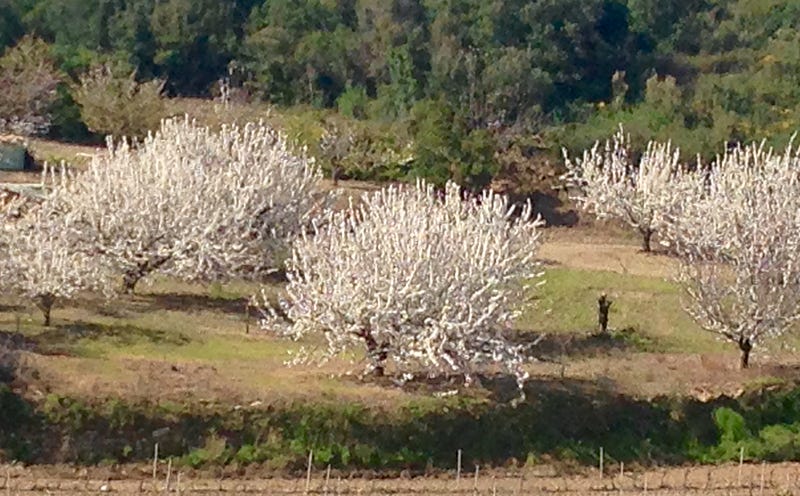
Spring has arrived in this part of France. It’s my favourite season. By the end of the month, the vineyards will wake from winter slumber and turn a verdant green. Meanwhile, Mother Nature has spread out the welcome mat. Scarlet poppies, clouds of pink and white blossoms and wild Iris on the roadsides — a Van Gogh painting come to life.
It’s uplifting, joyous. I breathe it all in while a mental soundtrack plays Louis Armstrong singing What A Wonderful World.
Except that it’s not.
It’s a crazy, insane world that seems to be on the verge of self-destruction. How can this be happening? How can World War 3, once so improbable, now be discussed as more than just a remote possibility?
I sat down at my desk this morning thinking that I’d write about spring. I wasn’t sure where I’d go with it — my stories often start that way — I’d just start writing and see where it took me. A recent picnic in the vines, lambs in the vines controlling weeds in a more climate-friendly way than tractors. Bulbs, I don’t remember planting, bearing blossoms like surprise gifts.
I couldn’t do it. Not when — on the same continent — entire cities are being destroyed. Where people who, just a few weeks ago, were doing ordinary things — buying groceries, shoes for the kids — are now fleeing for their lives.
At least the more fortunate ones. Others are buried beneath toppled buildings, blown to pieces while they sit in their perfectly ordinary cars — maybe on their way to buy groceries.
A brutish maniac is bent on the systematic destruction of a country and its people. Unstoppable, it seems, and voracious. Where will he go next?
I can’t wrap my brain around it. I don’t know how to think about it. How can I write about the tranquility and the joys of life when all this suffering is taking place. It feels either foolish and naive, or callous and self-absorbed.
I turn to Pema Chodron for some perspective.
We are like children building a sandcastle. We embellish it with beautiful shells, bits of driftwood, and pieces of colored glass. The castle is ours, off-limits to others. We’re willing to attack if others threaten to hurt it. Yet despite all our attachment, we know that the tide will inevitably come in and sweep the sandcastle away. The trick is to enjoy it fully but without clinging, and when the time comes, let it dissolve back into the sea.
Nothing lasts forever is the message. Impermanence is an inescapable fact of life. I have no trouble applying it to nature. By summer, the daffodils on my balcony will have faded. By autumn, the fruit will be picked from the vines, the leaves will fade and drop, winter will arrive and the cycle will begin again.
Wars have been waged throughout history. They begin and end and take their toll. Another one starts and people die. That too seems an inescapable fact of life.
Somehow, I’m not consoled.
I read today’s New York Times and remember the story I wrote (above) and am filled with disbelief that the world has gone so dark in just a few months.


