avatarBjorn Sorensen

Free AI web copilot to create summaries, insights and extended knowledge, download it at here

5207

Abstract

href="https://www.goodreads.com/book/show/20664086-alexandre-dumas-library-of-essential-writers-the-three-musketeers-the?from_search=true&amp;from_srp=true&amp;qid=Af7MhHGYX6&amp;rank=29">Three Muskateers</a> level sarcasm and grandstanding), wide-ranging and groundbreaking book — could come from such a difficult time in history and from an author who had lead such a gritty, tough life.</p><h1 id="2a8b">Following the Trail of the Author</h1><p id="cf5d">The life of Cervantes was a dangerous one. He was a soldier for several years and lost the use of his left arm in battle. He was a prisoner of war for five years. A tax collector. And a debtor who served prison time. Tragically, he died poor.</p><p id="0548">While the influence of Quixote can be seen all over Spain, most of the novel’s adventures take place in the generally unforested, flat, autonomous community state of Castile-La Mancha, just south of Spain’s centrally-located capital of Madrid. Cervantes’ famous novel, his tribute to the imagination, came while roaming these shallow valleys and unambitious hills.</p><figure id="2b85"><img src="https://cdn-images-1.readmedium.com/v2/resize:fit:800/1*DEFmln7WMR8uRmP-pDTJrA.jpeg"><figcaption>Evening, Castile-La Mancha, 2021. Photo by <a href="https://bjornsoren11.medium.com">author</a>.</figcaption></figure><p id="248d">South of Madrid, in Córdoba, I was lucky to hang out at the actual inn-tavern he frequently traveled to as a tax collector based in another southern city, Seville. An uninspiring landscape and job. Cervantes made so much out of seeminly nothing. A tribute to possibility sprung from the mundane.</p><figure id="c29c"><img src="https://cdn-images-1.readmedium.com/v2/resize:fit:800/0*fVgMoLbqkBIIQJhy.jpeg"><figcaption><a href="https://bjornsoren11.medium.com">Bjorn Sorensen</a> in Córdoba at the inn-tavern Cervantes frequented on his travels as a tax collector. Photo by passer-by.</figcaption></figure><p id="2e59">A bit closer to where I lived, just northeast of Madrid, is Alcalá de Hernares, the birthplace of Miguel de Cervantes. A couple of statues sit on a bench outside the museum commemorating the site — one of our fictionary knight, the other of his faithful travel sidekick, Sancho Panza.</p><p id="e179">While Quixote is tall, skinny and day-dreamy, Sancho is short, rotund, and very much practical. This, like the two sides of a person, one who dreams big and the other who remembers to pay the water bill. Quixote drives the car. Sancho remembers it needs to be put in the park before getting out.</p><figure id="f8ad"><img src="https://cdn-images-1.readmedium.com/v2/resize:fit:800/0*yKdhut9tyDtS07FL.jpeg"><figcaption>The birthplace of the author of Don Quixote. Our favorite fake knight Quixote is on the right of the author, his faithful sidekick Sancho Panza on the left. Alcalá de Hernares, Spain. Photo used with permission from Rebeca Laorga.</figcaption></figure><h1 id="7cd7">A Pandemic That Divides</h1><p id="7bd7">In 2021, COVID<b> </b>turned billions of the world’s survivors into introverts. For many of us, we discovered new riches in our own heads. Even pain, when processed, can sometimes turn into the biggest relief, the shiniest gold. Especially if you’re like our protagonist, Don Quixote, who doesn’t care what other people think as much as he tries to create freedom in his mind, then live it out.</p><blockquote id="eaa2"><p><i>People will shake their heads at you, just like they did at The Don, then go back to their own stifling routines. Quixote wasn’t having it.</i></p></blockquote><p id="855d">I knew some serious things were brewing inside that would need to have their say. I knew there were tears that would need to come out from looking hard at my past, at what I called regrets, and that I could be a much better friend to myself if I let that river of tears flow like Quixote’s imagination. Accept. Face the pain. Get grounded. Put new ground under my feet. And, for the love of God, don’t worry so much about what other people think.</p><p id="ac71">And I believed in where those feet were taking me. Travel, ironically, reminds me that I can’t run from my own issues. Spain gifted that to me. Cervantes was my emotional guru. Quixote, wandering here and there following his own whims and dreams, became my guide.</p><figure id="53a2"><img src="https://cdn-images-1.readmedium.com/v2/resize:fit:800/0*kxOMvp5BQBXtB0CU.jpeg"><figcaption>One of the actual windmills that inspired Cervantes. Campo de Criptana, Spain. Photo of <a href="https://bjornsoren11.medium.com">Bjorn Sorensen</a> by passer-by.</figcaption></figure><p id="682a">What the novel showed about movement helped me create a more authentic version of myself. When you’re in a totally new place, everything looks fresh and interesting. You see things you never thought possible, had never heard of, with people expressing themselves in novel, often humorous ways. You realize that in some ways, your life has been a privilege. In some ways, you have been denied what you needed as an individual. I journal a lot, and have always believed in seeing a therapist. I had some of my best writing and best counseling sessions in Spain, being hit left a

Options

nd right with different ways of looking at life.</p><figure id="86ed"><img src="https://cdn-images-1.readmedium.com/v2/resize:fit:800/0*3tjWGdGAh4Kcnflw.jpeg"><figcaption><a href="https://bjornsoren11.medium.com">Author</a> photo in the house of the woman that inspired Quixote’s imaginary love, Dulcinea. In his mind, she was a gorgeous, untouchable maiden. In the reality of the book, she was a garlic-munching farm girl. El Toboso, Spain.</figcaption></figure><h1 id="3cfb">Quixote On the Move</h1><p id="8b5a">Quixote left his home and traveled the countryside to verify his rich inner world, a world of brave people fighting for the fair and the righteous. The real world was far different, but no matter.</p><p id="6652">Quixote knew what he wanted. He knew what he wanted to go for instead of focusing on what he was against. He backed his thoughts and his words with actions. His exploits often came to disastrous ends, but they came from a place inside him that wanted to see himself and the world as their better selves.</p><figure id="3651"><img src="https://cdn-images-1.readmedium.com/v2/resize:fit:800/0*iXJyHQCrUvTqXVD1.jpeg"><figcaption>Know what a spittoon is? Well, Cervantes’ actual father was a doctor and a dentist. This is his office. When a patient puts the indented part of the bowl against his or her neck, they can spit into the center of the bowl. Or, if you’re our hero Quixote, you can wear this spittoon as you fight gloriously imaginary battles, thinking you have the best helmet in all of the earth. Alcalá de Hernares, Spain. Photo by <a href="https://bjornsoren11.medium.com">Bjorn Sorensen</a>.</figcaption></figure><p id="5b54">While funny and often wince-inducing, I knew I had my own ruts to get out of. As they say, it’s much easier to go down those familiar mental trails instead of creating new ones. But I could wince — and maybe laugh — and go for it anyway. Besides, someone (or many someones) will find fault with your best-laid plans. Do them anyway because it’s your decision. It comes from inside you and no one else. That builds a stronger backbone.</p><p id="89ba">The world will be more creative because of you doing you. You’ll have better intel afterwards, no matter if it was right or wrong. Finally, no decision is perfect. If you want perfection, you won’t make many authentic decisions. And like our hero in declining armor, you’ll be skipping out on a universe of adventures.</p><figure id="b3f9"><img src="https://cdn-images-1.readmedium.com/v2/resize:fit:800/0*wDTJLsUwNDiLiQzv.jpeg"><figcaption>“A place in La Mancha.” Pedro Muñoz, Spain. Photo by <a href="https://bjornsoren11.medium.com">author</a>.</figcaption></figure><p id="a1a0"><a href="undefined"><b>Kimberley Silverthorne</b></a><b> </b>urges us to go to the Quixote festival in October and provides a fantastic summary of the author, the book and who around the world it inspired:</p><div id="de12" class="link-block"> <a href="https://medium.com/@kimsilv/cervantes-week-in-alcal%C3%A1-de-henares-3b682b2e7276"> <div> <div> <h2>Cervantes Week in Alcalá de Henares</h2> <div><h3>A festive journey to the 16th century to honour Spain’s most illustrious writer, Miguel de Cervantes.</h3></div> <div><p>medium.com</p></div> </div> <div> <div style="background-image: url(https://miro.readmedium.com/v2/resize:fit:320/0*rUXO3M2eGzCSl1zt.jpeg)"></div> </div> </div> </a> </div><p id="9a76">And little did I know Quixote has so many famous quotes! <a href="undefined"><b>Bookey</b></a> has the scoop:</p><div id="5484" class="link-block"> <a href="https://medium.com/@bookey.en/don-quixote-30-must-read-quotes-from-the-iconic-novel-14545de30d3c"> <div> <div> <h2>Don Quixote: 30 Must-Read Quotes from the Iconic Novel</h2> <div><h3>Introduction</h3></div> <div><p>medium.com</p></div> </div> <div> <div style="background-image: url(https://miro.readmedium.com/v2/resize:fit:320/1*BU6aNUb8lMCY8tokWH1FpQ.png)"></div> </div> </div> </a> </div><h1 id="9b61">Your Catfish Friend</h1><figure id="5048"><img src="https://cdn-images-1.readmedium.com/v2/resize:fit:800/0*pt7nJCfrW3LCfoIy.png"><figcaption>Photo and Canva design by <a href="https://bjornsoren11.medium.com">author</a>.</figcaption></figure><p id="9061"><i>If you haven’t read it, the introduction to the “Your Catfish Friend” book reviews is <a href="https://bjornsoren11.medium.com/your-catfish-friend-book-reviews-4ae879877073"><b>here</b></a>, while you can dive right in with a review of the <a href="https://readmedium.com/meditating-while-checking-your-feed-6b193ecff86e"><b>Buddhist farce</b></a><b> </b>from<b> <a href="undefined">Joshua Samuel Brown</a></b>.</i></p><p id="9870">Like what you read? Medium is only $50/year and writers get paid when their work is read. Join using <a href="https://lanupitan.medium.com/membership"><b>this link.</b></a><b> 😍</b></p></article></body>

The ‘Year That Was’ Keeps Opening Doors

In Quixote We Trust

YOUR CATFISH FRIEND BOOK REVIEWS #3 (TRAVELOGUE EDITION)
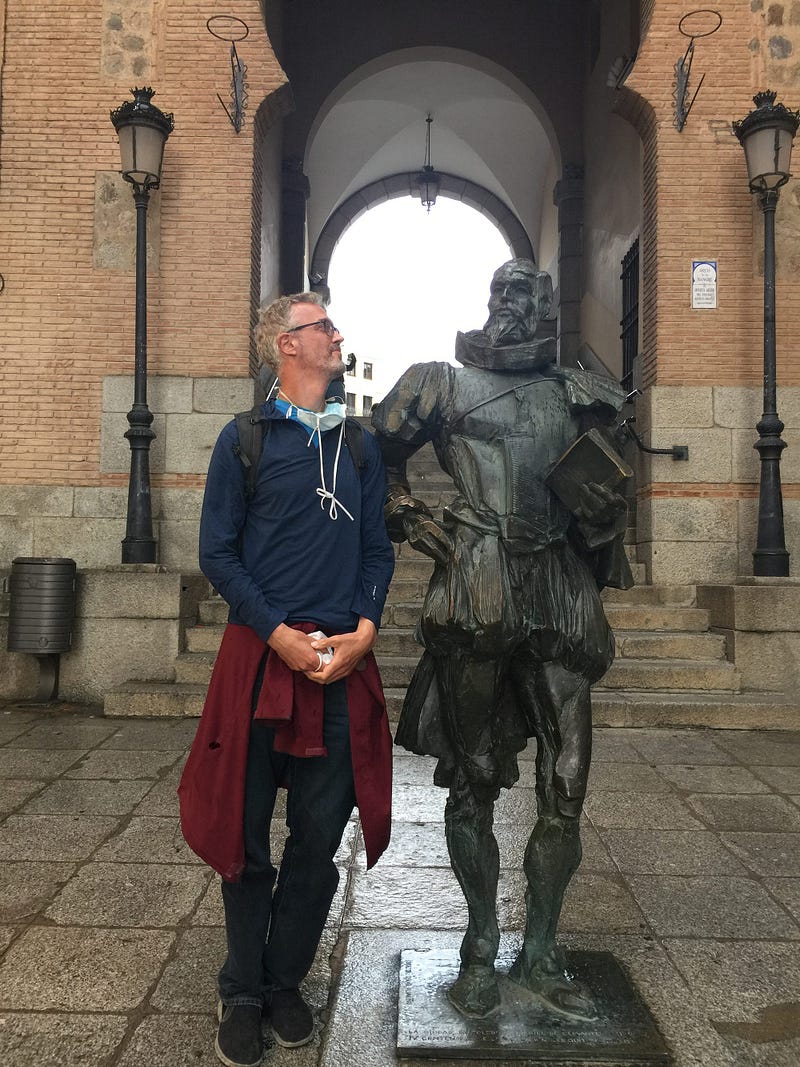
Bjorn Sorensen and his hero, Don Quixote novelist Miguel de Cervantes, Toledo, Spain, 2021. Photo by passer-by.

It’s oh so right that many consider Don Quixote to be the world’s first major novel. The main theme of the book is novelty. Sure, our tall, skinny, half-crazy protagonist — our knight in declining armor wandering around Spain — may have thought prostitutes to be royalty and sheep herds invading armies, himself having read so many novels about valiant men and women in King Arthur-esque literary works. What is novel is Quixote’s desperation to use his sense of justice — a more black and white brand learned from reading stories of heroic knights — to right the wrongs of a society seeing bigger and bigger forces unraveling it. What is novel is his powerful use of the imagination in an increasingly intolerant and jaded world.

Quixote would sometimes help the people he encountered as he rode his skinny, tired horse around the countryside with his more pragmatic, tunnel-visioned friend, Sancho Panza. Usually, however, his exploits would come to disastrous ends. The most famous scene of him attacking a windmill, thinking it was a dragon, comes to mind. He doesn’t protect Spain from flying, fire-breathing monsters, but instead gets his lance caught in one of the blades and suffers a circular throw-down. We’re treated to over-the-top chapter titles such as “Chapter XVII: In which a further account is given of the countless hardships that the brave Don Quixote and his good squire Sancho Panza underwent at the inn that, unfortunately for him, he mistook for a castle.” As we keep reading, amused, we wonder if we’ll learn more about Quixote’s particular brand of crazy, or whether the world is picking on a good man. That Quixote himself is pushing the envelope is what most fascinated this reader. At some point — if you’re lucky — you get to live your own authentic life. You get to face up to what your past and this world is constantly throwing at you. You often stand there alone.

Author Miguel de Cervantes finished “Don Quixote” part 1 in 1605 and part 2 in 1615. The 1600s in Spain, as we’ll see, was not a pretty time. It was a part of a Europe rife with poverty, war, judgmental mainstream religions, constricted political systems, and, importantly, newly-created insane asylums. Essentially, Quixote got out of his house and began wandering the countryside before they came to take him away.

In another us-and-them dynamic, a lot of the novel revisits the path the Muslims took as they lost battles to the Catholics and were driven south, eventually forced to flee the country in 1492. “The Moor’s Last Sigh”, of a Moor military leader fleeing the city of Granada and stopping to look at the famous Alhambra fortress one last time-where the Moors had been since 711-influenced our novel. And let’s not forget that all Jews were kicked out (or forced to convert to Catholicism if they stayed) in 1492 as well.

But the characters Quixote encountered in his travels-the goatherds, royalty and garlic-munching townspeople-would often go from thinking he was absolutely bonkers to eventually seeing someone boldly trying to forge an alternate reality of a more just, creative world.

This allows us as readers to reflect on our individual lives and the society we live in as well.

2021: Overwhelmed
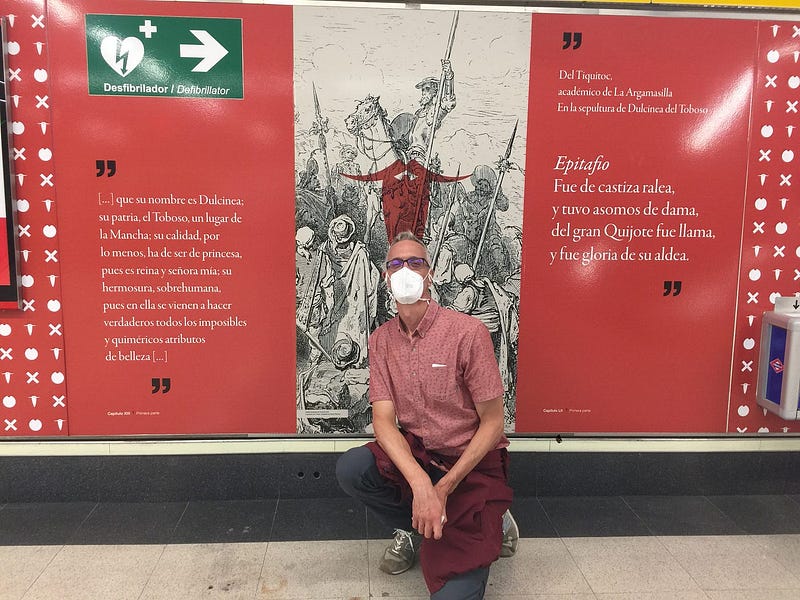
Author at a Madrid subway station. The entire novel adorns the walls of the train platform-lucky for you if it’s your stop. Photo by passer-by.

It was a year to take the pandemic pain, confusion and suffering all around and use it to fulfill one of my life-long dreams — being on the same land that inspired my favorite book. I used the lockdown to shed the four walls closing in around me and live in Spain.

Some called it crazy, even irresponsible. I double-masked and got on the plane anyway. Crazy or not, I needed a new space.

The phrase “one door closes and another opens” comes from Quixote, after all.

To live in Europe during Covid, you had to have a job. I didn’t think my Spanish was strong enough to continue my bookstore career abroad, so I taught English in a Madrid-area high school for seven months.

Basically, one of my biggest inspirations for wanting to go to Spain was seeing how Quixote — such a hilarious, over-the-top (think Three Muskateers level sarcasm and grandstanding), wide-ranging and groundbreaking book — could come from such a difficult time in history and from an author who had lead such a gritty, tough life.

Following the Trail of the Author

The life of Cervantes was a dangerous one. He was a soldier for several years and lost the use of his left arm in battle. He was a prisoner of war for five years. A tax collector. And a debtor who served prison time. Tragically, he died poor.

While the influence of Quixote can be seen all over Spain, most of the novel’s adventures take place in the generally unforested, flat, autonomous community state of Castile-La Mancha, just south of Spain’s centrally-located capital of Madrid. Cervantes’ famous novel, his tribute to the imagination, came while roaming these shallow valleys and unambitious hills.
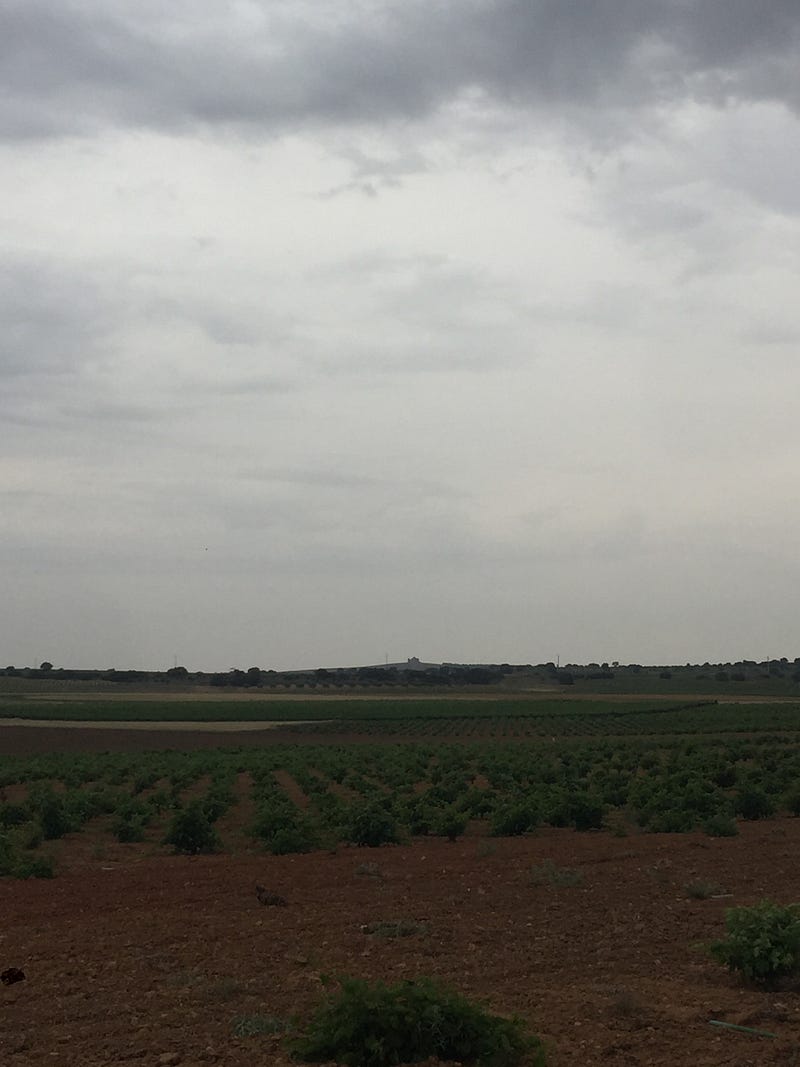
Evening, Castile-La Mancha, 2021. Photo by author.

South of Madrid, in Córdoba, I was lucky to hang out at the actual inn-tavern he frequently traveled to as a tax collector based in another southern city, Seville. An uninspiring landscape and job. Cervantes made so much out of seeminly nothing. A tribute to possibility sprung from the mundane.
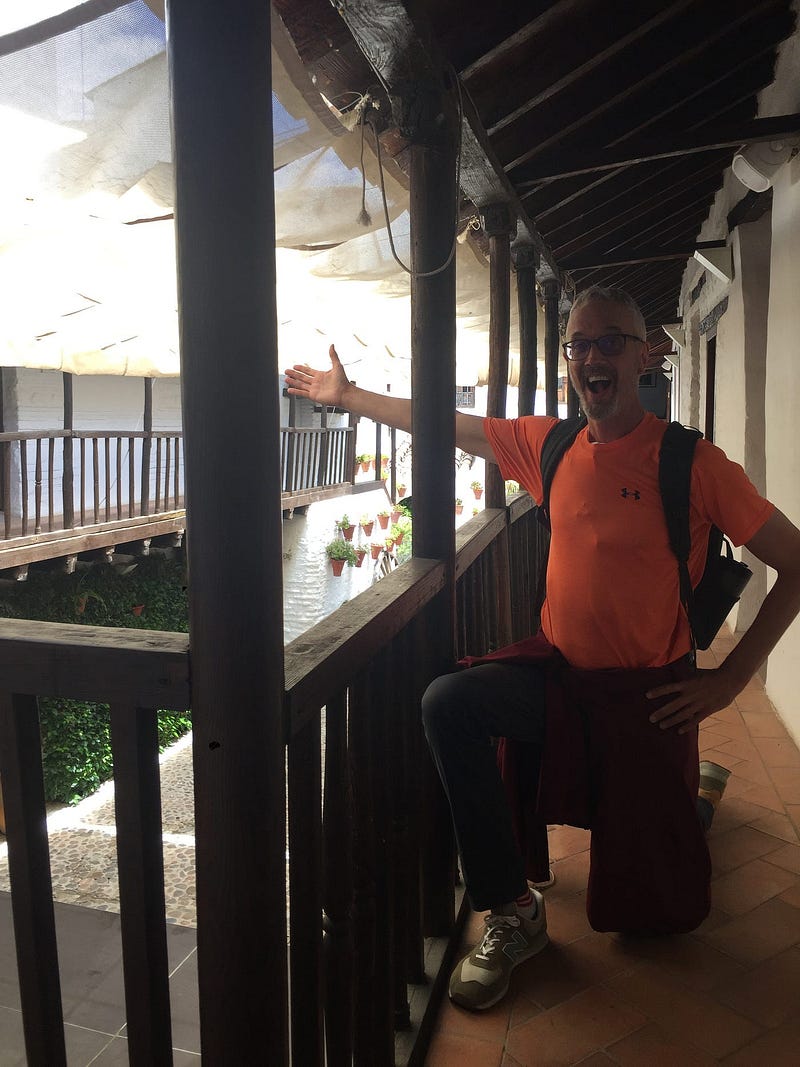
Bjorn Sorensen in Córdoba at the inn-tavern Cervantes frequented on his travels as a tax collector. Photo by passer-by.

A bit closer to where I lived, just northeast of Madrid, is Alcalá de Hernares, the birthplace of Miguel de Cervantes. A couple of statues sit on a bench outside the museum commemorating the site — one of our fictionary knight, the other of his faithful travel sidekick, Sancho Panza.

While Quixote is tall, skinny and day-dreamy, Sancho is short, rotund, and very much practical. This, like the two sides of a person, one who dreams big and the other who remembers to pay the water bill. Quixote drives the car. Sancho remembers it needs to be put in the park before getting out.
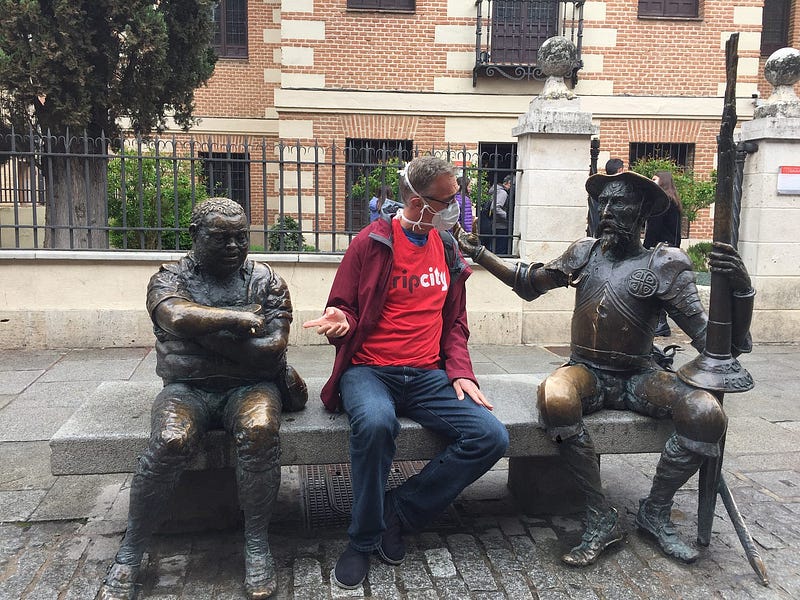
The birthplace of the author of Don Quixote. Our favorite fake knight Quixote is on the right of the author, his faithful sidekick Sancho Panza on the left. Alcalá de Hernares, Spain. Photo used with permission from Rebeca Laorga.

A Pandemic That Divides

In 2021, COVID turned billions of the world’s survivors into introverts. For many of us, we discovered new riches in our own heads. Even pain, when processed, can sometimes turn into the biggest relief, the shiniest gold. Especially if you’re like our protagonist, Don Quixote, who doesn’t care what other people think as much as he tries to create freedom in his mind, then live it out.

People will shake their heads at you, just like they did at The Don, then go back to their own stifling routines. Quixote wasn’t having it.

I knew some serious things were brewing inside that would need to have their say. I knew there were tears that would need to come out from looking hard at my past, at what I called regrets, and that I could be a much better friend to myself if I let that river of tears flow like Quixote’s imagination. Accept. Face the pain. Get grounded. Put new ground under my feet. And, for the love of God, don’t worry so much about what other people think.

And I believed in where those feet were taking me. Travel, ironically, reminds me that I can’t run from my own issues. Spain gifted that to me. Cervantes was my emotional guru. Quixote, wandering here and there following his own whims and dreams, became my guide.
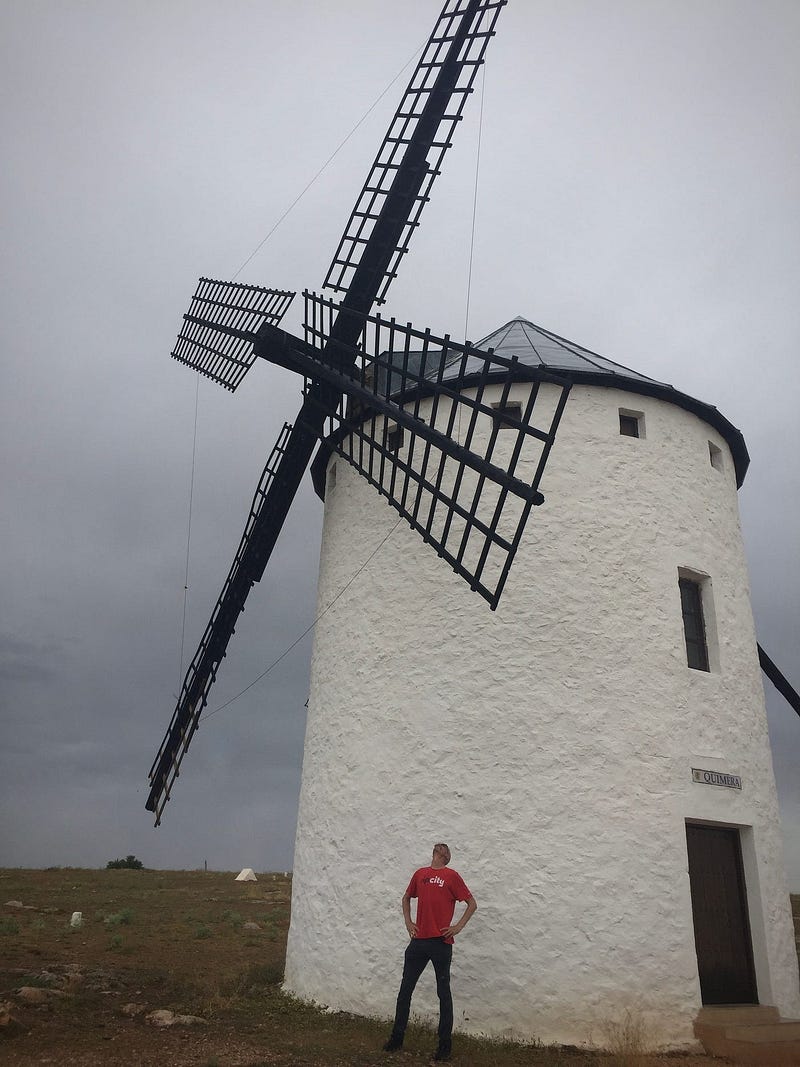
One of the actual windmills that inspired Cervantes. Campo de Criptana, Spain. Photo of Bjorn Sorensen by passer-by.

What the novel showed about movement helped me create a more authentic version of myself. When you’re in a totally new place, everything looks fresh and interesting. You see things you never thought possible, had never heard of, with people expressing themselves in novel, often humorous ways. You realize that in some ways, your life has been a privilege. In some ways, you have been denied what you needed as an individual. I journal a lot, and have always believed in seeing a therapist. I had some of my best writing and best counseling sessions in Spain, being hit left and right with different ways of looking at life.
Author photo in the house of the woman that inspired Quixote’s imaginary love, Dulcinea. In his mind, she was a gorgeous, untouchable maiden. In the reality of the book, she was a garlic-munching farm girl. El Toboso, Spain.

Quixote On the Move

Quixote left his home and traveled the countryside to verify his rich inner world, a world of brave people fighting for the fair and the righteous. The real world was far different, but no matter.

Quixote knew what he wanted. He knew what he wanted to go for instead of focusing on what he was against. He backed his thoughts and his words with actions. His exploits often came to disastrous ends, but they came from a place inside him that wanted to see himself and the world as their better selves.
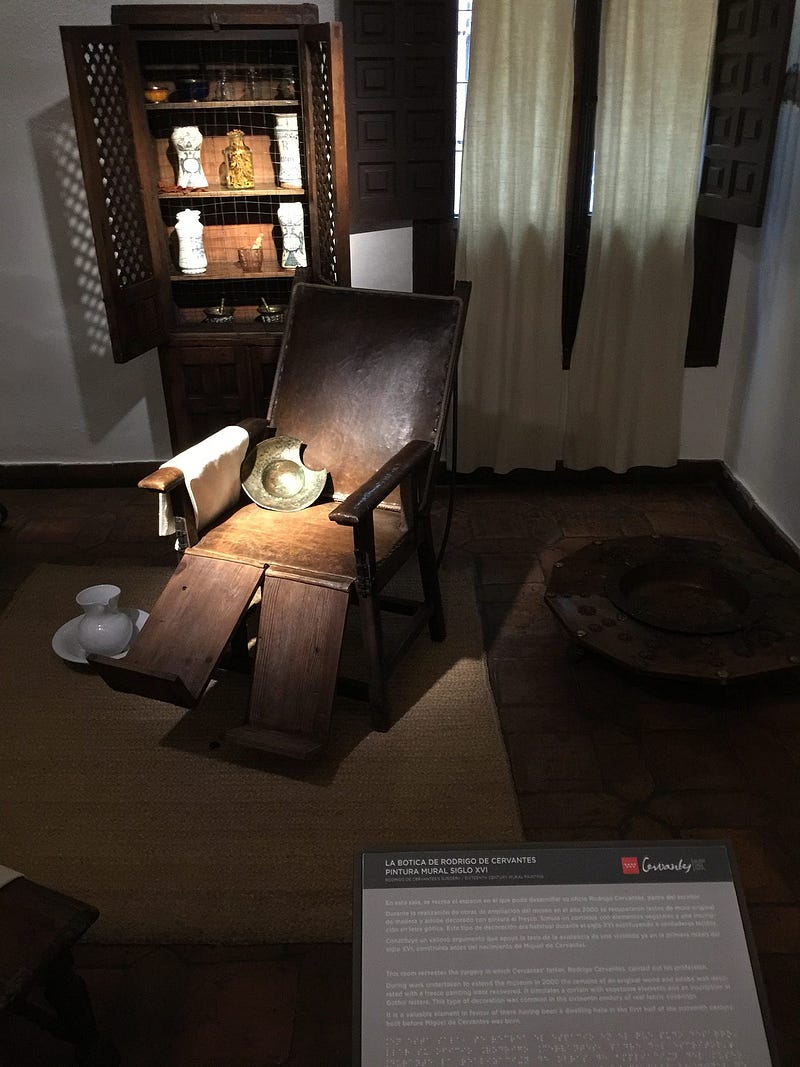
Know what a spittoon is? Well, Cervantes’ actual father was a doctor and a dentist. This is his office. When a patient puts the indented part of the bowl against his or her neck, they can spit into the center of the bowl. Or, if you’re our hero Quixote, you can wear this spittoon as you fight gloriously imaginary battles, thinking you have the best helmet in all of the earth. Alcalá de Hernares, Spain. Photo by Bjorn Sorensen.

While funny and often wince-inducing, I knew I had my own ruts to get out of. As they say, it’s much easier to go down those familiar mental trails instead of creating new ones. But I could wince — and maybe laugh — and go for it anyway. Besides, someone (or many someones) will find fault with your best-laid plans. Do them anyway because it’s your decision. It comes from inside you and no one else. That builds a stronger backbone.

The world will be more creative because of you doing you. You’ll have better intel afterwards, no matter if it was right or wrong. Finally, no decision is perfect. If you want perfection, you won’t make many authentic decisions. And like our hero in declining armor, you’ll be skipping out on a universe of adventures.
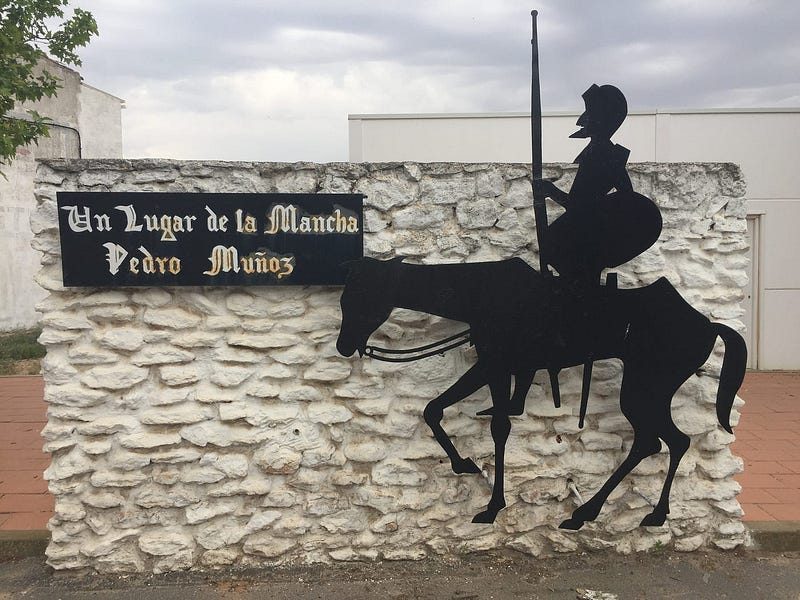
“A place in La Mancha.” Pedro Muñoz, Spain. Photo by author.

Kimberley Silverthorne urges us to go to the Quixote festival in October and provides a fantastic summary of the author, the book and who around the world it inspired:

And little did I know Quixote has so many famous quotes! Bookey has the scoop:

Your Catfish Friend
Photo and Canva design by author.

If you haven’t read it, the introduction to the “Your Catfish Friend” book reviews is here, while you can dive right in with a review of the Buddhist farce from Joshua Samuel Brown.

Like what you read? Medium is only $50/year and writers get paid when their work is read. Join using this link. 😍

Humor
Travel
Spain
Books
Self Improvement
Recommended from ReadMedium