
Americans Are Obsessed With Money But Rarely Talk Honestly About It
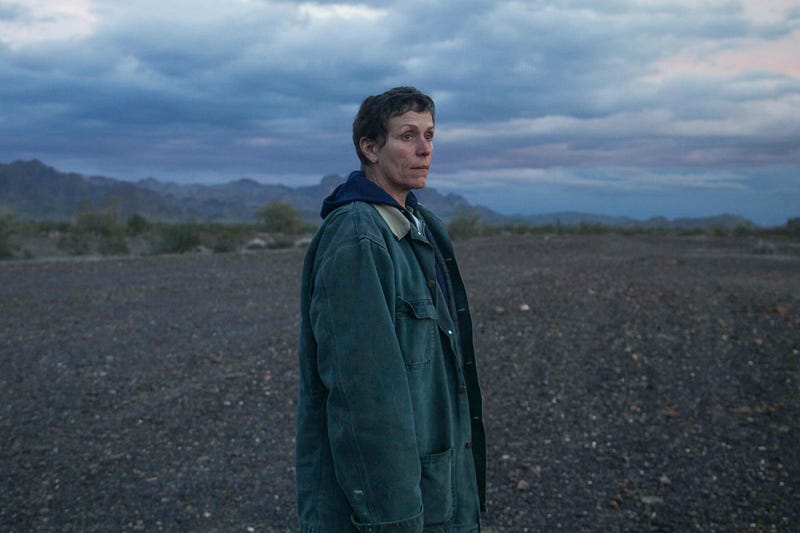
In ‘Nomadland,’ Frances McDormand stars as a struggling widow on the road
I have shared deeply personal feelings during my weekly men’s group therapy sessions. I have opened up about past traumas, and substance abuse, and embarrassingly petty resentments but when it came time to tell them I had been laid off, again, I winced. I didn’t want to do it. I didn’t want to confess that I was out of work and struggling to pay the bills. I had talked about my sexual insecurities but discussing money was too intense, too intimate.
A few weeks prior I had openly ugly cried about missing my late father but somehow saying “I’m broke” out loud was too much to bear. I managed to get it out. I had failed. I made sure they knew I was looking for work, though.
The session ended with grim nods and our therapist reminding us that we are not our jobs. Later, one of the men asked me for my home address via text. He was in the frozen meat business and wanted to send me steaks and lobster tails so my girlfriend and I would have a nice Valentine’s Day.
I was laid-off during the 2008–2009 Great Recession. I spent a few years unemployed, then had a run of pretty steady work but over the past few years, I’ve lost back-to-back jobs. The dream — the deal — is that I’d work hard and then do better, make more money, buy more stuff. And people would point at me and say “that’s an important man.”
But that dream is dead. Or maybe it is sleeping. I don’t know. My retirement plan is to live near a casino. Until then, I still have to work.
Thankfully, group is far cheaper than individual therapy.
The new documentary-style drama Nomadland is a beautiful, melancholy Hollywood western about a middle-aged widower on the road, living out of a cramped van. She is a victim of the Great Recession — both she and her late husband were employed at a sheetrock plant in Nevada that closed down and took the town with it in 2011.
She is, in her words, houseless, not homeless.
Her name is Fern and she is played with quiet dignity by movie star Frances McDormand. Fern wanders from part-time paycheck to part-time paycheck, cleaning toilers, working a deli slicer, shoveling beets. She finds seasonal work at a dystopian — and magnificent — Amazon distribution warehouse that employs hundreds, many of whom sleep in parking lots after punching out.
In between gigs, she joins a loose community of itinerant people, mostly white and older, always on the move, living a new kind of American dream where they’re not defined by what they have, but by what they’ve lost. Capitalism’s rejects. These folks are not their jobs or their homes with multiple garages. They define themselves by sunrises and cheap gasoline and freedom, freedom from rent and stuff, and a society built to hide pain under extra cheese, or at the bottom of hot tubs, or cut with ground-up pain pills.
Their RVs are crowded with only what they need, but there is room for ghosts. The dead ride shotgun in Nomadland. The balance sheets of Fern, and the others she meets on the trail, are full of loss because, in the end, that’s all that matters: Who did you love and how did you say goodbye?
Nomadland’s director, Chloé Zhao, is in love with the American West, which is easy to fall in love with. The endless deserts, the distant mountains, highways winding every forwards towards new hopes and opportunities. The West is a myth, and that myth is that there is gold in yonder hills, even if there isn’t.
There are moments in the movie when I worried this accomplished filmmaker and her crew of outsiders were romanticizing poverty from a safe distance. But to her credit, Zhao sees through the beauty of the vast states like Nevada. She understands that the West is a place of eternal promise. For centuries, easterners have made the long trek from one coast to the other. The frontier has always been picturesque but cruel, a temporary home to countless hobos and families on the march.
Her Nomadland is a ballad for modern-day tramps who can’t quite afford to live the good life and she seems to know this is an old song.
The striking mountains Zhou frequently captures have been a backdrop to misery for generations. Fern, and her compatriots, aren’t the first to wander the heavenly wastelands of Arizona and Nebraska and the Dakotas looking for a lucky break or a second chance. They won’t be the last either. Nomadland is almost a prequel to the Mad Max movies, the characters sort of road warrior pioneers ahead of their time, right before the collapse of everything.
Based on a nonfiction book by accomplished journalist Jessica Bruder, Nomadland wants to balance gritty reality and timeless fiction, and mostly succeeds. It never rubbernecks, and only occasionally bows its head.
McDormand, and all-star character actor David Strathairn, are superb as intelligent, and troubled, drifters but the movie’s other characters are an assortment of non-actors from the community Brudel writes about in her book. Zhou makes sure to show the joys of a tight-knit community, the laughter, and support. These aren’t wretches from Les Miserables.
They are members of a counter-culture born of necessity: America is a land of plenty, but not enough. These roamers are survivors with a good attitude generously teaching newbies how to survive the wagon train. Their mass migrations fuel an entire mini-economy that sells everything from buckets for easy defecation to tasers for personal-protection. There are a few times when the real-life nomads threaten to steal the movie but Zhao is always able to return to the up-close study of Fern, and her grief. McDormand is at her best during the small moments of Fern’s life, the sweat, and the sudden jolts, and small victories.
Fern is a deeply lonely woman who resists human connection. She wrestles with that contradiction throughout the movie. She spends time with fellow wanderer Dave, played by Strathairn, and they’re happy together until he decides to put down roots with the family he abandoned. Their relationship is prickly and sweet and sad.
At one point, she has no choice but to reach out to Swankie, an elderly woman with terminal cancer who has decided to die out in the world, rather than in a hospital room. Fern needs help, and Swankie obliges, begrudgingly. She has sights to see. Their short friendship is vulnerable and human and then they say goodbye.
Americans are obsessed with money but rarely talk about it. The therapist who runs my group mentions, often, that it’s easier for some people to talk about their love life than their bank account. My parents didn’t grow up with money, and I know we had really lean times, but it was never brought up. It was as if the topic didn’t exist.
There were some years, though, especially near the end of his life, when my dad did pretty well. When he was sick, very sick, he used to express surprise that a preacher’s son became successful working for a politician—what a blessing. It was something he’d whisper as if he didn’t deserve it.
He was alive for my first layoff, at the turn of the century. He told me to remember the people who returned my calls when I was down because one day I’d have a job again, I’d be up, and I’d want to buy them a coffee or lunch, just say hi. He knew that losing a job was painful, a loss. My stomach still clenches when I talk about it, or think back to the paperwork, the credit card debt, the new ties I bought at thrift stores for interviews that would go nowhere. The hopelessness. Anger.
I felt ashamed when I told the men in my group that I was broke and I’m glad I told them because they unburdened me of that feeling, just by listening. Watching Nomadland also helped, and not because I want to live like a nomad, or because my situation isn’t as dire — I am middle-aged, but not yet a disposable senior citizen. I can still make someone money, probably. Hopefully. No, the movie just reminded me that you can’t take it with you, and we’re all going to the same place.
In Nomadland, the American Dream sleeps in a van parked in the desert, and in the morning, the dream is to find some work, anything really. It is a thoughtful and affecting drama that reminds its audience that we are all crushed by the gravity of money, whether we want to talk about it or not.