
In fear of the Orient — How Australia’s debate of foreign interference draws on our xenophobic past
Since colonisation, Australian social and political culture has permeated a constant and perhaps ironic anxiety of external invasion. Given its cultural unease as a lonely European outpost in the Asia-Pacific, Australia has struggled to identify itself within its own geopolitical sphere.
This struggle translated into a cultural fear from its neighbouring Asian countries and was kept alive by an orientalist narrative of demonising the unknown. The White Australia Policy was a culmination of this fear and although Australia enjoys its current multicultural status, our dark and exclusionary past can seep to the surface in moments of social and political change.
Historically, China has often been the object of political and cultural fear in the Australian imagination. Today, as is it asserts its presence on the world stage, fears of invasion once more begin to rise within Australian academic, political and social discourse. A new found fear of a Chinese takeover within Australian academic and political discourse, most particularly found in Clive Hamilton’s ‘The SIlent Invasion’, expounds a dangerous orientalist narrative that politicises the unknown.
Chinese Presence in Australia — Constructing the Other
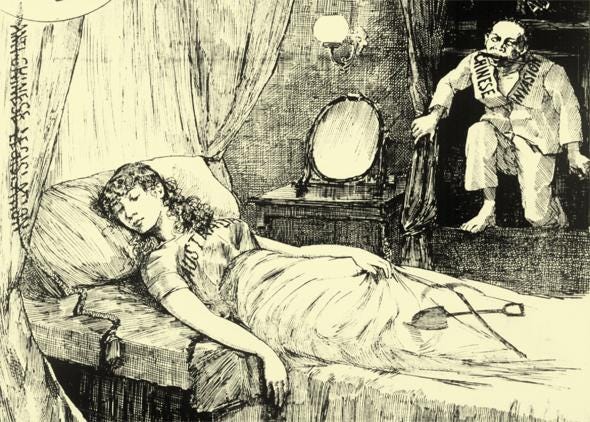
Australia’s interaction with the outer world has, as Anthony Bourke describes, been built on a restless ‘invasion anxiety’.The White Australia policy that began with the Immigration Restriction Act of 1905 was the defining policy of a federated Australia and brought to light the blinding sense of apprehension Australian’s held to the non-Anglo-Saxon world. While the policy was instigated from a fear of cultural degradation caused by the mixing of races, it was also built upon an inherent anxiety of both metaphorical and literal Asian invasions.
This was particularly directed towards the Chinese, which as was the anvil against which Australia and other young societies established their own identity. During the second world war, Japan took the position of enemy number one in Australian orientalist discourse which projected a stereotype of a backwards and insidious unknown.However when Japan was defeat in 1949, China resumed the role of the dominant other. This ‘otherness’ was compounded by its new communist status, China now epitomised both Yellow Peril and the Red Menace in the Australian mind.
In his text ‘Orientalism’, Edward Said outlined the ways in which the west discursively characterise the orient as both hostile and alien. Countries and peoples of the orient were thus created to suit a theatrical stage populated by characters built to fit within the minds of a European audience. China with its large population and historical position of power within the orient itself, perpetuated an orientalist projection of the undesirable, ultimate other. This can be seen in early works of Australian fiction where Chinese people were characterised as a faceless invading mass of enormous numbers.
Furthermore, the influx of Chinese workers during the gold rush period of the nineteenth century created a unique position for Chinese people within the Australian mind-set. This position was characterised as a mysterious unknown that should not be allowed to penetrate Australian society, leaving a lingering scar on the national psyche.Even after the abandonment of all White Australia policies and the introduction of the Racial Discrimination Act in 1975, within Australian academic and political discourse remained a lingering anxiety of ‘Asian invasion’.
Vestiges of our xenophobic past emerged constantly in political debate in the 1980s and 90s. This was exemplified by Pauline Hanson and her ‘One Nation Party’, whose rhetoric on being ‘swamped by Asians’ and reducing immigration intake to zero played well to the ears of regional farmers going through hardships caused by global economic change. Yet before this, prominent academics such as Geoffrey Blainey in his book ‘All for Australia’ argued for a dramatic cut to immigration to stop the ‘Asianisation of Australia’.
This was also supported by John Howard in 1988 with his comments that to maintain social cohesion, he was in favour of slashing immigration from Asian countries. The story of multiculturalism and Chinese Australians, however, hasn’t all been gloom. Since the 1975 Racial Discrimination Act, Australia has made remarkable strides as a multicultural nation.
Yet policies built on fear from being swamped by a foreign unknown are ubiquitous from our policy on asylum seekers to the resurgence of ‘One Nation’ and extremist groups such as ‘Reclaim Australia’. Despite the eradication of overt racism and xenophobia, Australia cannot rid itself from what Brian Edgar claims as an ‘invasion theology’.
The Modern Chinese Invasion
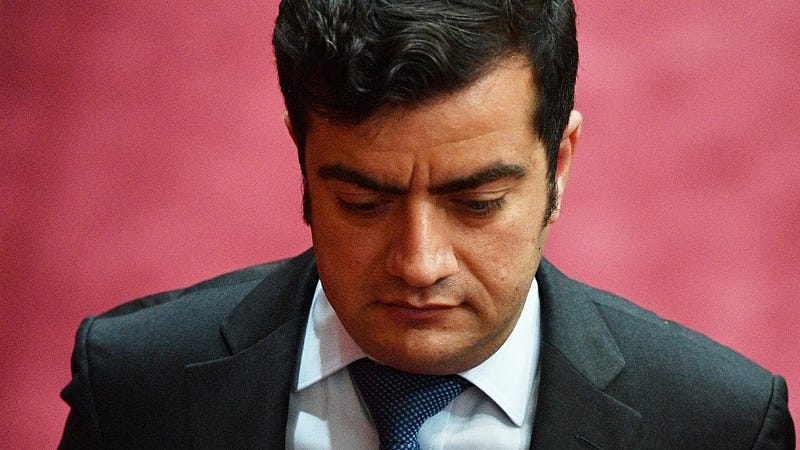
There has been a recent resurgence of anxiety within political and academic circles of Chinese influence within the Australian body politic and universities. As senator Sam Dastyari was removed from office over Chinese bribery scandals in 2017, the Australian Security and Intelligence Office warned of possible Chinese influence in Australian universities.Prominent academics such as Malcolm Davis also claimed that China was “trying to intimidate us” and that “the Chinese are seeking to interfere in our political process.”
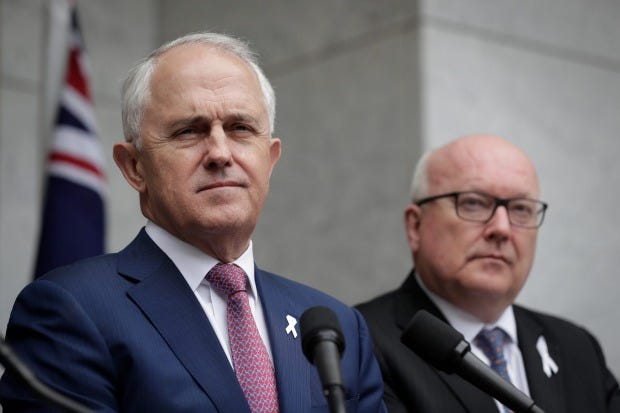
Simultaneously, diplomatic relations with China soured as Australia upped its anti-Chinese rhetoric. Prime Minister Malcolm Turnbull announced a suite of foreign interference laws in late 2017 that was aimed at curbing foreign influence and money within Australian politics. While the laws where apparently claimed not to be directed at any particular nation, there was, as the Chinese Community Council of Australia described an ‘obvious elephant in the room’.
The focus of the laws on China also became painfully apparent when Malcolm Turnbull used a misquoted saying from Mao Zedong “Zhōngguó rén zhàn qǐlái” (The Chinese People have stood up) to “Àodàlìyǎ rén zhàn qǐlái” (The Australian People have stood up) to justify the new laws.To the dismay of China, Turnbull thought it was appropriate to use a quote that was used after China came out of a brutal eight year war with Japan and equally horrific succeeding civil war, killing more than 22 million Chinese people.
Fears of a silent Chinese invasion have been most prominently promoted by the investigative four corners report ‘Power and Influence’ and Clive Hamilton’s book ‘The Silent Invasion’ both of which propagate a narrative of exceeding Chinese power on Australian politics. In the four corners report, Professor John Fitzgerald from the U.S based ‘Ford Foundation — Beijing’ claimed that Australia should be concerned with China as “the difference with China is that it operates in clandestine networks”.
This is ironic given the clandestine affairs of our greatest security ally the United States, and its Central Intelligence Agency which has been involved in the clandestine overthrow of democratically elected governments. Furthermore, the documentary deliberately displays Chinese students as obedient government agents. This is evidenced by their interview of Lupin Lu, foreign student and president of the Chinese Scholar’s Association at the University of Canberra.
The documentary took pains to highlight her response if a student was planning protests or sedition against the CCP abroad and if the Chinese government provided consular support for events to welcome Chinese officials to Canberra. Her responses, both reporting students to the embassy and receiving consular support for official events, are natural reactions of almost any citizens of any country.
Yet the report goes to great lengths to display the Chinese as a homogenous entity that “unlike people of other countries” are “not out to win an argument but to silence dissent”. While some issues of foreign influence are certainly worth exploring, the report dangerously seeps into orientalist territory by casting the Chinese people in one broad paint stroke as the suspicious other.
Clive Hamilton’s book ‘Silent Invasion’ dives further into this territory, this time in an academic environment. Hamilton claims that China is using fake history to make a future claim over Australian sovereignty and that over two hundred thousand Chinese living in Australia are obedient and loyal to the Chinese Communist Party. Hamilton pits the Chinese as a horde trying to erode the sovereignty of Australia and dangerously plays little attention to the nuance of the Chinese people and its diaspora.
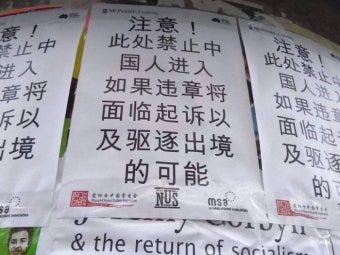
The repercussions of arguments such as Hamilton’s, have already led to Chinese students in Australia being victims of racial abuse, prompting the Chinese government to give an unprecedentedly strong warning to Chinese students studying or living in Australia. Meanwhile new foreign interference laws, while aimed at ‘foreign influence’, have given the government unprecedented powers to halt the work of research organisations, charities and journalists to operate in Australia. The language of national security is being invoked to protect the government’s broader interests.
There is always a fear within political and academic circles of foreign influence. It is the right of academics and politicians to advocate the sovereignty of their homeland. Yet the argument of a silent Chinese invasion all too painfully reignites a dormant Australian anxiety of being overrun from the dangerous orient. Edward Said stated that “the closeness between politics and orientalism” and that “the great likelihood that ideas about the Orient drawn from Orientalism can be put to political use, is an important yet extremely sensitive truth”.
As academics, it is fundamentally important to write in a responsible manner and delineate the nuanced nature of the subject matter we study. It is unfortunate to see a credible conversation of foreign interference using ideas from our dark past. This research has subsequently been politicised to justify laws that dangerously impede our relations with both foreign governments and non-government organisations alike. Australian history has a painful scar of racism and xenophobia that is still difficult to lose; it’s alarming to see the scar beginning to open once more.
Want to know more on the issue? I recommend these books and articles:
Atkinson, D C, ‘The White Australia Policy, the British Empire, and the World’, Britain and the World, 2015, Vol. 8, no. 2, pp. 204 -224.
Hamilton, C, The Silent Invasion: China’s Influence in Australia, Hardie Grant Books, Richmond, 2018.
Bourke, A, Fear of Security: Australia’s Invasion Anxiety, Cambridge University Press, Cambridge, 2010.
Blainey, G, All for Australia, Methuen Haynes, Sydney, 1984
Edgar, B, Invasion theology: Asylum-seekers, Aborigines, ANZACS and Australian identity, Zadok Papers, no. 198, 2013.
Four Corners, Power and Influence, Television Program, Australian Broadcasting Channel, Ultimo, Australia, 2018.
Longxi, Z, ‘The Myth of the Other: China In The Eyes of the West’, Critical Inquiry, vol. 15, no.1, 1988, pp. 108–131.
Ouyang, Y, ‘Australian invention of Chinese invasion: A century of paranoia’, 1888–1988, Australian Literary Studies, Vol. 17, no. 1, 1995, pp.74–83.
Yarwood, AT and Yarwood MJ, Race Relations in Australia: A history, Methuen Australia, North Ryde, 1982.