
In Defense of “Lucky Louie”
Louis CK’s first show is better than you remember
The following is an excerpt from Christopher Pierznik’s new book In Defense Of… Supporting Underappreciated Artists, Athletes, Actors, and Albums, in which the author defends and celebrates individuals and projects that were unfairly maligned or misunderstood from the world of music, sports, TV & film. It can be purchased in both paperback and Kindle.
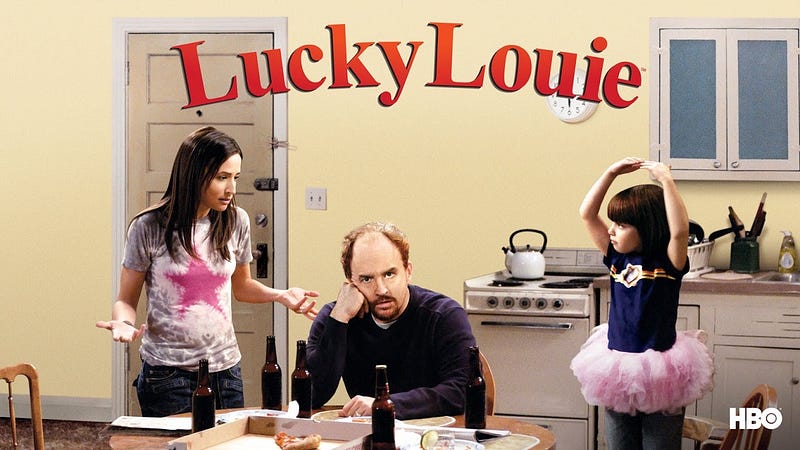
What if The Honeymooners had been transported fifty years into the future and broadcast on HBO, where there were no constraints on language and nudity, with updated sensibilities? The result would be 2006’s Lucky Louie, the brainchild of Louis C.K. and his “reaction to what he felt was the unacceptable direction that sitcoms took beginning in the 1980s, when they became more elaborate, phony, and hollow.”[1]
The most jarring thing about Lucky Louie was the appearance. It looked like nothing else on television at the time. As single-camera shows without audiences like Arrested Development and 30 Rock were garnering critical acclaim and becoming the fashionable way to shoot sitcoms, HBO, which had already done that way back in 1984 with 1st & Ten, went the other way, allowing creator/writer/executive producer/star C.K. the freedom to create a modern twist on the old sitcom — a blue-collar family with money worries and marital problems that inhabit a sparse set in front of a live studio audience. “It was so edgy and different. We shot it on videotape, and it looked very rough.”[2]
It may have had the look of a show that lacked any real substance, but the content was both deep and wide. It took great pleasure in tackling larger issues like gender stereotypes and race relations while also addressing mundane problems like marriage, parenthood, and muddling through a generally unfulfilled life. It was at once clever and crass, placing razor-sharp wit and eyebrow-raising comments in a lower-middle class environment. “The comedy is nifty, light and kind, even as it tries to be real, slitting open the stand-up themes of marital sex, masturbation and dope smoking until it’s dirty enough to convince you that you’re not being condescended to, but smart enough not to be grim. That’s a huge feat.”[3]
Despite the great writing, wonderful chemistry between C.K. and his on-screen wife Pamela Adlon (who would eventually become his unrequited love interest on FX’s Louie), and the fact that it was on HBO, where ratings do not drive decisions and most shows are given plenty of time to develop and grow, Lucky Louie lasted a mere thirteen episodes.
Perhaps it was just a victim of poor timing: the show premiered just as C.K. was becoming an A-list comedian after years of toiling in dark clubs. In the coming years, he would begin selling out theaters and eventually become, in the words of GQ, “America’s undisputed king of comedy.” If the show had premiered a year or two later, it may still be on the air. Or maybe it was simply mishandled: its lead-in, Entourage, was everything Lucky was not — bright, colorful, aspirational, superficial — and it is very likely that its audience did not want to watch something so dull and dreary, not only visually, but also in tone and attitude.
Regardless of the reason, the show was cut short just before it was able to find its groove and has been seen in the years since as a necessary stepping stone, a way for C.K. to learn how to harness and unleash his greatness while getting it out of his system. Only, that’s unfair. “The show probably deserves a little better than being known as a historical curiosity; instead it should get credit for its attempt at being something different, for being honest, for being honest to goodness funny (most important of all).”[4] It was building towards something great, it just needed time to get there. “Lucky Louie isn’t the weird misfire it seemed like in 2006. It’s a really compelling first draft.”[5]
Of course, it became a blessing in disguise for Louis C.K. He has said that if Lucky Louie had been successful he would have quit stand-up, thereby robbing us of one of the greatest comics of all time at the start of what would become one of the best runs in history (2006–2011). Instead, he went right back out on the road and would go on to become the biggest comedian in the world, ultimately using his leverage and difficult experience on HBO to strike a deal with FX for a new show, Louie, over which he has complete creative control, no fear of interference from the network, and enjoys both critical acclaim and strong ratings.
The success of Louie should not take anything away from its forerunner, though. Because Lucky Louie was hilarious in 2006 and holds up very well to this day. As the man himself said when he learned of the show’s cancelation, “If you weren’t laughing, you were wrong.”[6]
[1] Cormier, Roger. “Right Before the Sainting of Louis C.K., There Was Lucky Louie.” Splitsider, April 8, 2013.
[2] Harris, Will. “Pamela Adlon on Snorting Fake Coke, Louie, and the Fate of Her Vulcan Ears.” The A.V. Club, April 1, 2014.
[3] Heffernan, Virginia. “Setting Out to March Boldly Into TV’s Rabbit-Eared Past.” The New York Times, June 10, 2006.
[4] Cormier, Roger. “Right Before the Sainting of Louis C.K., There Was Lucky Louie.” Splitsider, April 8, 2013.
[5] Lyons, Margaret. “Reconsidering Lucky Louie.” Vulture, June 27, 2012.
[6] Thorn, Jesse. “Lucky Louie Cancelled; Louie’s Comments.” Maximum Fun, September 20, 2006.
Christopher Pierznik is the author of eight books, all of which can be purchased in paperback and Kindle. His work has appeared on numerous sites, including XXL, Cuepoint, Business Insider, The Cauldron, I Hate JJ Redick, and many more. Follow him on Facebook or Twitter and subscribe to his monthly reading review newsletter.


